
The complete beginner’s guide
Learn to Play Guitar: The Complete Guide for Beginners
From your first guitar to your first song: a clear step-by-step plan, with articles at every step that take each topic further.
Short answer: To learn to play guitar, start with a guitar that suits you, a good posture and a guitar that is in tune. Then you learn a few open chords like Em, Am, C, G and D, practice switching between them with a simple rhythm and play your first song. With 20 to 30 minutes a day, most beginners get there within a few weeks.

At a glance
What to know before you start
Anyone can learn it
The basics are within reach without reading music and without a teacher. Chord charts and tabs are quick to learn.
Choose the right guitar
Classical, acoustic or electric: pick the guitar that suits the music you want to play.
Start with open chords
With Em, Am, C, G and D you can already play along with a lot of songs. Above all, practice switching.
Practice short and often
A fixed 15 to 30 minutes a day works better than a long session now and then. Playing smoothly takes a few months.
Before you start
Can you teach yourself guitar?
Yes. With a guitar, a tuner, good learning material and regular practice, you can get a long way without a teacher. You don’t need special talent or the ability to read music: most beginners play from chord charts and tabs. Read how that works in learning guitar without reading music.
- Not sure guitar is for you? Read can anyone learn to play guitar, which also covers small hands and starting late.
- How to get through the tough first weeks: is guitar hard to learn.
- No teacher nearby? Read learning guitar without a teacher.
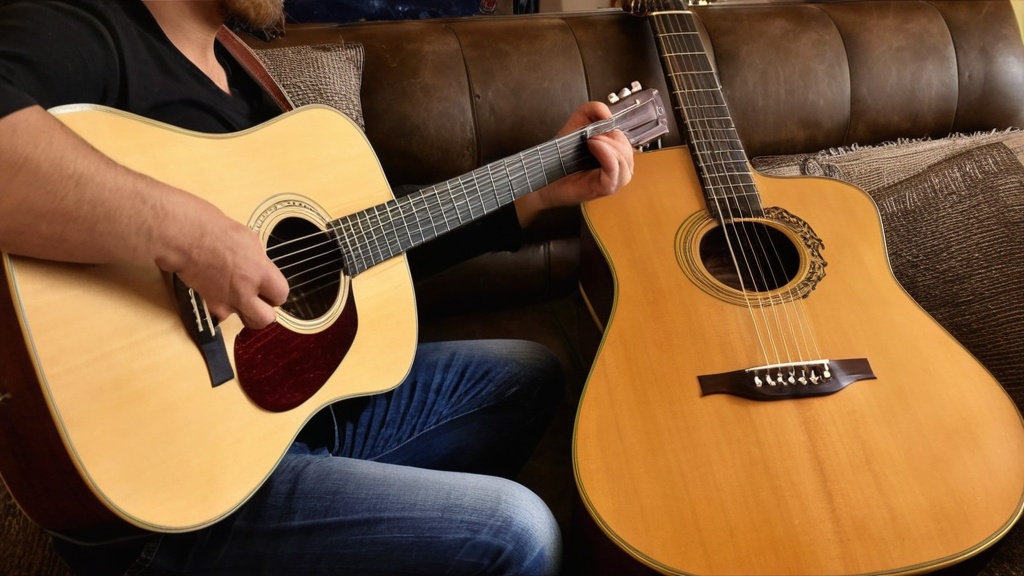
Is guitar hard to learn?
A little, in the first weeks. Your fingertips hurt, chord changes are slow and your fretting and strumming hands have to learn to work together. For almost everyone, that passes if you keep practicing.
Step 1
Choose your first guitar
The best guitar to start with suits the music you want to play, your hands and your budget. There are three main types.
| Type | Strings | Good for | Keep in mind |
|---|---|---|---|
| Classical guitar | Nylon | Classical, flamenco, quiet songs, kids | Gentle on your fingertips, but the neck is wider |
| Acoustic (steel-string) guitar | Steel | Pop, singer-songwriter, campfire songs, singing and playing | Fuller sound; steel strings press harder into your fingers at first |
| Electric guitar | Steel, thinner | Rock, blues, metal, funk | Plays easily, but you need an amp and a cable |
Low string action
Strings close to the neck are much easier to press down. A badly set-up guitar makes learning harder than it needs to be.
Stays in tune
Good tuning machines mean you don’t have to keep adjusting. Still, tune before every practice session.
Comfortable size
You should be able to sit with it in a relaxed way. If you are left-handed, read about playing left-handed first.
Which type is easier is covered in which is easier: electric or acoustic guitar, and what to look for in each type in the best guitar to learn on. For a sense of the cost, see how much a good beginner guitar costs. Beyond that you need very little: a tuner, a few picks and maybe a strap and a capo. You’ll find the full list in what you need to learn guitar at home.
Step 2
Posture, tuning and your first week
In your first week you lay the foundation: holding the guitar properly, tuning it and strumming your first chords. That way you avoid habits you would have to unlearn later.

Posture
Sit up straight on a chair without armrests, with the guitar on your right leg (the other way around if you play left-handed) and the neck angled slightly up. Press with your fingertips just behind the fret, and keep your shoulders loose and your wrist as straight as possible. More in how to hold a guitar with good posture.
Tuning
In standard tuning the strings are E, A, D, G, B and E, from thick to thin. Tune before every session with a clip-on tuner or an app, because an out-of-tune guitar makes even good chord shapes sound wrong. See how to tune a guitar with a tuner.
Learning guitar in 7 days: what is realistic?
You won’t learn to play guitar in 7 days, but you can build a solid foundation. With 15 to 30 minutes a day, this is a realistic plan for the week:
Day 1
Practice your posture, tune the guitar and pick the open strings one at a time.
Day 2
Learn Em (two fingers) and play four slow downstrokes per bar.
Day 3
Add Am and switch slowly between Em and Am.
Day 4
Learn C and switch between Am and C.
Day 5
Learn G and switch between G and Em.
Day 6
Learn D and switch between D and G.
Day 7
Play G, C and D in a row at a slow tempo and pick out a simple song.
Sore fingertips are normal
After a few days your fingertips get tender. That fades as calluses form; take a break if it really hurts. You’ll find a more detailed plan in how to start guitar as an absolute beginner and in the 30-day practice schedule.
Step 3
Your first chords
Start with the open chords Em, Am, C, G and D: with these you can already play along with a lot of songs. Open means that some strings ring without being fretted, which makes the shapes relatively easy.
Read the diagrams from left (low E string) to right (high e string): an x means don’t play that string, an open circle lets the string ring open and a dot is a finger on that fret. Many beginners start with E and Em, because those shapes are close to each other; see learning your first chord: E major. A full overview with progressions is in learn guitar with chords.
Practice changes in pairs
Count four beats on one chord, switch and count four beats on the other. Leave fingers that stay in the same place where they are.
Save F for later
F (133211) is a barre chord: your index finger presses down all the strings on the first fret. Start on it once the open chords go well.
Tabs alongside chords
Six lines for the six strings, numbers for the frets: that’s how you play riffs and melodies without reading music.
Step 4
Rhythm and your first songs
You can play a song as soon as you can switch between two or three chords in a steady rhythm. A chord that arrives on time but doesn’t sound perfectly clean yet sounds better than a perfect chord that comes in late.
1
Four downstrokes
Start with four downstrokes per bar, one on each beat.
2
Count out loud
1, 2, 3, 4: that keeps you in rhythm while you change chords.
3
Use a metronome
Play at a slow tempo and only speed up once it goes well a few times in a row.
4
Down, down-up, up-down-up
Once that works, try this well-known strumming pattern.
5
Hum the melody
Then you’ll naturally hear where the chord changes fall.
How to connect counting and strumming is explained in how counting rhythm on guitar works. For your first song, pick one with two to four chords and a relaxed tempo; many pop, folk and campfire songs run on G, C, D and Em. You’ll find ideas in easy guitar songs with 3 chords, and how soon you can play your first song tells you what to expect.
Singing and playing at the same time?
First practice the chords until you no longer need to look at your hands, and only then add the vocals. With a capo you can move a song higher without learning new shapes, so it suits your voice better.
Step 5
Practice smart
As a beginner, practice 20 to 30 minutes a day, ideally (almost) every day. Regular practice pays off more than long sessions, because new movements become automatic through repetition and rest. Here is how to split up half an hour:
5 min warm-up
Finger exercises and picking the open strings.
10 min chord changes
Two chords at a time, at a slow tempo.
5 min rhythm
A strumming pattern with the metronome.
10 min a song
From start to finish, even if it isn’t perfect yet.
Why this works is explained in how long to practice guitar each day. Want a fixed plan? Use the 30-day guitar practice schedule or choose from the 10 daily guitar exercises for beginners.
Common beginner mistakes
- Pressing the strings too hard, so your hand tires quickly.
- Rushing: playing a song at full speed before the chord changes work.
- Not tuning, so everything sounds off and you think you’re doing it wrong.
- Only practicing what already works and skipping the tricky change.
- Quitting in the first weeks, just before your fingertips get used to it.
Read about more pitfalls in mistakes to avoid when learning guitar.
Expectations
How long does it take to learn guitar?
That depends mostly on how often and how focused you practice. With 20 to 30 minutes a day, you can often play a simple song within a few weeks, and after a few months you switch smoothly between the open chords.
- The first weeks
Posture, tuning, picking the open strings and your first chords like Em, E and Am. Your fingertips get used to the strings. - The first months
The open chords C, G, D, A, Em and Am, smooth chord changes, simple strumming patterns and your first complete songs. - Advanced beginner
Barre chords, reading tabs, scales and techniques like hammer-ons, pull-offs and slides. - After that
Your own style, improvising, playing by ear and more complex chords.
See this as a rough route, not a fixed schedule. A detailed explanation of each stage is in how long it takes to learn guitar. Above all, don’t compare yourself with others: people who already play another instrument or have more time move faster at the start.
Learning method
Self-taught, online or with a teacher?
The best way to learn guitar is the one you stick with. Teaching yourself is flexible; a teacher gives you direct feedback and structure. Many beginners combine the two.
Videos and apps
You set your own pace and schedule, but nobody corrects your posture or mistakes.
Lessons with a teacher
Personal feedback, a regular appointment that keeps you motivated and material at your level.
Without expensive lessons
With free material and a good plan, you can get far too.
Record yourself
If you’re teaching yourself, film yourself with your phone now and then. That way you see and hear what a teacher would otherwise point out, like a string you accidentally mute or a rhythm that keeps speeding up. Want guidance from a distance? Read about learning guitar with online guitar lessons.
All topics
Choose your next topic
The articles on this site are grouped into ten topics that together cover the whole route, from your first guitar to performing and recording.
The first steps and answers to typical beginner questions.
Guitars, gear and maintenance →
Choosing a guitar, strings, amps, tuning and maintenance.
Chord charts, progressions, tabs and the theory behind them.
Practice schedules, strumming, fingerpicking and lead techniques.
Easy songs with chords and writing your own songs.
Blues, rock, jazz, flamenco and famous guitarists.
Guitar lessons and learning online →
Lessons, apps, online courses and books.
The right age, guitar size and children’s songs.
Posture, sore fingers and preventing injuries.
Playing with others, your first gig and recording at home.
Go deeper
Further reading for beginners
Tips for learning to play guitar →
Practical tips on posture, exercises and learning material.
Why tuning matters for beginners →
Why an in-tune guitar makes learning easier.
At what age can you start guitar? →
Tips on the right age to start playing.
Free tips for starting out on an acoustic guitar.
Tips and techniques for starting on an electric guitar.
Making an effective practice schedule →
How to put together your own practice plan.
When reading music is and isn’t useful.
The best strings for beginners →
Which strings feel best when you’re just starting out.
Which thickness and shape to choose.
How to get through the tender first weeks.
Learning guitar with little time →
Practicing when your schedule is full.
Is guitar harder than piano? →
An honest comparison if you’re still undecided.
Read more
New in Getting started with guitar
-
Can You Learn Guitar Without a Teacher?
Can you learn to play guitar without a teacher? Yes, absolutely, as long as you practice in a…
-

Is Guitar Harder Than Piano?
Is guitar harder than piano? For many beginners, guitar feels trickier in the first few weeks, but piano…
-

How Quickly Can You Play Your First Song
How quickly can you play your first song? If you practice a little almost every day, you can…
-
What You Need to Learn Guitar at Home
What do you need to learn guitar at home? A guitar that suits you, a tuner, a few…
-

Do You Need to Learn Notes to Play Guitar?
Do you need to learn to read music to play guitar? No, most guitarists don’t. If you play…
-

Success Stories of Adults Learning Guitar
Success stories of adults learning guitar almost always follow the same pattern: they started small, practiced regularly and…
FAQ
Frequently asked questions about learning to play guitar
Is your question not listed? Browse all articles or pick a topic in the menu.
How long does it take to learn to play guitar?
That depends on how often you practice. With 20 to 30 minutes a day, you can often play a simple song with two or three chords within a few weeks. Switching smoothly between all the open chords usually takes a few months.
Can you teach yourself to play guitar?
Yes. With a guitar that is in tune, a fixed practice plan and learning material such as videos, apps or a book, you can learn the basics on your own. Record yourself now and then, so you catch mistakes in posture or rhythm yourself.
What is the best way to learn to play guitar?
The best way is the one you stick with. Start with a few open chords, practice briefly but almost every day and connect everything to a song you enjoy as soon as you can. A teacher helps if you want structure and direct feedback.
Is learning guitar hard?
The first weeks are the hardest: your fingertips need to get used to the strings and chord changes are still slow. Those hurdles shrink quickly if you practice regularly. The basics are within reach for almost everyone.
Can you learn guitar in 7 days?
You won’t learn to play guitar in 7 days, but you can build a good foundation. In a week you learn to tune and hold the guitar, a few chords like Em, Am, C, G and D and a simple rhythm. With that, you can then start practicing your first song.
What should you learn first on guitar?
The basics are good posture, tuning the guitar and a few open chords. Start with Em, because it only takes two fingers, and expand to Am, C, G and D. Then practice switching between them in a steady rhythm.
How can you learn guitar quickly and easily?
You learn fastest by practicing short and often and tackling one thing at a time. Choose easy songs with three or four chords and play at a slow tempo with a metronome. Save tricky chords like F for later.
Do you need to read music to learn guitar?
No. Most guitarists play from chord charts and tabs, which you learn to read much faster than sheet music. Reading music only becomes useful if you want to play classical guitar or learn more music theory.
Ready to start?
Grab your guitar, tune it and play your first Em chord today. After that, it’s a matter of practicing short and often.