


With these 10 daily guitar exercises for beginners, you train everything you need in a short time: finger exercises, chord changes, strumming patterns, a first scale, fingerpicking and rhythm. You do not have to do them all every day: pick a few per session and spend a few minutes on each one. That way you build strength, technique and muscle memory step by step.
When you are just starting out on guitar, it can be overwhelming to learn the many techniques and styles. Daily exercises are crucial for beginners, because they help you build a solid foundation. By practicing every day, you develop not only your skills, but also your confidence.
Repeating exercises helps you get the movements and techniques under your fingers. This is especially important in the early stage, when every small step forward can be a big motivation. Daily practice also helps you create a routine.
When you choose a fixed time of day to practice, it becomes a habit that helps you stay consistent. Consistency is the key to success in learning an instrument. It allows you to make progress, which is essential for your development as a musician. Still unsure about your instrument? The comparison between guitar and piano lines up the differences.
By practicing regularly, you will notice that you progress faster and get more enjoyment out of playing guitar.
Summary
- Daily exercises help beginners achieve consistency and progress in playing guitar
- Warm-up exercises are essential to prevent injuries and improve performance
- Regularly practicing simple chords lays a solid foundation for further progress
- Scales and fingerings are crucial for developing technique and skill on the guitar
- Daily exercises improve rhythm and timing, which is essential for a good musical performance
The 10 daily guitar exercises
- Spider exercise: place your index finger on the first fret of the low E string and play frets 1, 2, 3 and 4 with your index, middle, ring and pinky fingers. Do this on every string up to the high E string and back again. You will find more ideas in the warm-up exercises for guitar.
- Chord change in one minute: choose two chords, for example Em (022000) and G (320003), and count how many times you change cleanly in one minute. Try to raise that number every week. Handy tricks are in tips for changing faster between chords.
- Checking a chord: form a chord such as C (x32010) and pick the strings one by one. If a string sounds dull or buzzes, move your finger closer to the fret or arch it more.
- Strumming pattern with a metronome: play the pattern down, down-up, up-down-up on one chord, with the metronome at about 60 to 70 bpm. See also learning guitar with a metronome.
- Pentatonic scale: play the A minor pentatonic scale in fifth position: low E string frets 5 and 8, A string 5 and 7, D string 5 and 7, G string 5 and 7, B string 5 and 8, and high E string 5 and 8. Play it up and down with alternating downstrokes and upstrokes. What you can do with it afterward is explained in improvising with the pentatonic scale.
- Hammer-ons and pull-offs: pick the G string at the fifth fret and, without picking again, place your ring finger on the seventh fret (hammer-on). Then pull that finger off slightly sideways so the fifth fret sounds again (pull-off). More on this in practicing hammer-ons and pull-offs.
- Fingerpicking pattern: form a C chord, play the A string with your thumb and then the G, B and high E strings with your index, middle and ring fingers (p-i-m-a). You will find a complete routine in this daily fingerpicking exercise.
- Notes on the low E string: learn the natural notes: open is E, fret 1 is F, fret 3 is G, fret 5 is A, fret 7 is B, fret 8 is C, fret 10 is D and fret 12 is E again. Say the note out loud as you play it.
- Barre preparation: lay your index finger flat across all the strings at the fifth fret and pick the strings one by one. At the fifth fret this is easier for most beginners than at the first fret. After that you can move on to learning barre chords.
- Playing a song: finish with a simple song using chords you already know, for example G, C and D (xx0232). That way you end every session with music instead of separate exercises.
How much time you spend in total per day depends on your schedule; you will find guidelines in how long to practice per day to learn guitar.
The importance of warm-up exercises for guitarists
Warm-up exercises are an essential part of every practice session for guitarists. They help not only to warm up your fingers, but also to prepare your mind for the music you are about to play. By warming up your muscles and joints, you reduce the risk of injuries and make sure you can play smoothly.
This is especially important for beginners, who are not yet used to the physical demands of playing guitar. Warm-up exercises can also help improve your technique. By practicing simple fingerings and scales, you gain more control over your fingers and develop a better feel for rhythm and timing.
This lays the foundation for more complex pieces you want to learn later. So it is not only a matter of physical preparation; it is also a way to strengthen your musical skills.
Practicing simple chords for beginners

Simple chords form the basis of many popular songs and are therefore essential for every beginning guitarist. By practicing these chords regularly, you learn not only how to play them, but also how they are used in different songs. This helps you develop a better understanding of musical structure and makes it easier to learn new songs.
Practicing chords can be fun too! Try different combinations and follow the chords of your favorite songs. This makes practice less boring and gives you a sense of satisfaction when you can play a song you like.
Do not forget that consistency matters; even if you spend only a few minutes a day on chords, it will make a big difference to your playing in the long run.
The importance of scales and fingerings
Scales are a fundamental part of music and play a crucial role in the development of every guitarist. They help you understand musical structure, but also improve your technique and fingering. By practicing scales regularly, you develop a better ear and learn how different notes relate to each other.
This is especially useful when you start improvising or playing solos. Fingerings are also very important when playing guitar. A good fingering lets you move smoothly across the neck of the guitar and helps prevent tension in your hands. Which scales and rhythms belong to blues, jazz or funk is covered in learning to improvise in different styles.
By practicing scales and fingerings daily, you train not only your fingers, but also your memory. This makes it easier to play complex pieces as you advance.
Improving rhythm and timing with daily exercises
Rhythm and timing are crucial elements in music, and daily exercises can contribute enormously to improving them. As a beginner, it is important to develop a good sense of rhythm, because it forms the basis for everything else you learn. By practicing regularly with a metronome or together with other musicians, you learn how to match your playing style to the music.
Specific rhythm exercises can also help refine your timing. Try out different rhythms with simple chords or scales. This will not only help improve your technique, but also help you develop a feel for musical phrasing.
The more attention you pay to rhythm and timing during your daily exercises, the better you will eventually become at playing different styles of music.
The importance of training your left and right hands
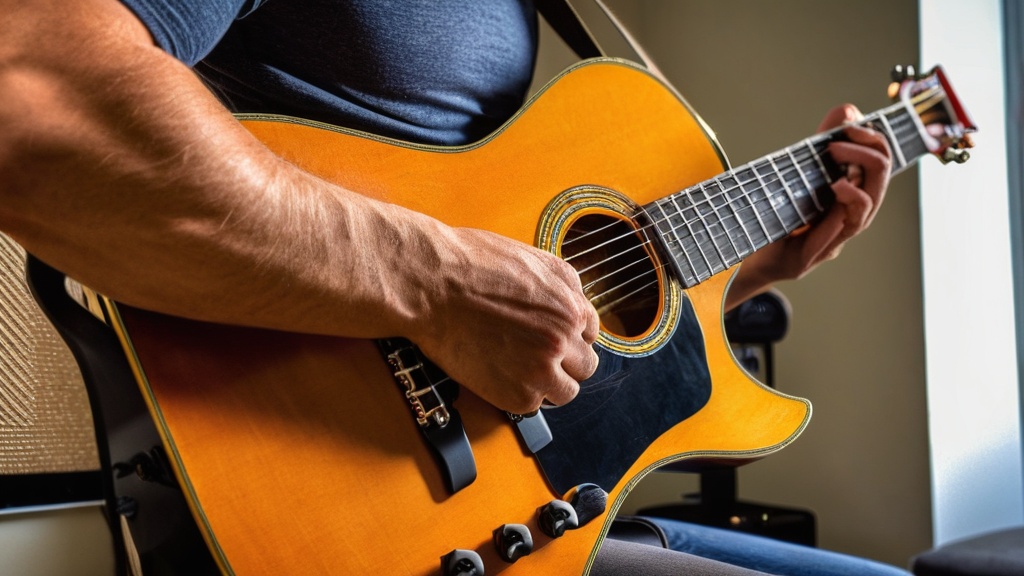
When playing guitar, it is essential to train both your left and right hands well. The left hand is responsible for forming chords and notes on the neck, while the right hand takes care of the picking and strumming technique. Both hands need to be well coordinated to play smoothly and efficiently.
Daily exercises can help improve this coordination. A good way to train both hands at the same time is to play simple chords or melodies while applying different strumming techniques. This helps not only to develop strength and precision in both hands, but also to improve your overall musical expression.
Do not forget that consistency matters; by spending time every day training both hands, you will notice that they work together better as you progress.
How daily exercises help develop muscle memory
Muscle memory is a crucial aspect of learning to play guitar. It refers to the ability of your muscles to carry out certain movements automatically, without you having to think about them consciously. Daily exercises are essential for developing this muscle memory, because repetition is the key to success.
The more often you practice certain techniques or chords, the faster they become part of your system. By practicing regularly, you build not only strength in your fingers, but also learn how they need to move across the neck of the guitar. This makes it easier to learn new songs and apply more complex techniques without much mental effort.
In the end this leads to a smoother playing style and more confidence during performances or jam sessions.
Tips for sticking with daily exercises
Sticking with daily exercises can sometimes be a challenge, especially if you are busy or do not see immediate progress. A good tip is to set realistic goals for yourself. Start with short practice sessions of 10 to 15 minutes a day and build this up gradually as you gain confidence. If you want to put those exercises in a fixed order, use this practice schedule for learning guitar in 30 days.
The most important thing is that you stay consistent, even if that means spending a little less time practicing now and then. It can also help to add variety to your practice sessions. Try different styles or techniques to challenge yourself and stay interested.
Listening to music that inspires you can also be motivating; try playing songs you like or look for new challenges at your own level. By applying these tips, you will notice that daily exercises are not only doable, but also become more enjoyable as you make progress in your guitar playing.
Besides these daily exercises, you can also consider developing your guitar playing further with online lessons. A related article that can help you with this is Learn to Play Guitar With Online Guitar Lessons. This article gives insight into how to learn effectively using online resources, which can be a great addition to your daily practice routine.
Frequently asked questions about daily guitar exercises
What are some common guitar exercises for beginners?
Some common guitar exercises for beginners are learning chords, practicing scales, training your fingers to play notes and improving your overall finger strength and dexterity.
How often should beginners do guitar exercises?
For beginners it is recommended to practice at least 20 to 30 minutes every day. Regular practice is essential for building muscle memory and improving your overall skill on the guitar.
What are some examples of daily guitar exercises for beginners?
Some examples of daily guitar exercises for beginners are practicing chord changes, playing simple melodies, training your fingers with exercises such as fingerpicking and practicing rhythm and timing.
What are the benefits of daily guitar exercises for beginners?
Daily guitar exercises help beginners improve their technique, build finger strength and dexterity, develop their musical ear and improve their overall playing skill. Regular practice also helps build confidence and motivation.
Do you have to do all ten exercises every day?
No. Choose three to five exercises per session and rotate the rest over the week. Do start every time with a short warm-up and finish with something you enjoy playing.
What do you do if an exercise hurts?
Sensitive fingertips are normal at the start, but sharp pain in your wrist, hand or forearm is a sign to stop. Relax your hand, check your posture and do not press harder than needed for a clear tone. Pick the exercise up again later at a slower tempo.






Leave a Reply