
For adult beginners
Learning Guitar as an Adult: How to Start (at Any Age)
Guitar for adults, whether you’re 30 or just retired: how to get started, how to choose a guitar and a way to learn, and how to practice around work and family.
Short answer: Learning guitar as an adult is possible at any age: there’s no age limit and you don’t need any musical experience. Choose a guitar that plays easily, practice 15 to 30 minutes every day, start with a few open chords and pick songs you love to listen to. With patience, you’ll play your first song within a few weeks.

At a glance
What you should know before you start
You’re never too old
There’s no age limit. You know what music you want to play and you can easily follow explanations about chords and rhythm.
Practice briefly and daily
15 to 30 minutes a day works better than one long session a week.
A guitar that plays easily
Light strings and low action make getting started a lot easier.
A way of learning that fits
On your own, online, private lessons or a music school: choose what fits your schedule and budget.
Before you start
Can you still learn guitar as an adult?
Yes, learning guitar as an adult works just fine, whether you’re 25, 45 or 70. There’s no age limit, and you don’t need musical experience or music theory. What does differ from kids is the way you learn.
Kids often learn through play and have more free time. Adults have less time, but bring other strengths: you know what music you want to play, you quickly understand explanations about chords and rhythm, and you can set yourself a goal. Whether it’s doable for you, you can read in can anyone learn to play guitar. Which milestones are realistic is covered in success stories of adults learning guitar.
What adult beginners run into
| Challenge | What helps |
|---|---|
| Little time because of work and family | Short sessions of 15 to 30 minutes at a set time of day |
| High expectations: you hear exactly how it should sound | Choose doable songs and compare yourself with yourself a month ago |
| Sensitive fingertips | Start with short sessions; light strings or nylon strings press less hard into your fingers |
| Less flexible fingers or joints | Warm up your hands, choose a guitar that plays easily and start with simple chord shapes |
| Discomfort with making mistakes | Practice on your own first and only play for others when you feel like it |
Step-by-step plan
A step-by-step plan for adult beginners
As an adult, you start best with a concrete goal and a fixed order: first posture and tuning, then a few chords, then rhythm and after that your first song.
1
Set a concrete goal
For example: being able to accompany three songs in three months. Then you know what you’re practicing for.
2
Choose a guitar that’s comfortable to play
A guitar that plays easily makes every chord shape easier.
3
Learn posture and tuning
Sit up straight, keep your shoulders loose and tune before every session.
4
Learn five open chords
Em, Am, C, G and D: below you can see where your fingers go.
5
Practice switching in a steady rhythm
Four downstrokes per chord, with a metronome at a slow tempo.
6
Play your first song
Choose a song with three or four chords that you like to listen to.
Read the diagrams from the low E string to the high e string; an x means don’t strike that string. There’s an explanation in learn guitar with chords, and about posture in how to hold a guitar. Ideas for your first song are in easy guitar songs with 3 chords.
Then turn it into a routine, for example with the practice schedule to learn guitar in 30 days. More tips for adults, such as planning and combining chords with scales, are in tips for adults learning guitar.
The right guitar
Which guitar suits an adult beginner?
An adult beginner does best with a guitar that plays easily, with low action and strings that aren’t too heavy. Whether that’s a classical, acoustic or electric guitar depends on the music you want to play.
Classical, acoustic or electric
- Classical guitar (nylon): gentle on your fingertips and good for quiet songs, classical and bossa nova. The neck is wider; some people like that, others find it harder.
- Acoustic guitar (steel): the go-to choice for accompanying songs and singing along. Choose light strings to spare your fingers.
- Electric guitar: the thinnest strings and usually the lowest action, so the easiest to press down. You do need an amp, but with headphones you can practice without disturbing anyone.

Which one is easiest, you can read in which is easier: an electric or acoustic guitar. What to look for per type is in the best guitar to learn on, and which strings are comfortable to play in the best guitar strings for beginners.
Get your guitar set up
If needed, have a new or used guitar set up at a music store: action that’s too high makes every chord harder than it needs to be. With small hands or short fingers, a smaller size or a narrower neck can help; see learning guitar with small hands.
Little time
Learning guitar around work and family
With little time, the best way to learn guitar is to practice briefly every day: 15 to 30 minutes a day gets you more than one long session on the weekend. Your hands and brain need repetition, and you get that with short, regular sessions.
Keep your guitar on a stand instead of in its case, so you pick it up when you have five minutes to spare. Tie practice to a fixed moment, for example after dinner.
Example: a week with little time
Monday
Tune up, check your posture and learn Em and Am.
Tuesday
Start with what was hard yesterday: switch between Em and Am.
Wednesday
Add C and switch between Am and C, with the metronome at a slow tempo.
Thursday
Five minutes in between: only the change that isn’t working yet.
Friday
Learn G and D and switch between the two.
Saturday
Half an hour: a song with three or four chords from start to finish.
Sunday
Play something you already know and write down what you practiced this week.
Why short sessions work so well, you can read in how long you should practice each day. More practical ideas are in learning guitar for busy people and making guitar part of your day.
Ways to learn
Guitar lessons for adults: which option fits?
Guitar lessons for adults come in different forms: teaching yourself with apps and videos, an online course, private lessons or lessons at a music school. The best choice depends on your schedule, your budget and how much guidance you want.
| Option | A good fit if | Keep in mind |
|---|---|---|
| Teaching yourself with apps and videos | You want to practice flexibly and like working on your own | Nobody corrects your posture; record yourself now and then |
| Online course | You want a set structure without fixed lesson times | Choose a beginner-level course in a style that appeals to you |
| Private lessons | You want personal feedback quickly | Ask whether the teacher has experience with adult beginners |
| Music school or group lessons | You enjoy learning with others | The pace of the group doesn’t always suit you |
An overview of the options for adults and how to combine them with a busy life is in guitar lessons for adults. You can read more about each option in private guitar lessons, learning guitar at a music school, online guitar lessons and the best apps to learn guitar.
Combine teaching yourself with a few lessons
Many adults combine practicing on their own with an occasional lesson. If you get stuck, even a few one-off lessons help to get your posture and technique checked.
Later in life
Learning guitar at an older age
You can learn guitar at an older age too: the pace may be a little slower, but that doesn’t make it any less fun. Choose a light guitar that’s comfortable, practice fifteen minutes a day and take your time with each new step.
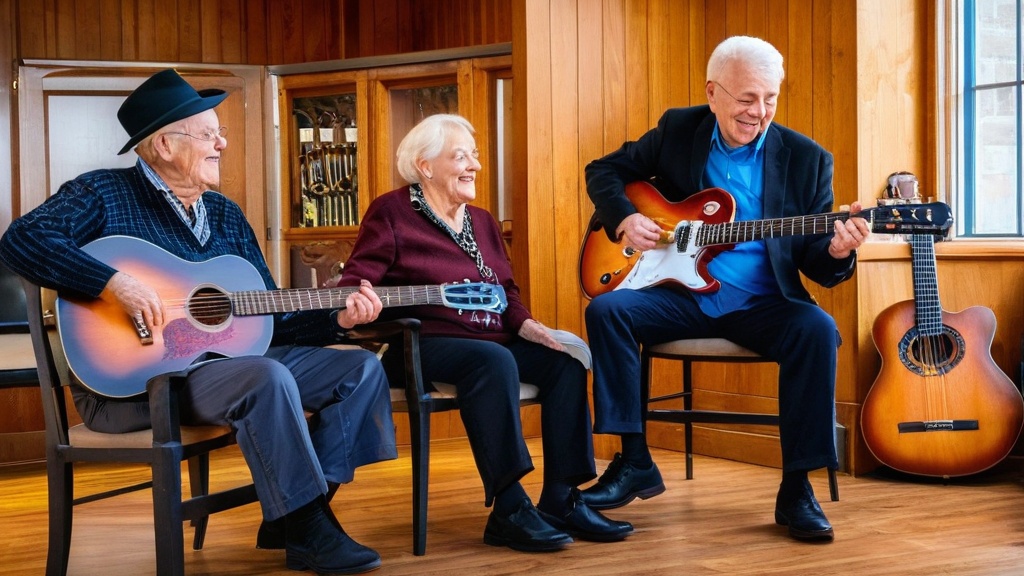
- Sit comfortably. A chair without armrests, and a footstool if you like, keep you from slouching.
- Use a capo. With it you move a song into a key that suits your voice, without harder chord shapes.
- Work with large chord charts. Print them big or put them on a tablet, so you don’t have to squint.
- Play together. With a friend, a grandchild or a group, you stay motivated and learn from each other. See tips for playing with other guitarists.
What’s involved in starting later in life, you can read in can you still learn guitar later in life.
Your body
Stiff fingers, arthritis or limited mobility
Stiff fingers, arthritis or limited mobility don’t have to stop you, as long as you adapt your guitar, technique and practice routine to what your body can handle. These adjustments often make the biggest difference:
Play briefly
Keep sessions short and take breaks in between.
Open chords and a capo
Choose open chords and use a capo instead of demanding barre chords.
Light strings
Light strings and low action reduce the strength you need.
If certain chord shapes don’t work, an open tuning or slide guitar can be a solution. You can read more per situation in learning guitar with arthritis and learning guitar with limited mobility.
Pain is a signal to stop
Sensitive fingertips in the first few weeks are normal; see preventing finger pain. Pain in your joints, wrist or forearm is a signal to stop. If the problem persists, talk to your doctor or physical therapist about how much strain is sensible.
Expectations
Motivation and realistic expectations
As an adult beginner, you stay motivated by setting achievable goals and choosing songs you really want to play. With 15 to 30 minutes a day, this is a realistic pace:
- The first weeks
You learn your first chords and your fingertips get used to the strings. Sensitive fingertips are normal at this stage. - After a few weeks
You can often play a simple song with two or three chords. - After a few months
You switch smoothly between the open chords. The pace differs from person to person.
What determines your pace, you can read in how long it takes to learn guitar. Success looks different for everyone, from your first song to making music with friends. Choose songs you can sing along to, because then you hear right away whether the rhythm is right; see easy songs to sing and play on guitar.
Not making progress for a while?
Everyone has weeks when things don’t move forward. Switch up your practice material, play a song you already know, or record yourself and compare it with a recording from a month earlier. More ideas are in staying motivated while learning guitar.
Go deeper
More reading for adult beginners
Learning guitar without a teacher →
What you can do yourself and when a teacher helps.
How to get through the tough first weeks.
Tuning a guitar with a tuner →
So your guitar sounds good every session.
Practice without disturbing housemates or neighbors.
Playing guitar with thick fingers →
Chord shapes and guitars for wide fingers.
Posture and habits that spare your wrist.
Why playing guitar is good for your brain →
What learning an instrument does to your brain.
Playing guitar to relieve stress →
Making music as a moment to unwind.
Benefits of learning guitar online →
A good fit for a busy schedule.
The best guitar books for beginners →
Method books with a set structure.
Online communities for guitarists →
Ask questions and share experiences.
Recognizable songs to start with.
Read more
New in Getting Started with Guitar
-
Can You Learn Guitar Without a Teacher?
Can you learn to play guitar without a teacher? Yes, absolutely, as long as you practice in a…
-

Is Guitar Harder Than Piano?
Is guitar harder than piano? For many beginners, guitar feels trickier in the first few weeks, but piano…
-

How Quickly Can You Play Your First Song
How quickly can you play your first song? If you practice a little almost every day, you can…
-
What You Need to Learn Guitar at Home
What do you need to learn guitar at home? A guitar that suits you, a tuner, a few…
-

Do You Need to Learn Notes to Play Guitar?
Do you need to learn to read music to play guitar? No, most guitarists don’t. If you play…
-

Success Stories of Adults Learning Guitar
Success stories of adults learning guitar almost always follow the same pattern: they started small, practiced regularly and…
FAQ
Frequently asked questions about learning guitar as an adult
Is your question not listed? Browse all articles or pick a topic in the menu.
Can you still learn guitar as an adult?
Yes. There’s no age limit and you don’t need musical experience. Adults have less time than kids, but they often know better what they want to play.
Can anyone learn to play guitar?
The basics are achievable for almost everyone, including people with small hands, left-handed players and those starting later in life. Talent mainly determines how fast it goes, not whether you’ll succeed. Regular practice is the most important factor.
Can you still learn guitar at an older age?
Yes. Choose a light guitar with light strings, practice fifteen minutes a day and take your time with each step. If you have stiff fingers or joints, adapt your chord shapes and practice time.
How long does it take to learn guitar as an adult?
With 15 to 30 minutes a day, you can often play a simple song with two or three chords within a few weeks. Switching smoothly between the open chords usually takes a few months.
Do adults need guitar lessons?
No, you can also teach yourself with apps, videos or a book. Lessons help if you want structure, personal feedback and a regular appointment. Many adults combine practicing on their own with an occasional lesson.
What is the best guitar for an adult beginner?
A guitar that suits the music you want to play and that plays easily, with low action. Classical is gentle on your fingers, acoustic suits accompanying songs and electric is the easiest to play.
Can you learn guitar with arthritis or stiff fingers?
Often, yes: warm up your hands, play briefly with breaks, and use light strings and open chords with a capo. Stop if your joints hurt, and if the problem persists, talk to your doctor or physical therapist.
Ready to start?
Tune your guitar, pick a set time of day and learn your first two chords today.