
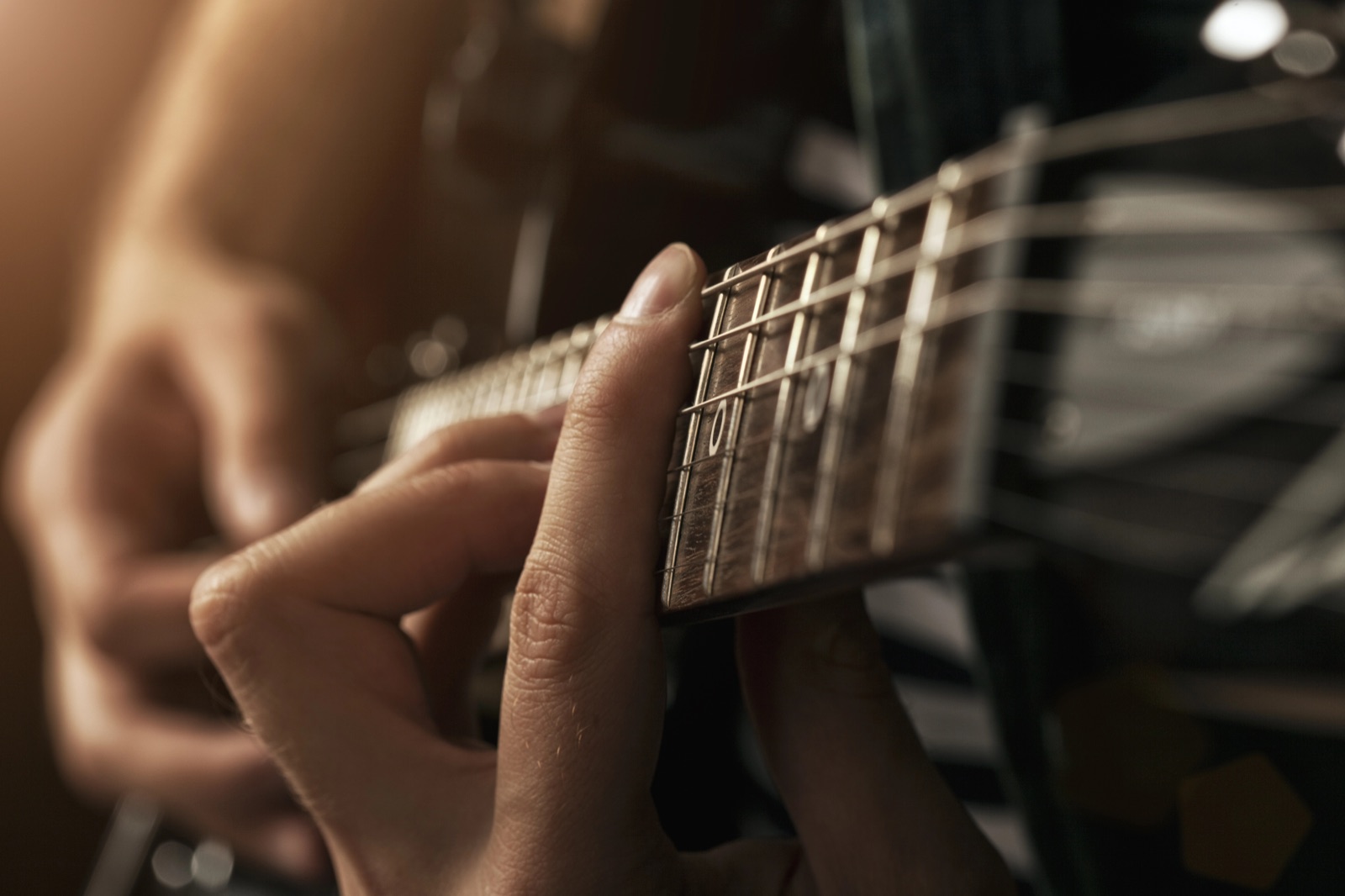

How do you learn to play barre chords as a beginner? Start with a small barre across two or three strings, then learn the E shape and the A shape, and practice a few minutes every day with the side of your index finger right behind the fret. Strength plays a smaller role than you think: with the right thumb and arm position, it is mostly about technique. Below you can read, step by step, how to make barre chords easier to learn, which mistakes to avoid and how to use them in songs.
What is a barre chord?
With a barre chord, you press down several strings at the same fret with one finger, usually your index finger. Your index finger takes over the role of the nut, and your other fingers form a chord shape above it. This lets you play chords that are hard or impossible to reach with open shapes.
The big advantage: a barre shape is movable. Slide the same shape up one fret and you play the same type of chord a half step higher, without learning a new fingering. That lets you play in any key, from pop and rock to folk, blues and jazz. Many guitarists see barre chords as a milestone: once they click, you can play many more songs, and improvising and making your own music gets a lot easier.
Summary
- With a barre chord, you press down several strings at the same fret with one finger, usually your index finger.
- The two basic shapes are the E shape and the A shape. You slide them along the neck to any key.
- A good hand position (thumb behind the neck, relaxed wrist, index finger straight and close to the fret) matters more than raw strength.
- Start slowly with small barres, check every string and build up speed with a metronome.
- The most common mistakes are uneven pressure, poorly placed fingers and too much tension in your hand and shoulders.
- A capo, open chords or power chords are handy alternatives until the full barre works.
The basics: E shape and A shape
For a barre, you lay your index finger flat across the strings at one fret, so that it presses down all the strings (or some of them) at that fret. With your other fingers you form a chord above it. The most commonly used shapes are the E shape and the A shape. Both come from an open chord you probably already know: you play the open shape with your middle, ring and pinky fingers and lay your index finger behind it as the barre.
- E shape: based on the open E major chord (022100). The root is on the low E string. At the first fret that is F (133211), at the third fret G (355433) and at the fifth fret A (577655).
- E minor shape: based on Em (022000). At the first fret you play Fm (133111), at the third fret Gm (355333).
- A shape: based on open A (x02220). The root is on the A string. At the second fret you play B (x24442), at the third fret C (x35553).
- A minor shape: based on Am (x02210). At the second fret you play Bm (x24432), at the third fret Cm (x35543).
Once you know which fret the root is on, you can find any major or minor chord. That also builds your understanding of the music theory behind guitar chords. You can read how a chord is built from the root, third and fifth in music theory for guitarists.
The right hand position for barre chords
A good hand position matters more than strength. Pay attention to these points:
- Index finger straight and close to the fret. Lay your index finger straight across the strings, not at an angle, right behind the fret wire. The closer to the fret, the less pressure you need.
- Use the side of your index finger. Rotate your index finger slightly toward the thumb side. The firm side presses the strings down more evenly, and the creases of your knuckles are less likely to land right on a string.
- Thumb behind the neck. Place your thumb behind the neck, roughly opposite your index or middle finger, for counterpressure. Don’t just squeeze with your hand, but let the weight of your arm pull along a little.
- Other fingers curved. The fingers that form the chord stay curved on their tips, so they don’t touch the strings under the barre.
- Relaxed wrist and shoulders. Keep your wrist at a comfortable angle and don’t hunch your shoulders. Tilting your hand slightly helps you apply more pressure without it getting uncomfortable.
The position of your guitar makes a difference too: hold the neck slightly raised, so your wrist doesn’t have to bend as much. Good posture gives you a clearer sound and prevents fatigue and discomfort. Also read how to avoid wrist injuries when practicing.
Step by step: how to learn barre chords more easily
- Start with a small barre. First lay your index finger across just two strings, as in the small F (xx3211). Your index finger then presses down only the B string and the high E string at the first fret. This gets your hand used to the pressure without having to cover six strings right away.
- Practice the barre on its own. Lay only your index finger across all six strings, for example at the fifth fret, and pick the strings one by one. If a string sounds dead or buzzes, shift your finger a few millimeters or rotate it slightly.
- Start higher up the neck. Many beginners find a barre around the fifth fret easier than at the first fret. Play the E shape there first (A major) and slide back down to F later.
- Add the other fingers. First place the fingers of the chord shape, then lay your index finger behind them. Play the chord, check every string and lift your hand again.
- Switch between chords. For example, switch between F, Bm and Gm, or between an open chord and a barre chord, like C and F. That improves your speed, your precision and your feel for the neck.
- Build up speed. Start slowly, so every note rings clearly, and only turn the metronome up once the chord sounds clean.
You can find more exercises for smooth transitions in the tips for switching between guitar chords faster.
Easing the pressure and preventing pain

Barre chords can feel uncomfortable at first or even hurt your fingers. Often you are pressing harder than necessary. Look for a balance between pressure and relaxation: press just hard enough to make all the strings ring clearly. Test this by slowly reducing the pressure until a string starts to buzz, and then press just a little harder.
Take short breaks regularly, so your hand can relax and you don’t overload it. Also try different positions on the neck to find out where it feels most comfortable for you: a small adjustment in your hand position often makes a big difference. A guitar with low string action and lighter strings also takes less strength. Here you can read more about how to prevent finger pain when you are learning to play guitar. If your strings sit high, a setup can help a lot; read when to get your guitar set up.
Exercises for strength and flexibility
Stronger and more flexible fingers make barre chords easier. These exercises help:
- Chromatic exercise: on each string, play four consecutive frets with fingers 1, 2, 3 and 4. This builds strength and improves your coordination.
- Stretching exercises: use your fingers to span slightly bigger distances between the frets each time. This increases the flexibility of your hand.
- Controlled pressing: lay down the barre, slowly press the strings down until everything rings clearly, relax your hand without letting go and repeat this a few times.
Start every practice session with a short warm-up and read more about developing finger strength for guitar playing.
Common mistakes and how to avoid them
- Not all strings pressed down properly. The chord sounds dead or a string is muted. Check string by string whether every note rings clearly, and shift or rotate your index finger if needed.
- Index finger not flat or at an angle. Then some strings are not pressed down properly. Lay your index finger straight, so it touches all the strings evenly.
- Other fingers in the way. Fingers that are not curved enough touch strings that need to keep ringing. Make sure they can move freely.
- Too much tension. Squeezing too hard with your hand or fingers leads to pain and fatigue. Stay relaxed and watch your posture.
- Rushing. Barre chords take time. Be patient with yourself: if you consciously avoid these mistakes, you will make progress faster.
Barre chords at different positions on the neck
Because barre shapes are movable, you play different chords with the same shape by moving your hand up or down. Start with a few fixed points, like F at the first fret (E shape) and Bm at the second fret (A minor shape). If you slide the E shape to the fifth fret, you play A; at the seventh fret it becomes B. This gives you insight into how chords relate to each other on the neck.
A handy tool: learn the names of the notes on the low E string and the A string. Then you know right away where to put an E shape or A shape. After that, you can experiment with more complex shapes and combinations.
Barre chords in musical styles and well-known songs
You come across barre chords in almost every style. In pop and rock they form the basis of strong chord progressions, in folk and blues you use them with strumming patterns and fingerpicking, and in jazz for richer harmonies. By applying them in different styles, you expand your repertoire and stimulate your creativity.
The most fun way to get barre chords under your fingers is to use them in songs you like to play. A few well-known examples:
- “Hotel California” (Eagles): includes Bm and F#, among others, two classic barre chords.
- “Creep” (Radiohead): G, B, C and Cm. You play the B and the Cm as barre chords.
- “House of the Rising Sun” (The Animals): Am, C, D, F and E, with F as the barre chord.
Alternate barre practice with easy songs with open chords, so you keep having fun and build confidence. You can find more songs to practice with in the rock classics for beginners. This way you learn how barre chords work in different musical contexts and also develop your sense of rhythm and timing.
Alternatives until the barre works
If a full barre doesn’t work yet, there are alternatives. With a capo you can replace barre chords with open shapes in some songs. Open chords and power chords are also usable, depending on the musical style and the sound you are after. Use them as a stepping stone, but keep practicing the barre too.
Consistency and patience

You don’t learn barre chords in one evening. It can be frustrating when you don’t make progress right away, but every guitarist has gone through this stage. Spend a few minutes every day on barre chords, even if it’s only a short session. That trains your muscles and gets you familiar with the positions on the neck.
Set yourself small goals, like learning one new chord or switching faster between two chords, and celebrate those small victories. Don’t be afraid to make mistakes, because that is part of the learning process. If you like practicing with videos, read how to learn guitar with YouTube tutorials.
Frequently asked questions about barre chords
What are barre chords?
Barre chords are chords where you press down several strings at once with one finger, usually your index finger, by laying it across one fret like a bar. Your other fingers form the chord shape above it.
Why are barre chords hard for beginners?
You have to make several strings ring clearly with a single finger, and that takes strength, precision and a good hand position. At first that feels physically demanding, but with the right technique it gets easier and easier.
How can I learn barre chords more easily?
Start with a small barre across two or three strings, use the side of your index finger close to the fret and put your thumb behind the neck. Avoid excess tension, practice around the fifth fret first and then practice transitions between barre chords. Short, regular practice works better than occasional long sessions.
Are there specific exercises for learning barre chords?
Yes. Press the strings down slowly and in a controlled way and pick them one by one, do chromatic finger exercises for strength and practice transitions, for example between F, Bm and Gm or between C and F.
Do I need strong fingers to play barre chords?
Strong fingers help, but technique matters more. With the right placement of your index finger and thumb and regular practice, beginners with less strong fingers learn to play barre chords too.
Are there alternatives to barre chords?
Yes. You can use open chords or power chords, depending on the musical style and the sound you want. With a capo you can replace barre chords with open shapes in some songs.
Which barre chord is best to learn first?
F appears in many songs, but at the first fret the barre is the hardest for many beginners. So start with the small F (xx3211), Bm (x24432) or the E shape at the fifth fret (A major). Once that works, slide the shape back down to F.
Is it normal for barre chords to hurt?
Sore fingertips or a tired hand are normal at first. Sharp pain or pain in your wrist is a signal to stop, check your posture and squeeze less hard. Take short breaks and build up your practice time gradually.






Leave a Reply