


Short answer: The most important guitar tips for beginners are: tune your guitar every time, sit relaxed, start with two easy chords, practice for fifteen minutes every day and play a song as soon as you can. After that, a metronome, reading tabs, recording yourself and playing with others will take you further. Below you will find 15 tips, divided into three phases.
Looking for the complete step-by-step plan, from your first guitar to your first songs? You will find it in the guide learning guitar for beginners. This page is the practical add-on: individual tips you can use right away, most of them with a link to more explanation.
All 15 tips at a glance
| No. | Tip | When |
|---|---|---|
| 1 | Choose a guitar that is comfortable to play | The first week |
| 2 | Tune your guitar every time before you play | The first week |
| 3 | Sit upright and relaxed | The first week |
| 4 | Start with two easy chords | The first week |
| 5 | Practice for fifteen minutes every day | The first week |
| 6 | Practice chord changes on their own | The first month |
| 7 | Play a song as soon as you can | The first month |
| 8 | Count along and use a metronome | The first month |
| 9 | Learn to read tabs and chord charts | The first month |
| 10 | Follow one learning path instead of random videos | The first month |
| 11 | Work with a fixed practice schedule | After the first month |
| 12 | Record yourself | After the first month |
| 13 | Play together with others | After the first month |
| 14 | Have someone watch you play now and then | After the first month |
| 15 | Play music you love | After the first month |
The first week: tips 1 through 5
In the first week you lay the foundation: a guitar that plays well, accurate tuning, a relaxed posture and your first chords. It is not about speed yet, but about good habits.

1. Choose a guitar that is comfortable to play
A guitar that is easy to play keeps you motivated. Pay special attention to the string height: if the strings sit far above the fretboard, you have to press hard and your fingers hurt sooner. So have a new or secondhand guitar checked or set up at a music store.
Choose the type to match the music you want to play: nylon strings feel soft, steel strings sound brighter and an electric guitar suits rock and blues. For children and people with small hands, a 3/4-size guitar is often more comfortable. If you are unsure, read which guitar is best to start with. For which guitar size fits a child, see the guitar size chart for kids.
2. Tune your guitar every time before you play
An out-of-tune guitar sounds off, even if you form the chord correctly. So tune at the start of every practice session. Standard tuning, from the thickest string to the thinnest, is E-A-D-G-B-E.
A clip-on tuner or a free tuner app works fine. Tune a string up to the right note from slightly below, and it will stay in tune better. You can read how that works step by step in tuning a guitar with a tuner.
3. Sit upright and relaxed
Good posture prevents pain and makes fretting easier. Sit on a chair without armrests, with your back straight and your shoulders low. With an acoustic or electric guitar, the guitar usually rests on your right leg. With a classical guitar it rests on your left leg, often with a footstool.
Keep your thumb behind the neck, roughly opposite your middle finger, and press the strings down just behind the fret. That way you need less force. You can find more explanation in how to hold a guitar with good posture.
4. Start with two easy chords
Start with Em and E: you only need two or three fingers for those. You play Em as 022000, with your middle finger on the A string and your ring finger on the D string, both on the second fret. For E, you add your index finger on the first fret of the G string: 022100.
Play each chord string by string and listen to whether every string rings clearly. Is one buzzing? Then press closer to the fret or place your fingertip more upright. A (x02220) and D (xx0232) follow after that. All the shapes with diagrams are in the guide guitar chords for beginners.
5. Practice for fifteen minutes every day
Fifteen minutes every day gets you more than one hour once a week. Your fingers and your memory learn through repetition, and short sessions are easier to keep up. Put your guitar on a stand in the room, and you will pick it up more often.
In the first weeks your fingertips become sore. That is normal: calluses form, and after a few weeks it gets better. Stop if it really hurts and continue the next day. You will find more tips in preventing finger pain.
Here is one way to divide fifteen minutes:
| Minutes | Part | Example |
|---|---|---|
| 2 | Tuning and warming up | Tune the guitar, stretch your fingers and wrists |
| 5 | Forming chords | Check Em and E string by string |
| 5 | Changing | Switch back and forth between two chords for one minute, and count how many times you manage |
| 3 | Play something fun | A song or riff you already know a little |
The first month: tips 6 through 10
After a week or two you know a few chords. In the first month you string them together, play in time and learn your first songs.
6. Practice chord changes on their own
For most beginners, changing is harder than the chord itself. So practice two chords at a time: set a timer for one minute and count how many times you get from Em to A and back. Write down the number and try to beat it the next day.
Also look at which fingers stay in the same spot in both chords. With C (x32010) and Am (x02210), your index and middle fingers simply stay put, and only your ring finger moves. You will find more exercises in changing chords faster.

7. Play a song as soon as you can
A song gives your practice a goal and is more fun than loose chords. With G, C, D and Em you can already accompany many well-known songs. Choose songs with two or three chords at a relaxed tempo, and at first only strum on the first beat of each measure. Also read how to accompany songs with chords.
A riff on a single string, like the intro of Smoke on the Water by Deep Purple, is also a fun first goal. You can find songs with their chords in the guide easy guitar songs.
8. Count along and use a metronome
Playing in time matters more than playing fast. A metronome, for example as an app on your phone, gives you a steady beat. Start slowly, around 60 beats per minute, and change chords exactly on the first beat.
If you can do that three times in a row without stumbling, raise the tempo by a few beats. You can read how to build that up in practicing guitar with a metronome.
9. Learn to read tabs and chord charts
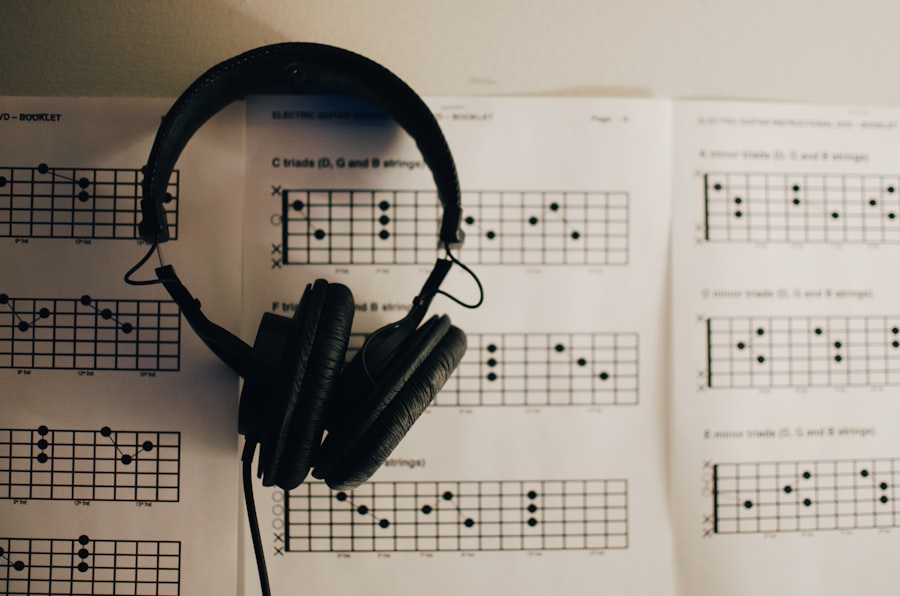
With tabs and chord charts you can play songs without reading sheet music. A tab has six lines for the six strings: the top one is the thin high e, the bottom one the thick low E. The numbers show which fret you press.
A chord chart shows where your fingers go in a chord. So you don’t need music theory to get started. The explanation is in reading guitar tabs, step by step. You can find tabs of well-known songs on Ultimate Guitar, among other places. Do check them by ear, though, because not every version is correct.
10. Follow one learning path instead of random videos
If you pick a different video every day, you learn lots of tricks but little that fits together. Choose one series of lessons that starts at the beginning, such as JustinGuitar’s free beginner course, an app or a lesson book, and work through it in order.
Feel free to play a video at half speed, play along and rewind until it works. You can read how to go about that in learning guitar with YouTube. You can compare apps that give feedback on your playing in the best apps for learning guitar.
After the first month: tips 11 through 15
After a month or two you can accompany a few songs. Now the point is to keep growing and not get stuck at the same level.
11. Work with a fixed practice schedule
A practice schedule keeps you from only playing what you can already do. Divide your time between a block of technique (chords, changing, strumming) and a block of songs. Pick one concrete goal per week, such as “the change from C to G without a pause” or “a new strumming pattern”.
You can read how to set up and keep track of such a schedule in making an effective practice schedule.
12. Record yourself
A recording lets you hear what you miss while playing: hesitations at a change, buzzing strings or a tempo that keeps getting faster. Your phone is enough. Also film your hands now and then, so you can see whether your posture stays relaxed.
Compare a new recording with the previous one every month. That way you also hear how much progress you are making. Tips for better recordings are in recording your guitar playing at home.
13. Play together with others
Playing together forces you to keep going when you make a mistake, and that is exactly what you need in a song. Play with a friend, accompany someone who sings or play along with a backing track. Agree on the tempo and the chords beforehand.
You can read what to watch for when you play with another guitarist in playing with other guitarists.

14. Have someone watch you play now and then
Teaching yourself works fine, but you often can’t see mistakes in your posture or picking yourself. A few one-off lessons with a teacher, or feedback from someone who has played longer, help you correct those mistakes early.
You can read when self-study works and when lessons are the wiser choice in learning guitar without a teacher.
15. Play music you love
Motivation comes mostly from music that makes you happy. Listen actively to songs you love, try to play the chords or a riff, and choose your next goal from there.
If your motivation dips, make your goal smaller instead of quitting. You will find more ideas in staying motivated while learning guitar.

Further reading
- Avoiding mistakes when learning guitar: the pitfalls beginners face and how to get around them.
- How fast can you play your first song? Realistic expectations for the first weeks.
- 10 daily guitar exercises for beginners: short exercises for your fifteen-minute routine.
Frequently asked questions about learning guitar as a beginner
How can a beginner learn to play guitar?
Start with a tuned guitar, a relaxed posture and two easy chords like Em and E. Practice for fifteen minutes every day, then learn A, D, G and C and play a simple song as soon as you can. Follow one learning path while you do, so you move forward step by step.
How long should a beginner practice each day?
For beginners, 15 to 30 minutes a day works well. Short daily sessions get you more than one long session a week, because your fingers and memory keep repeating what you have learned.
Does playing guitar hurt your fingers at first?
In the first weeks your fingertips can be sore. That is normal: calluses form, so it hurts less and less. Take a break if it really hurts, and check that the strings are not too high above the fretboard.
Which chord do you learn first on guitar?
Many beginners start with Em or E, because you only need two or three fingers for them. A, D and G follow. With G, C, D and Em you can already accompany many well-known songs.
Can you teach yourself guitar without lessons?
Yes, with videos, an app or a book and a fixed practice time, you can get a long way as a beginner. The risk is that you unknowingly pick up a wrong posture or fingering. So film yourself now and then or have someone watch you play.
Which accessories are handy when you are learning guitar?
A tuner or tuner app, a metronome, a few picks and a guitar stand are the most useful. A capo comes in handy once you want to play songs in a different key. Also read what a capo is and which fret to put it on.






Leave a Reply