


You learn to change between guitar chords faster by practicing only the transition, moving your fingers as one unit and using fingers that stay in the same place as anchors. Start slowly with a metronome and only raise the tempo when the change goes without hesitation. Below you’ll find the most important tips for changing between guitar chords faster, with concrete exercises you can use right away.
Why changing chords quickly matters
When you move smoothly from one chord to the next, the music keeps flowing and a song instantly sounds like a song. You spend less time searching for the right fingering, so you have more attention for rhythm, singing and expression.
Many popular songs require quick transitions. If you can’t manage that, the rhythm stalls and that can be frustrating, especially when you’re playing for others. By working on your chord changes, you expand your repertoire and your confidence grows.
Summary
- Practice each chord on its own first, so you know the shape well.
- Mainly practice the transition itself: two chords back and forth.
- Move your fingers at the same time and keep the movements small.
- Leave fingers that stay in the same place in both chords as an anchor.
- Use a metronome and build up the tempo gradually.
- Pay attention to your finger placement, hand position and how you hold your guitar.
- Practice briefly but regularly, so you build muscle strength and muscle memory.
Practice each chord on its own first
When you start playing guitar, it’s important to get the individual chords down well. That forms the basis for everything that follows. Take the time to practice each chord separately and learn to play guitar with chords step by step.
Start with the most common chords, such as C, G, D, Em and Am. Make sure your fingers are placed correctly and let every string ring clearly. Play each chord slowly and pick the strings one by one, so you can hear whether all the notes sound good.
Then practice the chords in different orders. That helps you remember the fingerings and develop a feel for how chords flow into each other. For example, try the progression C-G-Am-F. By playing chords in different orders, you gain confidence and learn to move smoothly from one chord to another.
Techniques for changing chords faster
Move your fingers as one unit
A common mistake is putting your fingers down one at a time. Instead, try to form the shape of the next chord in the air and let all your fingers land at the same time. This takes some practice, but once you get it, the time you need to change gets a lot shorter.
Use anchor fingers
For each change, look at which fingers are in the same place in both chords. Just leave those where they are. A few examples:
- C (x32010) to Am (x02210): your index finger (B string, 1st fret) and middle finger (D string, 2nd fret) stay put. Only your ring finger moves from the A string to the G string.
- Em (022000) to G (320003): if you play Em with your index and middle finger, your index finger can stay on the 2nd fret of the A string.
- D (xx0232) to G (320033): if you play G in this variation, your ring finger stays on the 3rd fret of the B string.
Keep your movements small
The farther your fingers move away from the strings, the longer the way back. Keep your fingers close above the fretboard and avoid unnecessary movements of your hand and wrist. If you see in the mirror that your fingers shoot up high, practice the change extra slowly.
Practice mini-transitions
You don’t always have to play the full chord. Also practice parts of a change, for example only the two fingers that do most of the work. That gives you a better feel for the movements your fingers need to make. It speeds up the transitions and improves your finger coordination and precision.
Let go on the last beat
If you can’t yet get to the next chord in time, release the old chord on the last beat of the measure and strum the open strings there. That keeps the rhythm going and gives you just enough time to set down the new shape. As your changes get faster, you’ll need this trick less and less.
Visualize the transition
Visualization is often overlooked. Imagine how your fingers move from one chord to the other. Close your eyes and picture how you place each finger and which strings you hit. You can also draw the chords on paper. That anchors the movements in your mind and helps you better understand how chords relate to each other.
Basic exercise: count your changes in one minute
A simple and effective exercise for changing between guitar chords faster:
- Choose two chords you still find hard to switch between, for example C and G.
- Set a timer for one minute.
- Keep switching between the two chords and strum each chord once. Count how many changes you make.
- Write down your score and repeat the exercise the next day.
By keeping track of your score, you see for yourself how you’re progressing. Want more exercises like this? Also check out these finger exercises for smooth chord changes.
Use a metronome
A metronome helps you keep consistent timing. Start at a slow tempo and play each chord evenly, for example four beats per chord. If that goes well, raise the tempo in small steps. That keeps you from playing too fast or too slow. In this article you can read how to practice with a metronome step by step. Count out loud while you do; you can read exactly how that works in how counting rhythm on guitar works.
At first, playing to the click can be hard, especially if you’re not used to a steady tempo. Try different rhythms, from simple strumming patterns to more complex rhythms. By practicing with a metronome regularly, your sense of timing improves and you change chords more easily without falling out of time.
Pay attention to finger placement and hand position
Correct finger placement is crucial. Poor placement leads to dull sounds or chords that don’t work. Place your fingers just behind the frets, but not on them. Then the strings vibrate well and the notes sound clear. Be aware of where your fingers are and adjust them when needed.
Also watch the pressure you apply. Too much pressure causes fatigue and pain, too little causes buzzing strings. Experiment until you find a balance that feels comfortable and sounds good.
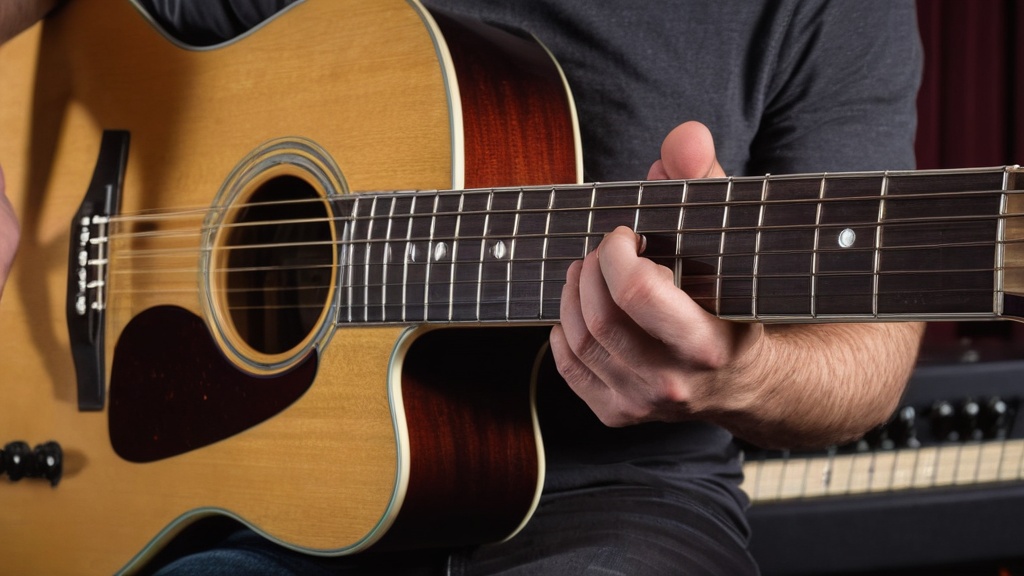
A relaxed hand changes faster than a tense hand. Keep your fingers in a natural, curved position. For most open chords, it helps if your thumb sits roughly in the middle behind the neck instead of over it. That gives your fingers more reach and control over the strings, and helps prevent injuries in the long run.
Build muscle strength and muscle memory
Muscle strength helps you play longer without fatigue. Exercises where you move each finger separately or use different finger combinations make your fingers stronger and more independent. Read more about developing finger strength for guitar playing.
Take regular breaks to prevent overuse. If your fingertips hurt, read how to prevent finger pain.
You build muscle memory through repetition. Short daily practice sessions often work better than long sessions that you only do now and then. Create a fixed routine in which you spend time specifically on chord changes and set yourself small goals, such as a higher score on the one-minute exercise or fewer mistakes in a song. Need help planning? Read how to make an effective practice schedule.
Practice with chord progressions and songs
Instead of only practicing individual chords, play them in coherent progressions. That improves your transitions and lets you hear how chords form a harmony together. Start with simple progressions such as I-IV-V (in C: C-F-G) and gradually work toward more complex structures. If you want to know why certain chords go together so well, read more about understanding chord progressions.
Every change has its own challenges and requires different movements. By practicing many different changes, you become more versatile technically and develop a better ear. Because many songs use the same or similar progressions, you also learn new songs faster. A good start is easy songs with 3 chords.
Combine the progressions with different strumming patterns. That develops your sense of rhythm and adds variety. By practicing with progressions regularly, you gain more musical freedom and can play along with other musicians more easily.
Adjust the position of your guitar

How your guitar sits has a big influence on how comfortably and effectively you play. Make sure the guitar rests stably on your lap, or hangs snugly against your body with a strap when you stand. Good posture prevents injuries and makes it easier to reach all the strings and frets. You’ll find more tips in the article on how to hold a guitar.
Experiment with different positions until you find what’s most comfortable for you. Some guitarists hold their guitar a bit higher or lower, depending on playing style and build. Good posture affects not only your enjoyment of playing, but also the sound.
Stay patient and challenge yourself
It can be frustrating when things don’t go as fast as you’d like, but every guitarist has their own pace. Keep practicing regularly and give yourself time. Even if you don’t notice improvement for a while, the time you invest pays off in the end.
Keep it fun. Choose songs you like to play and now and then try a new style, a harder song or a technique outside your comfort zone. Also ask for feedback from fellow musicians or a teacher: their view often helps you further than you can see yourself.
Your instrument plays a role too. A guitar with low action plays more lightly, which makes changing chords easier. Read more about the best guitar to learn on. And if you want to improve your playing more broadly, you’ll find even more useful tips in How can you learn guitar? 5 tips for beginners.
Frequently asked questions about changing guitar chords faster
What are the best tips for changing between guitar chords faster?
Practice regularly and focus on the transition itself, not just on the individual chords. Move your fingers at the same time, use anchor fingers, keep your movements small and build up the tempo with a metronome.
Why is changing chords quickly important?
Smooth changes let you play fluently without the rhythm stalling. That lets you play more complex songs and adapt more easily to different music styles.
How can I improve my fingering for changing between chords?
First learn the correct finger positions of each chord and play them slowly and cleanly. Then look at which fingers can stay in place during a change and do finger exercises that build strength and flexibility.
Which exercises help me get faster at changing between chords?
Good exercises are the one-minute exercise with two chords, playing chord progressions in different rhythms, practicing with a metronome and practicing changes within songs you like to play.
How can I improve my muscle memory for changing between chords?
Practice regularly and consistently, preferably a little every day. Pay attention to correct hand and finger positions, start slowly and build up the speed gradually.
How can I improve my hand strength and flexibility for changing between chords?
Do specific hand and finger exercises, such as squeezing a stress ball, practicing with a hand trainer and stretching your hands and fingers. Build up gradually and stop if you feel pain.
How long does it take before chord changes go smoothly?
That differs a lot from person to person. Someone who practices the same changes with focus for a few minutes every day usually notices progress sooner than someone who plays for a long time once a week. Keep track of your score with the one-minute exercise, and you’ll see for yourself how you’re progressing.
Should I look at my fingers when I change chords?
At first that’s fine. Gradually phase it out by first looking only at the difficult changes. That way you learn to play by feel, which is handy if you also want to sing or read from a chord sheet. You can read how to use those smooth changes while singing in accompanying yourself on guitar while singing.





Leave a Reply