
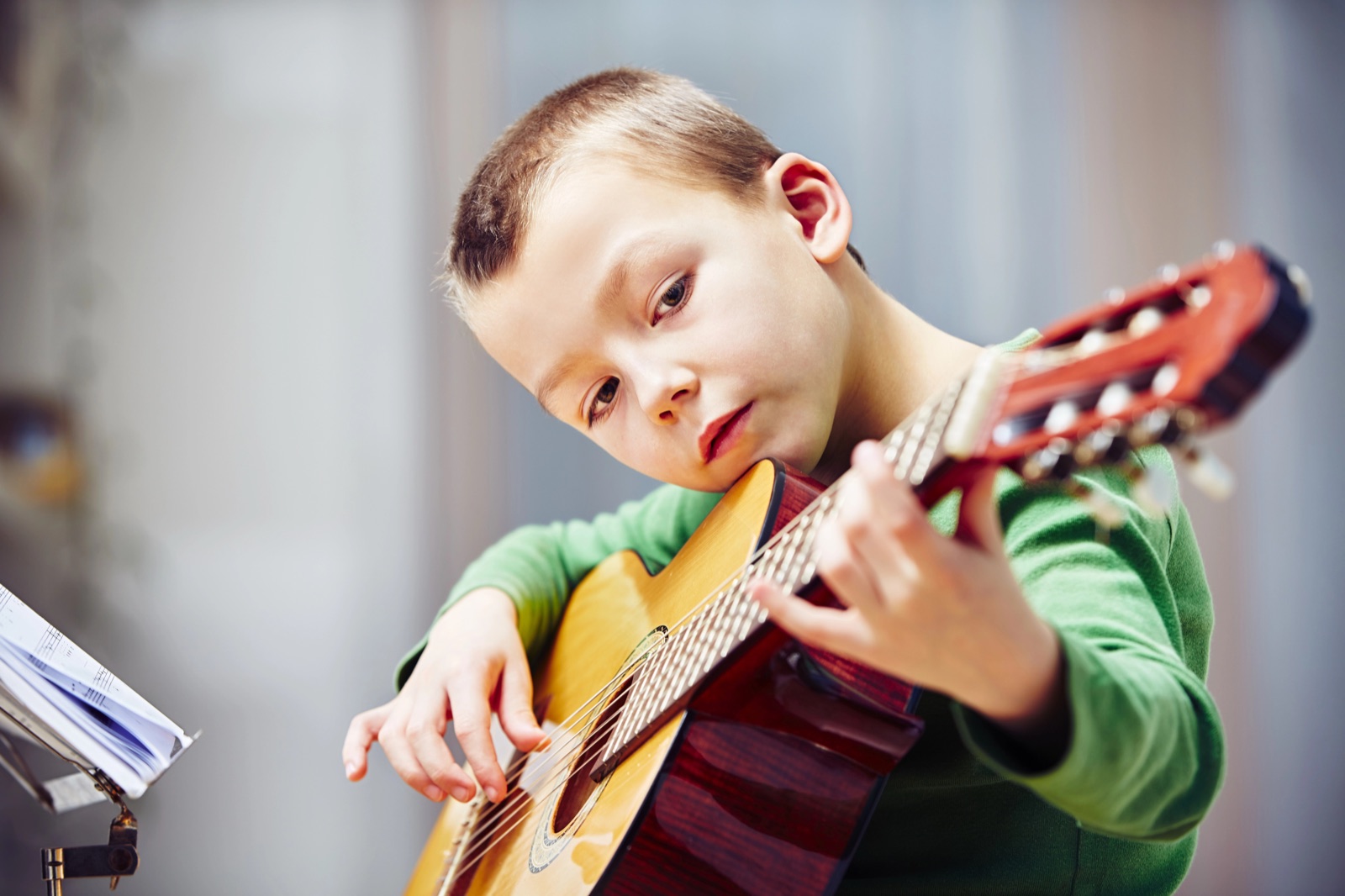

At what age can you start learning guitar? Most children can begin around age 6 or 7, and for adults there is no age limit. Around that age, children usually have enough fine motor control and concentration to press down strings and form simple chords. Every child is different: some are ready sooner, others need a little more time. Interest and enjoyment of music matter at least as much as age. If you are starting later in life, you can read which type of lessons fits best in guitar lessons for adults: lesson formats and practice tips.
Summary
- Most children can start guitar lessons around age 6 to 9, as long as they have enough motor control and concentration.
- Playing guitar supports children’s physical, mental and emotional development: fine motor skills, concentration, discipline and confidence.
- A guitar that fits your child’s height and strength prevents frustration.
- As a parent, you play a big role: encourage them, be patient and create a positive learning environment.
- Motivation is crucial. Children who play music they enjoy stick with it longer.
- Adults can start at any age with a good teacher or method, realistic goals and regular practice.
- Simple chords, tablature and well-known songs are a good start for every beginner.
The right age to start guitar lessons
Why around 6 or 7?
Music teachers and parents largely agree that children can understand the basics of playing guitar from about six or seven years old. At that age they can concentrate for longer and have enough strength and coordination to hold the guitar, press down the strings and form chords. It is also a time when children discover their interest in music and can express their creativity. You can find more practical tips for this age group in tips for learning guitar at elementary school age.
Every child develops differently
Some children are ready sooner, others later. That depends on their physical and mental development and on their interest in music. Young children are still developing quickly, so lessons need to match the child’s level and needs. There is no fixed starting age: mostly look at whether your child wants to make music and whether they can physically handle the guitar.
A positive first experience
Fun, engaging lessons keep children motivated to practice. A child who starts too early and mostly feels frustrated is more likely to quit. If your child is a bit younger, a ukulele with four nylon strings is often an accessible first step. You can read more about that in teaching your child to play ukulele.
What playing guitar gives a child
Physical development and motor skills
Playing strings and forming chords takes precision and coordination. Children who don’t yet have enough physical control may struggle with this, which can cause frustration. That is why the guitar should fit their size and strength.
By practicing regularly, children learn not only to play chords but also to coordinate their hands and fingers effectively. That improves their fine motor skills and hand-eye coordination, which also helps in sports or crafts. They also build confidence in their physical abilities.
Mental development
Making music takes more than technique. It also takes memory, concentration and problem-solving. While learning notes, chords and rhythms, children keep taking in new information. That stimulates their ability to learn and helps them concentrate better, including in other school subjects.
Playing guitar also contributes to creative thinking. Children are encouraged to make their own music, improvise or play existing songs in their own way. That combination of creative and analytical thinking will also serve them well outside of music later on.

Emotional and social development
Music is a way to express and process emotions. Whether a child is happy, sad or frustrated, an instrument offers an outlet. That is valuable for children who find it hard to put their feelings into words. Making music can also help reduce stress.
As children make progress, their confidence grows. That sense of accomplishment helps them take on other challenges with more confidence. Playing with others or performing for friends and family also teaches them how to handle social interaction and a bit of nervousness.
Discipline and perseverance
Practicing regularly and working toward a goal teaches children discipline and perseverance. These are skills they also use at school and in other hobbies. And if they keep enjoying it, they have a hobby for life.
The right guitar for a child
A child’s guitar has a shorter scale and smaller frets, which makes chords and notes easier to reach. Children’s guitars come in different sizes, such as 1/4, 1/2 and 3/4. Which size fits depends on your child’s height and arm length. You can read how to work that out in choosing the right guitar size for children. Older children can often start with a regular acoustic or electric guitar. If your child is already a teenager, learning guitar as a teenager covers which guitar, chords and practice routine work well. If you want to keep costs down while your child is still growing, look at affordable children’s guitars.
For young beginners, a classical guitar with nylon strings is a good choice, because nylon feels softer on the fingertips than steel. Also get the basics, such as a few picks, spare strings and learning materials. What else to look for when buying is covered in our tips for buying a guitar for kids.
How to support your child as a parent

Encourage them and show interest
As a parent, you play an important role in the learning process. Encourage your child to practice regularly and show that you see their progress: listen along and ask your child to play a favorite song. A positive attitude toward music helps too, for example by making music yourself, listening together or going to a concert together. That way you are also a role model.
Provide good gear and a good teacher
You can help in practical ways by arranging lessons and setting up a place to practice. Look for a guitar teacher who has experience with children and knows how to make lessons fun and engaging. Good lessons for children are often interactive and playful, with simple chords and songs from a child’s world, such as children’s songs on guitar.
Be patient and open to their taste in music
Learning guitar takes time and effort. Have realistic expectations and encourage your child to keep going, even when something doesn’t work yet. Be open to your child’s musical preferences, even if they differ from your own taste. That way your child feels free to express themselves through music. Listening or playing together also strengthens the bond between parent and child.
Why motivation matters for children
Without motivation, even talented young musicians become discouraged and stop practicing. Parents and teachers can encourage enthusiasm by giving children the freedom to choose music they enjoy, or by letting them try out their own musical ideas. Children who feel connected to the music they play are more likely to keep going when things get difficult.
Positive feedback plays a role too. Acknowledge your child’s effort and progress, and encourage them especially when something is hard or doesn’t work out. That way your child learns resilience. In an environment where making mistakes is allowed, a lasting love of music grows. You can find more ideas in how to motivate kids to practice guitar.
Tips for introducing guitar to children
- Choose a suitable guitar. A smaller children’s guitar is much more accessible than a standard model.
- Keep it playful. A positive, playful approach in the first lessons takes away fear or resistance. For example, use playful exercises for kids.
- Discover music together. From popular songs to traditional children’s songs: the most important thing is that your child feels connected to what they play.
- Use apps and online lessons. Interactive apps and platforms for beginners make learning notes and chords more varied.
- Practice short but often. Short daily practice sessions give better results than one long session per week.

Learning guitar as an adult
The idea that you can only start as a child is a misconception. Adults often have more patience and discipline, and can name their musical preferences and goals more clearly. That makes the learning process easier. Whether you already have experience with music or are completely new, you can start at any age. We go into this in more depth in can you still learn guitar later in life?
Start with a guitar that fits your wishes and budget. There are acoustic, electric and classical guitars, so choose an instrument that suits the music you want to play. Then find a guitar teacher or learning method that suits you, whether that is private lessons or online tutorials. What matters is that the method keeps you motivated and fits your pace and level. Relaxation, a hobby or a creative outlet: the reasons for starting later are diverse. You can find practical advice in our tips for adults who want to learn guitar. What you can expect from a teacher is covered in private guitar lessons.
The best learning methods for beginners
Private lessons with an experienced guitar teacher are a popular choice. You get individual attention, mistakes are corrected right away and the lesson plan matches your own goals. Online tutorials, apps and videos are a flexible alternative: you learn chords, techniques and songs at your own pace and in your own time. Group lessons and workshops, on the other hand, offer social interaction and extra motivation.
Whichever method you choose, start with simple chords, tablature and well-known songs. You can find a good overview of those first steps in guitar lessons for beginners. Choose a method that fits your learning style, goals and available resources.
Practicing consistently

Consistency and practice are the foundation of learning guitar, for children and adults. By practicing regularly you improve your technique, learn new skills and build a repertoire. You also build muscle memory, which makes difficult chords and riffs steadily easier. Even a few minutes a day helps. How much time makes sense is covered in how long to practice per day to learn guitar.
Practicing regularly also keeps motivation high. You notice that you are improving, and that gives you the confidence to try new techniques and songs.
Staying motivated and having fun
Staying motivated can be hard, especially at the start. Add variety to your practice routine with different songs, styles and techniques. Set achievable goals so you can celebrate your successes when you reach them. Playing with friends, family or fellow students makes learning more fun.
Allow yourself to make mistakes and be patient. Making music should be fun, for children and adults. Whether you start young or pick up a guitar later in life: with the right motivation, dedication and learning method, you will enjoy it for years.
Frequently asked questions about learning guitar and age
At what age can children start learning guitar?
Children can usually start around age 6 or 7. What matters is that they have enough strength and coordination to hold the guitar and press down the strings, and that they are interested in music themselves.
Is there a maximum age to start playing guitar?
No, there is no maximum age. Adults can successfully learn guitar at any age. It is never too late to learn a new skill, and making music is an enriching experience at any age.
What are the benefits of learning guitar at a young age?
Learning guitar at a young age helps develop fine motor skills, musical ear, concentration, discipline and creativity. It can also boost confidence and give a child a sense of accomplishment.
Do children need a special children’s guitar?
For young children, a children’s guitar is handy because of the shorter scale and smaller frets, which make chords and notes easier to play. Older children can also start with a regular acoustic or electric guitar.
Are there special guitar lessons for children?
Yes, there are guitar lessons designed for children. These lessons are often interactive and playful, and focus on simple chords and songs that fit a child’s world.
Can a 4- or 5-year-old already learn guitar?
It is possible, but for many children that age a regular guitar is still too big and the strings are hard to press down. A small children’s guitar or a ukulele and short, playful sessions work better. Mostly look at your child’s interest and attention span.
Does playing guitar hurt your fingers?
At first your fingertips can get sore, for children and adults alike. After a few weeks of regular practice, calluses form and the sensitivity fades. Nylon strings feel softer than steel strings. You can find more tips in how to prevent finger pain when learning guitar.






Leave a Reply