
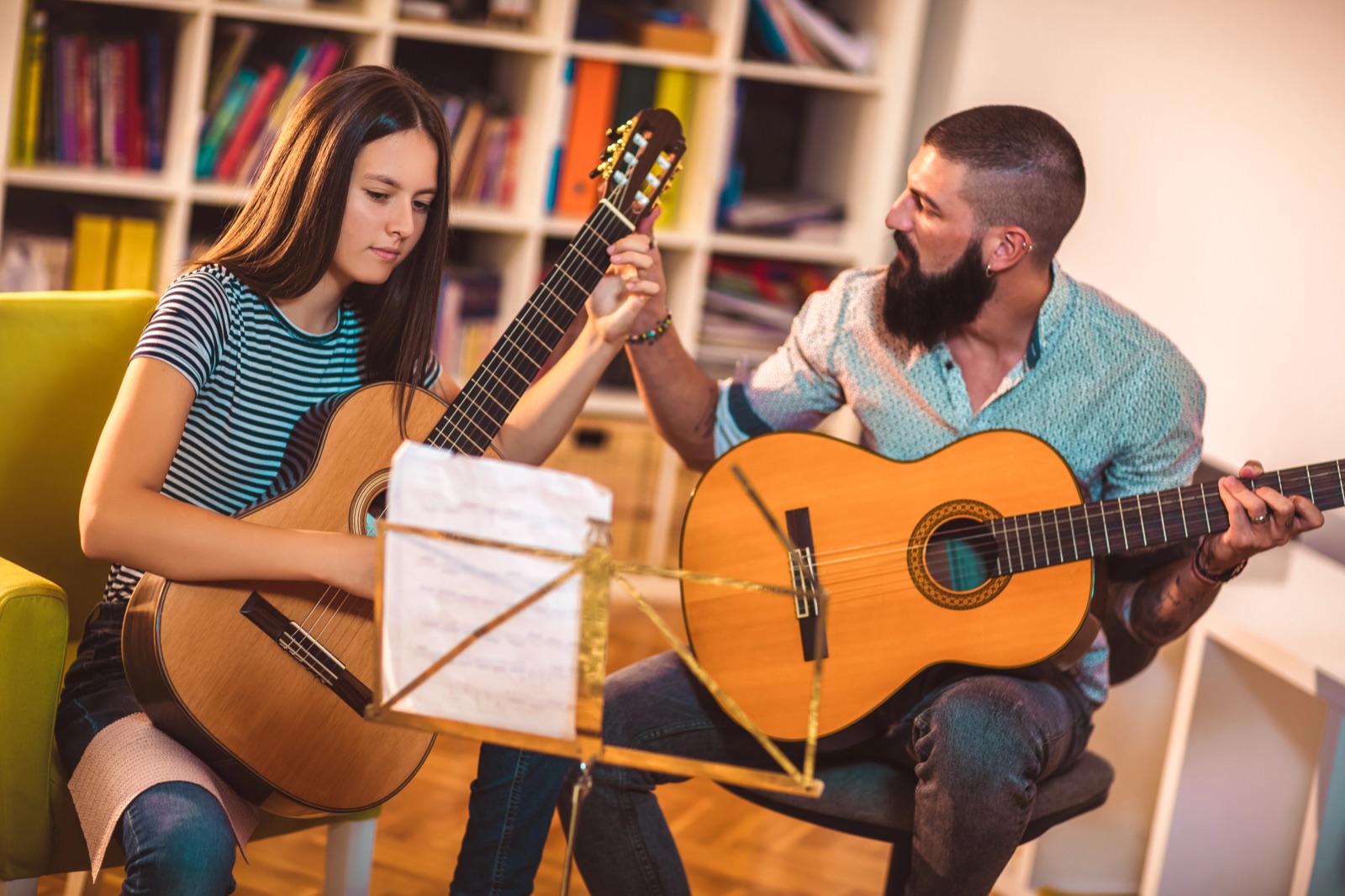

Short answer: Private guitar lessons are lessons where a teacher works with you one on one: at the teacher’s place, at your home or online via video. All the attention goes to your playing, so mistakes are corrected right away and the lessons fit your goals. It works especially well if you want a solid foundation quickly or are getting stuck with self-study.
If you are still unsure which type of lesson suits you, first take a look at the guide to guitar lessons, which puts all the options side by side. This page is only about private lessons: who they work for, what they offer, how to choose a good teacher and what to expect in the first lessons.
What Are Private Guitar Lessons?
With private guitar lessons, you are taught by one teacher, with no other students present. The teacher decides together with you what you learn and at what pace. A lesson usually lasts 30, 45 or 60 minutes, and most students go once a week or every other week.
Personal guitar lessons can take place in three locations. Each location has its own pros and cons:
| Where | Advantages | Keep in mind |
|---|---|---|
| At the teacher’s place or in a studio | A quiet lesson space, often with amps and teaching materials at hand. | You have to travel there. |
| Guitar lessons at your home | No travel time, and you play your own guitar in your own space. Handy for young children. | Not every teacher comes to your home, and travel time sometimes counts toward the rate. |
| Online via video | No travel time and a wide choice of teachers, including outside your region. | Posture and fingering are harder to correct. Make sure you have a camera that shows both your hands and a stable connection. |

Who Do Private Lessons Work For?
Private lessons work best for people who want to move forward in a focused way and practice on their own between lessons. You get the most out of them in these situations:
- You are a beginner and want to learn it right from the start. A teacher corrects your posture, fingering and timing before they become fixed habits.
- You are getting stuck with self-study. Apps and videos cannot see what you are doing wrong. A teacher sees it in a few minutes.
- You have a clear goal. A particular style, your first performance or an admission: a teacher builds the lessons around it. If you have to audition, also read how to practice for a guitar audition.
- You have a changing schedule. With an independent teacher, you can often agree on more flexible times than with a fixed lesson schedule.
Private lessons are less suitable if you mainly want to play with others, if your budget is tight or if you barely have time to practice between lessons. In that case, a group lesson, a band or learning on your own often fits better.
The Pros and Cons of Private Guitar Lessons
The biggest advantage of private guitar lessons is direct, personal feedback. The biggest drawback is that each lesson costs more than lessons where you share the teacher.
Advantages
- Direct correction: if you play a shape wrong or your wrist sits at an odd angle, you hear about it right away.
- A custom lesson plan: if you want to play rock, you work on power chords, riffs and solos. If you prefer acoustic, the emphasis is on fingerpicking and chord accompaniment.
- Your pace: if you need more time for something, you take it. If it goes quickly, you move on.
- More confidence: you play for someone every week, and a teacher can help you with nerves about playing for an audience. You can find practical tips in playing guitar live without stress.
Disadvantages
- Higher cost per lesson than a group lesson or an online course.
- No playing together: you do not automatically learn to play with other musicians.
- Dependent on one teacher: if the approach does not suit you, you notice it in every lesson.
- You still practice alone: progress comes from practicing between lessons, not from the lesson hour itself.
Private Lessons Compared With Other Types of Lessons
Private lessons give the most personal attention, but are not the best choice for everyone. This is how they compare with the other ways to learn guitar:
| Type of lesson | Attention for you | Playing together | Best for | Keep in mind |
|---|---|---|---|---|
| Private lessons | Full | No | A solid foundation and personal goals | More expensive per lesson, you practice alone |
| Group lessons | Shared across the group | Yes | Learning together with a lower threshold | The pace is set by the group |
| Music school | Private or in a small group | Often, through ensembles and student recitals | Structure, children, exams | Fixed lesson times and a lesson year |
| Online lesson or course | Live lesson: full. Course: none | No | Flexible learning, wide choice of teachers | No correction with a course that has no teacher |
| Teaching yourself | None | No | Independent learners with a small budget | Mistakes easily go unnoticed |
If you are looking for structure, playing with others and student recitals, guitar lessons at a music school may suit you better. If you want to learn when it suits you, look at online guitar lessons. And whether you can manage without lessons is covered in can you learn guitar without a teacher.
How to Choose a Good Guitar Teacher
A good guitar teacher not only plays well, but can also explain clearly and tailors the lessons to what you want to achieve. When choosing, look at four things.
1. Teaching Experience
A strong guitarist is not automatically a good teacher. Ask how long someone has been teaching and whether the teacher has experience with your level and age. Teaching an eight-year-old takes a different approach than teaching an adult beginner.
2. A Style That Suits You
A teacher who is at home in rock does not necessarily know much about jazz or classical. Choose someone who plays the music you want to learn, or who is broad enough to let you try different styles.
3. A Trial Lesson
Many teachers offer a trial lesson. That is the moment to find out whether there is a click. During the trial lesson, pay attention to these points:
- Does the teacher ask about your goals and the music you want to play?
- Is the explanation understandable, and do you dare to ask questions?
- Does the teacher correct your posture and fingering, even if you do not ask?
- Do you leave the lesson with clear practice material for home?
4. Questions to Ask
Ask these questions before you commit. The answers show how the teacher works:
- What does an average lesson look like, and how long does it last?
- Do you work with a lesson method, or do you tailor the lessons to the songs I want to play?
- How do we keep track of whether I am improving?
- Do you teach at your place, at my home or online?
- What are the arrangements for canceling, making up lessons and paying?
Experiences of other students or a recommendation by word of mouth help too. They often say more than a nice website.
What Does the Price of Private Lessons Depend On?
The price of private guitar lessons differs by teacher and by region. So always ask for the rate and the terms in advance. These factors largely determine what you pay:
- Lesson length: a 30-minute lesson costs less than a one-hour lesson.
- Experience and training of the teacher.
- Region: in big cities, rates can be higher than in smaller towns.
- Location: with guitar lessons at your home, a teacher sometimes counts travel time.
- Single lessons or a package: some teachers work with a lesson card or a subscription.
- Independent teacher or music school: a music school usually works with fixed rates per lesson year.
What Do You Learn in the First Lessons?
In the first lessons, you lay the foundation: posture, tuning, your first chords and a simple strumming pattern. The first lesson almost always starts with an introduction, in which the teacher asks about your experience, your goals and the music you like to listen to.

- Introduction and level: the teacher sees what you can already do and sets a goal for the coming months together with you.
- Posture and tuning: how to hold the guitar, use the pick and tune your guitar with a tuner or app.
- First chords and a strumming pattern: often starting with easy shapes like Em, A and D.
- Your first song: as soon as you can switch between two or three chords, you play a simple song.
- Homework: you get practice material to take home, so you can keep going between lessons.
You can find a more detailed overview per lesson in guitar lessons for beginners.
How to Get More Out of Your Lessons
- Be open about your goals and about what you find difficult. Then the teacher can adjust the approach.
- Ask questions if something is not clear, even while playing.
- Practice a little every day, preferably fifteen minutes a day rather than two hours on Sunday. An effective guitar practice schedule helps you divide your time smartly, and that is how you make playing guitar part of your day.
- Write down after each lesson what you learned and what you are working on this week.
- Be patient: progress comes in small steps. Notice them, and you stay motivated.
Further Reading
- Guitar lessons for adults: what to look for as an adult beginner when choosing lessons.
- Guitar lessons for kids: which type of lesson fits which age.
- Taking guitar lessons: an overview of the ways to get lessons.
Frequently asked questions about private guitar lessons
What are private guitar lessons?
Private guitar lessons are lessons where one teacher teaches one student. The lessons are tailored to your level, your goals and the music you want to play. They can take place at the teacher’s place, at your home or online.
How long does a private guitar lesson last?
Usually 30, 45 or 60 minutes. For beginners, half an hour a week is often enough. If you are working on harder pieces or want to progress faster, a longer lesson makes sense.
How often should you take private lessons?
Many students take a lesson once a week, so there is time to practice the material at home. Every other week can work too, if you play regularly in between. More important than how often you have lessons is that you practice a little every day between lessons.
Are there guitar lessons at your home too?
Yes, some teachers come to your home to teach. That saves travel time, and you play your own guitar. Do ask whether the teacher charges for travel time.
Can private guitar lessons be online too?
Yes, many teachers give lessons over a video connection. The teacher sees you play and can correct you right away, although your posture is harder to correct from a distance. Place your camera so that both your hands are clearly in view.
What do I need for private guitar lessons?
You need a guitar that fits your height and age, and a tuner or tuning app. A pick and a notebook for your practice material are handy. If you play electric, ask whether the teacher has an amp or whether you should bring your own.
Are private lessons better than teaching yourself?
With private lessons, you usually learn a good foundation faster, because a teacher sees mistakes right away. Teaching yourself can work too, if you are disciplined and use good sources. Many guitarists combine the two: a few lessons for the basics and then continuing on their own.




Leave a Reply