


Want to teach your child to play the ukulele? Start with a soprano ukulele in standard G-C-E-A tuning, learn the chords C, Am, F and G first, and pick songs your child likes. Keep practice sessions short and play together regularly: that way, playing the ukulele stays mostly fun for your child.
The ukulele is a stringed instrument that is often recommended for children to learn. It has four strings and is smaller than a guitar, which makes it suitable for younger players. The ukulele originated in Hawaii and was developed in the 19th century.
Learning to play the ukulele has several benefits for children:
- Motor skills: playing takes coordination between hands and fingers.
- Music theory: children learn about chords, rhythm and melody through play.
- Concentration and memory: remembering songs and chord shapes trains these skills.
- Creativity: playing an instrument encourages self-expression.
- Social skills: making music together encourages interaction with others.
- Discipline and perseverance: regular practice is needed to make progress.
The ukulele is relatively easy to learn, and children can often play simple songs quickly. This can be motivating and boost their confidence. The instrument is also light and compact, which makes it easy to take along and transport.
Summary
- Learning to play the ukulele can help children develop musical skills and confidence.
- Choose a ukulele that suits your child’s age and size, and consider the quality of the instrument too.
- Teach your child the basics of playing the ukulele, such as chords, strumming and playing melodies.
- Start with simple, fun songs to motivate your child and let them enjoy playing the ukulele.
- Encourage your child and reward their efforts to keep them motivated and enjoying the ukulele.
How do you choose the right ukulele for your child?
Choosing the right size
In general, ukuleles come in four sizes: soprano, concert, tenor and baritone. For young children, a soprano ukulele is often the most suitable because of its smaller scale and frets, which are better suited to small hands.
Ukulele quality
Although it can be tempting to buy a cheap ukulele, a poor-quality instrument can get in the way of your child’s learning. So look for tuning machines that hold their tuning well and a low string height, so the strings are easy to press down.
Tuning and design
Another factor to consider is the tuning of the ukulele. The most common tuning for a ukulele is G-C-E-A, but other tunings are available too, such as D-G-B-E. For beginners it is usually best to start with standard G-C-E-A tuning, because plenty of learning material is available for it. Finally, it is important to consider the design and look of the ukulele. Choose a ukulele that appeals to your child and inspires them to practice and play.
The basics of playing the ukulele

Learning to play the ukulele starts with learning the basics of the instrument. First, children need to learn how to hold and tune the ukulele. It is important that they are comfortable holding the instrument and that they know how to tune the strings to produce the right notes.
Next, children need to learn how to form chords on the ukulele. This means placing their fingers on the right frets and strings to form different chords. Besides chords, it is also important for children to learn how to play melodies on the ukulele.
This involves plucking or strumming individual strings to produce different notes and create melodies. It is also useful for children to learn how to play simple rhythms on the ukulele, using different strumming patterns and techniques. By mastering these basics, children can soon play simple songs and develop their musical skills further.
The first four chords
With four chords your child can already play along with many songs: C, Am, F and G. The numbers below run from the G string (the one closest to your face) to the A string; 0 means you let the string ring open.
- C (0003): ring finger on the third fret of the A string.
- Am (2000): middle finger on the second fret of the G string.
- F (2010): middle finger on the second fret of the G string, index finger on the first fret of the E string.
- G (0232): index finger on the second fret of the C string, middle finger on the second fret of the A string, ring finger on the third fret of the E string.
Let your child switch calmly between C and Am first, then add F and G. You will find more ideas in these playful exercises for teaching kids guitar; many of them work on the ukulele too.
Fun songs to learn on the ukulele
| Song | Difficulty | Chords |
|---|---|---|
| Twinkle Twinkle Little Star | Easy | C, F, G |
| The Wheels on the Bus | Easy | C, G |
| Riptide (Vance Joy) | Easy | Am, G, C, F |
| I’m Yours (Jason Mraz) | Easy | C, G, Am, F |
| Somewhere Over the Rainbow/What a Wonderful World (Israel Kamakawiwo’ole) | Medium | C, Em, Am, F, G, E7 |
There are countless fun songs that are perfect for children to learn on the ukulele. One of the most popular songs to learn is “Somewhere Over the Rainbow” by Israel Kamakawiwo’ole. This song has simple chords and a recognizable melody, which makes it ideal for beginners.
Another fun song to learn is “Riptide” by Vance Joy. This song has a cheerful feel and a catchy melody that suits the sound of the ukulele perfectly. There are also plenty of children’s songs that are perfect for the ukulele, such as “Twinkle Twinkle Little Star” and “The Wheels on the Bus”. Looking for more simple songs? In first children’s songs with 2 chords you will find songs that also work on the ukulele; the chord names are the same, only the shapes differ.
These songs are simple and fun to play, which makes them ideal for young children who are just starting to learn the ukulele. Other popular songs that suit beginners include “I’m Yours” by Jason Mraz and “Count on Me” by Bruno Mars. By learning these fun songs, children can improve their ukulele skills while enjoying the fun of making music.
Tips for keeping your child motivated to play the ukulele
It can sometimes be a challenge to keep children motivated to keep practicing and playing the ukulele. One way to do this is to encourage them to learn songs they like and that connect with their interests. If you let them choose which songs they want to learn, they will be more motivated to practice and improve their skills.
It can also help to practice and make music together with your child. This can be fun, but it can also create a sense of togetherness and encourage your child to continue their musical journey. Another way to keep your child motivated is to set goals and offer rewards for their effort. You can read more practical ideas in how to motivate kids to practice.
Rewards can range from small treats like stickers or candy each time they practice, to bigger rewards like an outing or a new songbook when they reach a certain level in their playing. By setting goals and encouraging them to work toward them, children can stay motivated and keep enjoying playing the ukulele.
The benefits of learning the ukulele for children
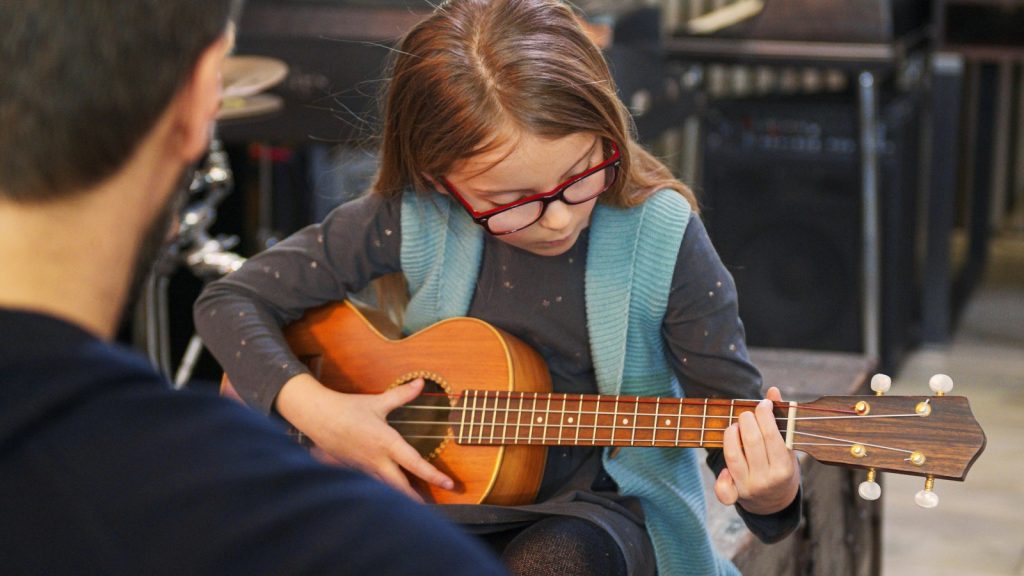
Learning to play the ukulele has countless benefits for children, both musically and personally. Musically, learning the ukulele helps children develop their musical skills, such as sense of rhythm, reading music and ear training. It also lets them be creative and express themselves through music, which can support their emotional well-being.
Personally, learning the ukulele can help children develop discipline, perseverance and confidence. It takes regular practice and dedication to make progress, which teaches children valuable lessons about perseverance and hard work. Succeeding at playing the ukulele can also boost their confidence and encourage them to take on new challenges in other areas of their lives.
Ukulele vs. guitar: what are the differences?

Although both the ukulele and the guitar are stringed instruments, there are several differences between them. One of the most noticeable differences is the number of strings. A standard guitar has six strings, while a standard ukulele has only four. If your child chooses guitar after all, this guide explains which kids’ guitar fits best.
This makes the ukulele easier to handle for young children, because they have fewer strings to worry about. Another difference between the two instruments is the tuning. The standard tuning for a guitar is E-A-D-G-B-E, while the standard tuning for a ukulele is G-C-E-A.
This means chords are formed differently on a guitar than on a ukulele, so children who play both instruments have to learn different chord shapes. Finally, the guitar generally has a wider range and more possibilities for complex chords and melodies, while the ukulele is known for its cheerful sound and simpler chord progressions. In short, both the ukulele and the guitar have their own unique features and benefits, and both can be valuable instruments for children to learn. The shapes are related, though: the ukulele tuning G-C-E-A matches the four thinnest guitar strings with a capo on the fifth fret. The G chord on the ukulele therefore has the same shape as the D chord on the four thinnest guitar strings. To learn exactly what a capo does, read the explanation of the capo on guitar.
Choosing between the two depends on the child’s interests and needs, as well as their physical abilities and musical goals. If your child wants to switch later, read how to choose the right guitar size for kids and how to get a good start with guitar lessons.
Not sure whether your child is old enough for guitar? Then read what age you can start learning guitar. If you want to play children’s songs together on guitar after the ukulele, learning to play children’s songs on guitar will get you started.
Frequently asked questions about ukulele for kids
What is a ukulele?
A ukulele is a stringed instrument that looks like a small guitar. It usually has four strings and is often associated with Hawaiian music.
Is playing the ukulele suitable for children?
Yes, playing the ukulele is very suitable for children. Because of its small, light build, the ukulele is an ideal instrument for children to learn.
At what age can children start playing the ukulele?
Children can start playing the ukulele at a young age, usually from 5 or 6 years old. It is important that the child is big enough to hold the ukulele and press the strings down.
What are the benefits of playing the ukulele for children?
Playing the ukulele can help children develop their motor skills, musical ear and creativity. It can also contribute to the child’s confidence and discipline.
Do children need special ukuleles to learn?
For children there are special kids’ ukuleles available that are smaller and lighter than standard ukuleles. These are often better suited for children to learn on.
How often should my child practice the ukulele?
Short and regular works best. A few short sessions a week keep it fun and give fingertips time to get used to it. Stop while your child is still enjoying it, and they will gladly pick up the ukulele again next time.
Is the ukulele a good stepping stone to guitar?
Yes. Your child learns chords, rhythm and switching between shapes on a smaller instrument with fewer strings. Because the ukulele tuning matches the four thinnest guitar strings, many chord shapes are recognizable later on guitar. Also see the tips for learning guitar at elementary school age.





Leave a Reply