

Sweep picking exercises for advanced players come down to three things: larger arpeggios across five or six strings, clean muting so notes don’t ring on, and a tempo you build up step by step with a metronome. Below you’ll find a concrete A minor exercise, followed by exercises for speed, precision, articulation and dynamics.
Sweep picking is a technique widely used by guitarists, especially in genres such as rock, metal and jazz. It means playing across several strings with a single motion of the pick, which lets you play chords or arpeggios quickly and efficiently. Unlike traditional picking, where you strike each note separately, sweep picking uses one fluid motion that touches the strings in a single sweep. If you’re just starting out, first read sweep picking for beginners, with a first exercise across three strings.
This results in a clear, fast sound that’s perfect for playing complex musical passages. The origins of sweep picking lie in the need for speed and precision. Guitarists such as Yngwie Malmsteen, Jason Becker and Frank Gambale popularized this technique through their virtuoso playing style.
Sweep picking lets you move quickly through arpeggios, which is essential for creating impressive solos and melodies. It’s a technique that requires not only speed, but also good coordination between your right and left hand. By mastering this technique, you can take your playing to a higher level and expand your musical repertoire.
Summary
- Sweep picking is a guitar technique where you strike multiple strings in one fluid motion with a pick.
- The basic principles of sweep picking include using a smooth, even motion of the pick, muting the strings and mastering your fingering.
- Exercises aimed at developing speed in sweep picking include playing arpeggios at a fast tempo and using a metronome to build up speed gradually.
- Exercises aimed at developing precision in sweep picking include focusing on striking each string evenly and avoiding unwanted noise.
- Exercises aimed at developing articulation in sweep picking include working on the clarity and definition of each note in the arpeggio pattern.
- Exercises aimed at developing dynamics in sweep picking include varying your picking strength and playing with expression to improve musicality.
- Tips for integrating sweep picking into your playing include listening to and studying professional guitarists who have mastered this technique and gradually working sweep picking into your daily practice routine.
- Common mistakes in sweep picking exercises include trying to go too fast, neglecting proper technique and not listening to the sound of the arpeggios. You can avoid these by practicing patiently, paying attention to proper technique and listening critically to your own playing.
The basic principles of sweep picking
To learn sweep picking effectively, it’s important to understand the basic principles well. The technique is built around making a fluid motion with your pick, touching the strings in an upward or downward sweep. This means you not only have to hit the right strings, but also master the right timing and dynamics.
It’s crucial to practice with a metronome to make sure you stay consistent in your tempo. Another important aspect of sweep picking is the position of your fingers on the fretboard. Your left hand must be able to move quickly from one note to the next, while applying the right pressure to produce a clear sound.
It’s also essential to make sure your fingers don’t move unnecessarily, because this can lead to inaccuracy and slowing down in your playing. By mastering these basic principles, you lay a solid foundation for developing your sweep picking skills further.
Basic exercise: A minor arpeggio across five strings
This shape is a classic and the basis for many other sweeps. You play the notes A, C and E of the A minor chord:
- A string fret 12
- D string fret 14
- G string fret 14
- B string fret 13
- High E string fret 12, then a hammer-on to fret 17
- Pull-off back to fret 12 and, in one upward motion, back down via B 13, G 14 and D 14 to A 12
You play the first five notes with one continuous downward motion, and the way back with one upward motion. The D and G strings are on the same fret: roll from one string to the other with a single finger, so the two notes don’t ring at the same time. Lift each finger as soon as the next note sounds, and mute the strings you aren’t playing with the heel of your picking hand. Start at a tempo where every note sounds separate, and only raise the metronome once you can play the pattern flawlessly a few times in a row. You use the same continuous pick motion in economy picking.
Sweep picking exercises for developing speed
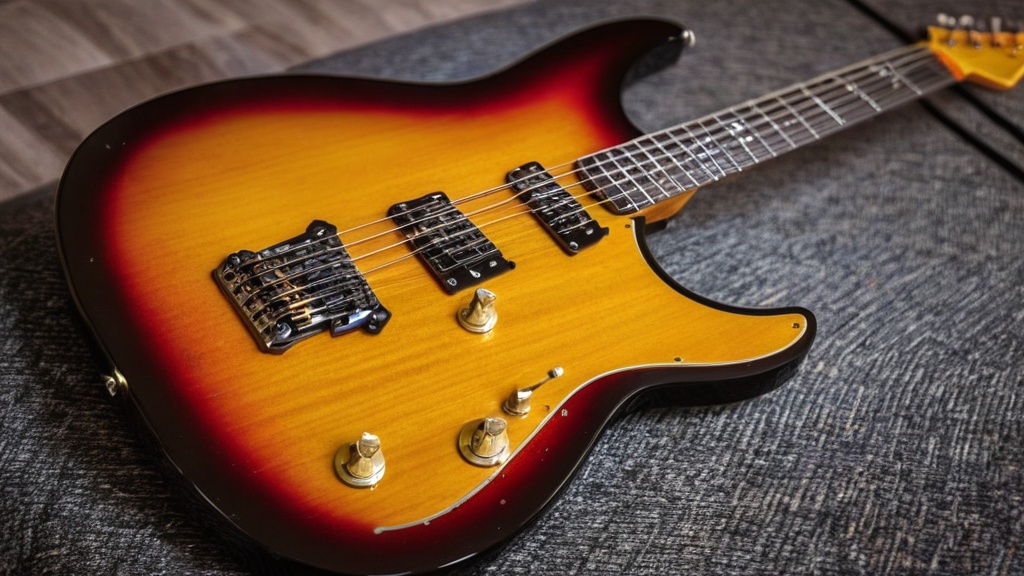
To develop speed with sweep picking, there are several exercises you can try. A popular exercise is playing simple arpeggios in different positions on the neck of the guitar. Start with a basic C major arpeggio and play it slowly with a metronome.
Gradually increase the speed while making sure every note sounds clear and distinct. It’s important not to rush; focus on accuracy before you raise the speed. Another effective exercise is using chromatic patterns.
For example, play four notes per string in an upward motion and then back down. This helps not only with developing speed, but also with improving the coordination between both hands. Try to work these exercises into your routine every day, and you’ll notice your speed and precision improving gradually.
Sweep picking exercises for developing precision
Besides speed, precision is a crucial aspect of sweep picking. To improve it, you can do exercises that focus on playing arpeggios with different intervals. Start with simple triads and gradually expand to more complex structures such as four-note chords (seventh chords) or even ninth chords.
Make sure you hear every note separately and that there are no unwanted noises or muting. Another useful exercise is playing arpeggios with variations in dynamics. For example, play each note softly at first and then gradually increase the volume with each repetition.
This helps not only with improving your precision, but also with developing a better feel for dynamics in your playing. By doing these exercises regularly, you’ll notice you gain more control over every note you play.
Sweep picking exercises for developing articulation
Articulation is essential for creating expressive music, and sweep picking is no exception. To improve your articulation, you can start by playing arpeggios where you attack each note in a different way. For example, try playing some notes harder than others or vary the timing between the notes.
This will help add more emotion and character to your playing. Another effective way to practice articulation is to use legato techniques in combination with sweep picking. For example, play an arpeggio where you pick the first note and add the following notes with hammer-ons or pull-offs. You can read how to alternate legato with slides for more expression in combining slides and legato in solos. If those are still difficult, first practice hammer-ons and pull-offs for solos on single strings.
This creates a smooth transition between the notes and helps develop a more expressive playing style. By combining these techniques, you can create a unique sound that reflects your personal style.
Sweep picking exercises for developing dynamics
Dynamics play a crucial role in music, and sweep picking offers many possibilities for exploring this aspect. Start by playing arpeggios where you deliberately vary the volume. For example, play an arpeggio softly at first and gradually increase the volume as you go.
This helps not only with developing control over your picking, but also with creating tension and emotion in your music. Another interesting exercise is to combine different techniques with sweep picking to explore dynamics. For example, try alternating staccato notes with longer notes within the same arpeggio.
This creates contrast and keeps the listener engaged. By integrating dynamics into your sweep picking exercises this way, you develop not only technical skills, but also a deeper understanding of musical expression.
Tips for integrating sweep picking into your playing
Integrating sweep picking into your playing can be challenging at first, but with patience and practice you can work this technique seamlessly into your style. Start by identifying pieces or solos where sweep picking is already used and try to play them. This gives you insight into how other guitarists apply this technique, and also helps you develop your own style.
It’s also important to improvise with sweep picking techniques regularly. Try out different arpeggios and patterns while playing over backing tracks. This will help not only with improving your skills, but also with developing creativity in your playing. If you want to make your arpeggios even faster, try combining them with tapping in your solos.
Don’t forget that consistency is key; by practicing regularly and trying out new ideas, you’ll notice that sweep picking feels more and more natural.
Common mistakes in sweep picking exercises and how to avoid them
When learning sweep picking, there are a few common mistakes guitarists often make. One is trying to go too fast without first getting the basics down. It’s crucial to start slowly and make sure each note sounds clear before you increase the speed.
Take the time to get comfortable with the movements and techniques before moving on to more complex patterns. Another common mistake is a lack of attention to the position of the fingers on the fretboard. Make sure your fingers are always ready to move to the next note without unnecessary tension or movement.
This will help improve both speed and precision. By being aware of these common pitfalls and actively working to correct them, you can improve your sweep picking skills considerably and get more enjoyment out of playing guitar.
For advanced guitarists who want to improve their sweep picking skills, it’s essential to keep practicing and discovering new techniques. An interesting addition to your practice routine can be learning the best metal riffs. These riffs can help you develop your technique and speed further. For more inspiration and challenging riffs, take a look at the article about learning the best metal riffs by Metallica. This article offers valuable insights and can help you take your guitar playing to a higher level.
Frequently asked questions about sweep picking
What are sweep picking exercises for advanced players?
Sweep picking exercises for advanced players are specific exercises meant to improve the sweep picking technique on guitar. These exercises are aimed at advanced guitarists who are already familiar with the basic principles of sweep picking.
What is sweep picking?
Sweep picking is a guitar technique where the strings of the guitar are struck quickly and fluidly with a pick. Several strings are struck in one fluid motion, which creates a smooth, arpeggio-like sound.
Why are sweep picking exercises important for advanced guitarists?
Sweep picking exercises are important for advanced guitarists because they help improve the technique and skill of sweep picking. By practicing regularly, guitarists can increase their speed, precision and fluidity in sweep picking.
What kinds of exercises fall under sweep picking for advanced players?
Sweep picking for advanced players includes exercises aimed at playing complex arpeggios, improving coordination between the left and right hand, increasing speed and playing difficult patterns across the whole neck of the guitar.
How often should advanced guitarists do sweep picking exercises?
Advanced guitarists are advised to spend time practicing sweep picking regularly, preferably every day. By practicing consistently, guitarists can keep improving their technique and skill.
What is the difference between sweep picking and economy picking?
In sweep picking you usually play one note per string, and your pick moves across several strings in one continuous motion. In economy picking you combine alternate picking with that continuous motion at every string change, even when you play multiple notes per string.
Why does my sweep sound like a chord?
Then notes are ringing on. Lift each finger of your fretting hand as soon as you play the next note, roll across notes on the same fret, and mute the low strings with your picking hand. Play slower until you hear each note separately.




Leave a Reply