


How do you learn to play arpeggios on guitar? You take a chord and play its notes one at a time instead of all at once. Start with open chords such as Em, Am and C, play them slowly with a metronome and always use the same fingers or pick movement. Once that feels smooth, move on to chord changes, set patterns and separate arpeggio shapes up the neck. Below you will find simple arpeggio exercises to start with.
Summary
- An arpeggio is a broken chord: you play the notes of a chord one after another instead of together.
- The basics are knowing which notes are in a chord, using a fixed fingering and striking the strings in the right order.
- Beginners start with open chords such as C, G, D, A and Em and then build up to more complex patterns.
- Practice with a metronome: slow and precise first, faster only later.
- Scales help you understand the distances between notes and recognize arpeggios more quickly.
- Arpeggios work in almost every style, from classical and pop to rock and jazz, and also in improvisation.
What is an arpeggio?
An arpeggio is a chord whose notes you play one after another. Take a C chord: it consists of the notes C, E and G. If you play those notes one by one, you are playing a C arpeggio. You hear each note of the chord separately, which gives a flowing, melodic sound.
You will find arpeggios in classical music, pop, rock and jazz. You play them with your fingers or a pick, on simple basic chords but also on seventh chords and jazz harmonies. A well-known rock example is the arpeggio intro by Metallica; you can practice it in this explanation of Nothing Else Matters on guitar. Doing both at once is possible too: you can read how that works in the explanation of hybrid picking.
Practicing arpeggios gives you more than a beautiful sound. You train the cooperation between your left and right hand, you learn how chords are built and your ear gets used to the individual notes in a chord. You will need that later for improvising and writing your own songs.
The basics: notes, chords and technique
Begin with the different types of chords: major, minor and seventh chords. Each type has its own sound and structure, and you hear that in the arpeggio. If you know which notes are in a chord, you can play them in the right order and form arpeggios yourself.
Your technique matters too. A fixed fingering and an even attack make the difference between a messy and a flowing arpeggio. Try both your fingers and a pick and see what works best for you. Pay attention to timing as well: every note gets the same length and sounds clear. Start slowly; playing correctly comes before playing fast, because speed comes with practice.
Simple arpeggio exercises for beginners
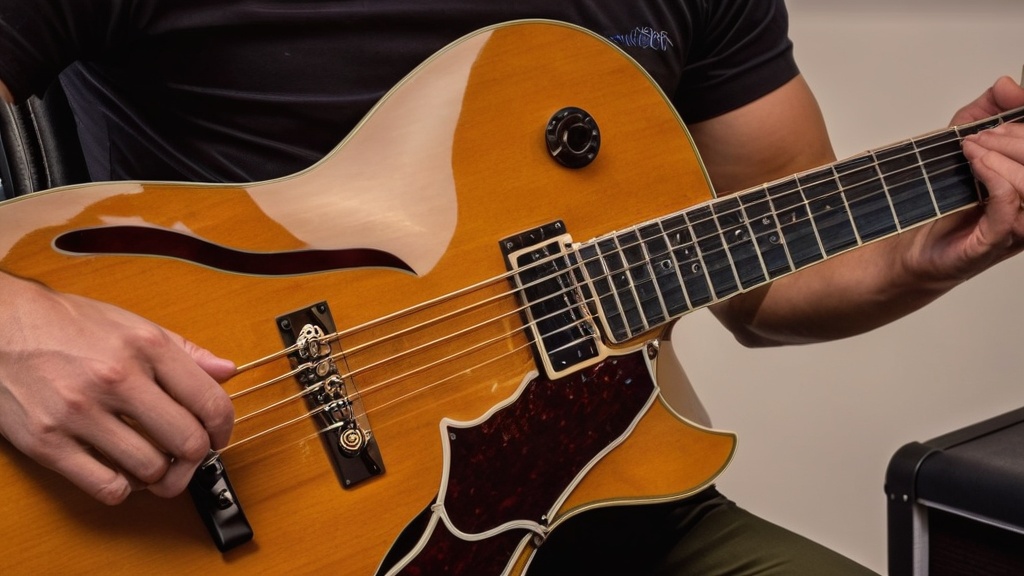
Start with basic chords you already know, such as C, G, D, A and Em. Form the chord and play the notes one by one, from the lowest to the highest string. This way you learn the notes of each chord and improve your fingering and coordination. If you play with your fingers, use the fixed assignment from fingerpicking for acoustic guitar: your thumb for the bass strings, your index finger for the G string, your middle finger for the B string and your ring finger for the high E string.
Exercise 1: Em on the open strings
Form Em (022000) and play strings 6, 4, 3, 2 and 1 one after another, and then back down via 2, 3 and 4. You hear the notes E, G and B each time. Because your left hand stays in place, you can focus entirely on an even attack.
Exercise 2: C and Am with the same pattern
Form C (x32010) and play strings 5, 3, 2, 1, 2, 3. Then do the same with Am (x02210). Both chords have their root on the A string, so your right hand plays exactly the same pattern; only your left hand changes. Count in groups of six, so that every note rings for the same length.
Exercise 3: arpeggios with chord changes
Play the pattern from exercise 2 over the sequence Em, C, G and D. For G (320003) you start on string 6, for D (xx0232) on string 4: your thumb or pick looks for the root of the chord each time. Only change once the last note of the previous chord has sounded. If you want to know which combinations sound good, read which guitar chords go together.
Exercise 4: an arpeggio up the neck
Once you are further along, play an arpeggio without open strings. The A minor arpeggio from the 5th fret goes like this: string 6 fret 5 (A) and fret 8 (C), string 5 fret 7 (E), string 4 fret 7 (A), string 3 fret 5 (C), string 2 fret 5 (E) and string 1 fret 5 (A). Play each note separately and don’t let it ring into the next. If you slide this shape up the neck, you play the arpeggio of other minor chords.
Once this goes smoothly, add variety: change the order of the notes, try other rhythms or add hammer-ons and pull-offs. Be patient and practice regularly, and you will grow naturally into more complex patterns.
Techniques for practicing arpeggios
Practice with a metronome: it improves your timing and rhythm. Start at a low tempo and only raise it once you play the notes and their order without thinking. In this explanation of playing guitar with a metronome you can read how to build that up step by step.
Vary your attack too. Alternate between your thumb and fingers, or use different picking techniques with a pick, such as alternate picking. For fast arpeggios with a pick there is sweep picking, where you move across the strings in one fluid motion. Also practice arpeggios in different positions on the neck, so that you get to know the whole fretboard.
Speed and precision
The tempo determines how fluid an arpeggio sounds, but speed without precision sounds sloppy. Every note must be clear and distinct. So first play slowly and correctly with the metronome, and then raise the tempo in small steps. Slow and accurate beats fast and sloppy; as your technique improves, the speed comes naturally.
Why scales matter when learning arpeggios
Scales and arpeggios are closely related: the notes of a chord come from a scale. By practicing scales you develop your fingering and coordination and you see how chords and arpeggios are built. That helps you recognize and play arpeggios faster.
Scales are also a good foundation for improvisation. If you know the notes of a scale, you can pick arpeggios from it that fit the music you are playing. Combining scales and arpeggios creates new musical ideas and helps you develop your own style.
Arpeggios in different musical styles
In classical music, arpeggios often accompany a melody or form the foundation of a piece; think of compositions by Bach and Beethoven. If you want to get started with that, take a look at the classical guitar pieces for beginners.
In rock, guitarists use arpeggios for intros, riffs and solos. Jimmy Page and Eric Clapton are well-known examples of guitarists who add emotion and dynamics with them. In jazz you use arpeggios mainly when improvising: you play the notes of the chord that is sounding at that moment. It helps if you know jazz chords for that.
Working arpeggios into your own playing
Start with simple arpeggios in songs you already play. For example, play the verse with arpeggios and the chorus with strumming; that gives the song more dynamics. You can also use an arpeggio as accompaniment under a vocal line or solo.
Combine arpeggios with other techniques, such as strumming or fingerpicking. This creates interesting rhythmic patterns and makes your playing more versatile. Try different combinations and discover what suits your style.
Well-known songs with arpeggios
- Blackbird (The Beatles): Paul McCartney plays a fingerpicking part in which the notes of the chords sound separately.
- Tears in Heaven (Eric Clapton): the broken chords carry the fragile mood of the song.
- Nothing Else Matters (Metallica): the intro is an arpeggio over the open strings of Em.
- Stairway to Heaven (Led Zeppelin): Jimmy Page opens with an arpeggio in A minor.
Listen to these songs and play along, and you will hear how arpeggios add emotion and depth to a song.
Common mistakes and how to fix them
- No fixed fingering. Use the right finger for every note. That helps with accuracy and later with speed. Learn the fingering well before you play faster.
- Too little attention to timing. Many guitarists only watch for the right notes. Practice with a metronome or play with other musicians, so that you stay in the rhythm.
- Hands that don’t work together. Play slower until both hands move in sync. A metronome gives you a constant beat to practice with.
- Notes that don’t ring clearly. Unwanted muting can usually be fixed with better finger placement and attack. Press the strings down firmly, place your fingertips right behind the fret and keep your fingers close to the strings.
Musicality and expression
An arpeggio is more than notes in the right order. Play with dynamics: louder or softer, depending on the song. Experiment with articulations such as slides, hammer-ons and pull-offs, or with tapping. Musicality comes from your own interpretation, so dare to express yourself. Then your arpeggios sound not only technically correct, but also move your audience. How to make tapped notes ring clearly is covered in our explanation of tapping on electric guitar. How to tap arpeggios with your picking hand and build a complete solo from them is covered in the explanation of tapping solos.
Regular practice and patience
Short daily sessions work better than an occasional long session in which you overwhelm yourself or lose focus. By practicing regularly you build muscle memory and confidence. Make a practice routine with both technique and creativity; an effective practice schedule helps you with that.
Set concrete goals, such as learning a new arpeggio pattern or raising your tempo. That keeps you motivated and focused. If something doesn’t work right away, give yourself time: every guitarist has stood at the same point. With patience and perseverance, arpeggios become a natural part of your playing.
Frequently asked questions about playing arpeggios on guitar
What are arpeggios on guitar?
Arpeggios are chords whose notes you play one after another instead of together. That gives a flowing, melodic sound.
Why is it important to learn arpeggios?
They let you play chords more melodically and add variety in almost every musical style. They also improve your fingering, your coordination and your understanding of chord structures and scales.
How do you learn to play arpeggios on guitar?
Start with simple chords and play the notes one by one, slowly and with a metronome. Then practice set patterns, chord changes and arpeggio shapes in different places on the neck.
Are simple arpeggio exercises suitable for beginners?
Yes. They build the basic skills you need and are a good stepping stone to more complex exercises. Good exercises focus on fingering, coordination between the left and right hand, and building speed and precision.
Which chords are often used in simple arpeggio exercises?
Usually the basic chords, such as C, G, D, A, E and Em. They are easy to form and make a good foundation for beginners.
Which techniques are useful when playing arpeggios?
Fingerpicking, using a pick and good fingering. You can also use hammer-ons, pull-offs and tapping to enrich your arpeggios.
How often should I do arpeggio exercises?
Practice regularly, for example daily or several times a week. Consistency pays off more than an occasional long session.
Do you play arpeggios better with your fingers or a pick?
Both work. With your fingers it is easier to let notes ring and to skip strings, which works well on acoustic guitar. With a pick the notes sound tighter and you can play faster, which you often hear in rock and metal.
What is the difference between an arpeggio and a scale?
A scale plays all the notes of a key in order, for example the seven notes of C major. An arpeggio uses only the notes of one chord, such as C, E and G for C major. That is why an arpeggio always sounds like the chord underneath it.






Leave a Reply