
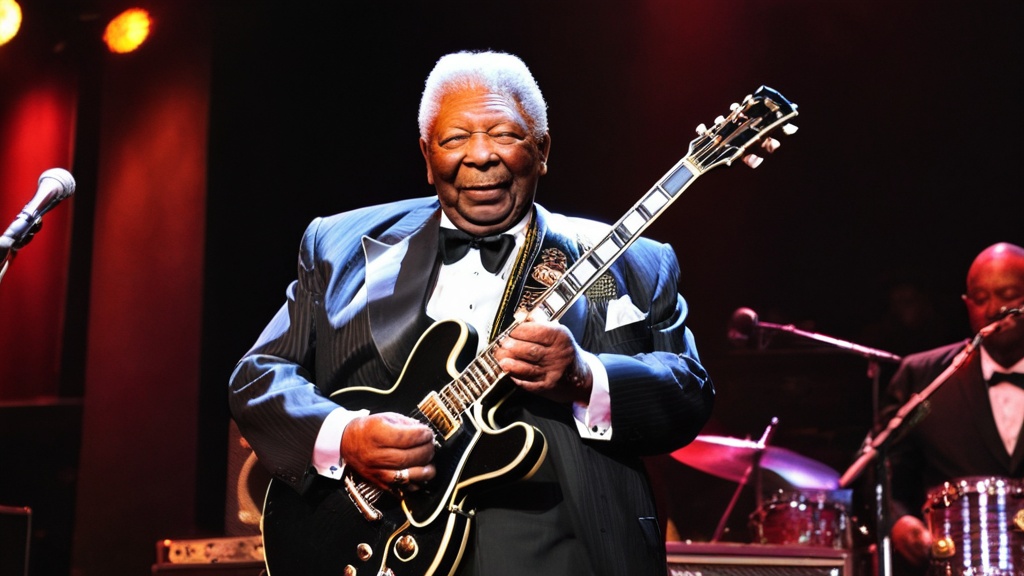

Learning to play in the style of B.B. King is not about speed, but about few notes with a lot of feeling. His trademarks are a fast vibrato from the wrist, bends that land exactly in tune, short phrases from the pentatonic scale around one fixed spot on the neck, and plenty of space between the notes. Below you can read, part by part, how to practice that, which songs you can learn and how to get close to his warm sound.
Who Was B.B. King?
B.B. King, often called the king of the blues, had an enormous influence on the world of music. He was born in Mississippi in 1925 and grew up at a time when the blues was developing into an important music genre. His style is a blend of traditional blues, gospel, jazz and R&B.
King told stories with his guitar: every note and every bend called up a feeling or a memory. He inspired countless artists, from rock and pop musicians to jazz and soul singers, and showed that the blues is not just an outlet for sorrow but can also express hope and joy. Guitarists like Eric Clapton name him as one of their great examples.
Summary
- B.B. King’s style is rooted in the blues from Mississippi and influenced by gospel, jazz and R&B.
- He mostly played single notes rather than chords, with long, singing tones.
- His vibrato and his in-tune bends are the most important guitar techniques to practice.
- He used simple chord progressions and the pentatonic scale, often mixed with major notes.
- Call-and-response between his voice and his guitar Lucille is typical of his music.
- Timing, rhythm and the silences between phrases are just as important as the notes themselves.
- You get close to his sound with a semi-hollow guitar with humbuckers and a warm, almost clean amp tone.
- Use his techniques as a foundation, but also develop your own voice.
The Distinctive Style of B.B. King
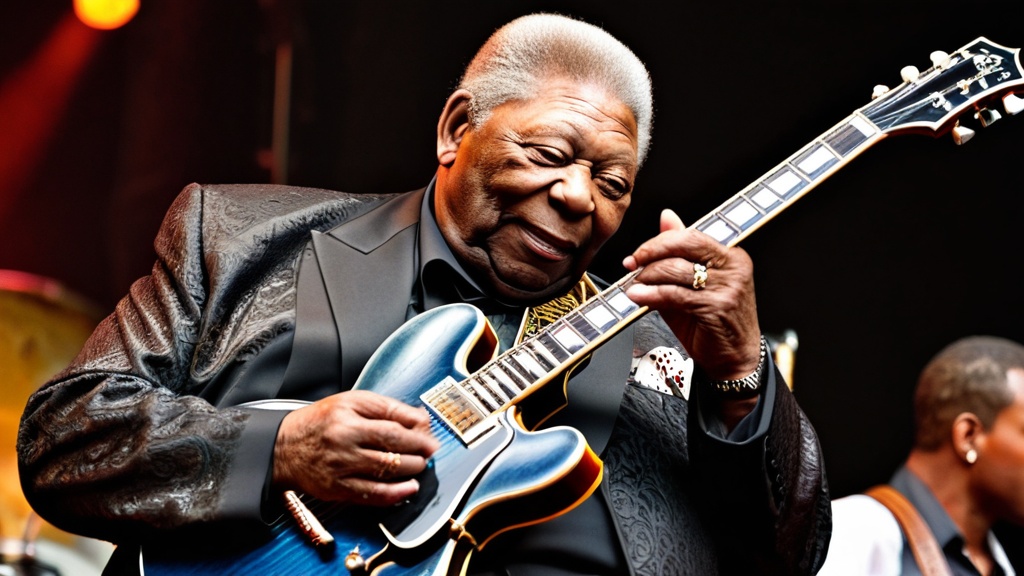
B.B. King’s guitar playing is instantly recognizable. He mostly played melodies made of single notes, often long, drawn-out tones with a deep emotional effect, while many other blues guitarists used more chords and riffs. He played with a pick and varied his attack a lot: soft for restrained phrases, hard for the exclamations. That gave him a lot of control over the dynamics of his playing.
Another trademark is call-and-response. King sang a line and then answered it with a phrase on his guitar, as if he were having a conversation with his instrument. He called that guitar Lucille: he named his guitars after a woman two men fought over in 1949 in a dance hall in Twist, Arkansas. A fire broke out during the fight, and King ran back inside to save his guitar. Lucille became a symbol of his musical identity: powerful, but also subtle.
Vibrato and Bends Like B.B. King
His vibrato is perhaps the most recognizable part of his playing. King often held the string with one finger and let the fast, even shake come from his wrist, while his other fingers moved freely away from the neck. That vibrato was not a decoration added afterward, but a way to make a note sing and strengthen his message. You can find focused exercises in improving your vibrato technique.
- Start slowly. First let a note shake calmly and in control, and only then increase the speed.
- Bend exactly in tune. First play the target note, for example two frets higher, and then bend the lower note until it sounds exactly the same.
- Build up. Start with half steps and then move on to whole steps.
- Combine. Add a vibrato to a bent note at the end, without the pitch sagging.
With bends, King built tension and gave his melodies depth. You can read how to learn to play bends and slides in tune in learning slides and bends on electric guitar.
Scales, Chords and the B.B. King Box
The foundation of his solos is the pentatonic scale, supplemented by the blues scale and notes from the major scale. King used those notes not only for solos, but also for melodies that are easy on the ear. You can read how to drill the pentatonic and blues scales yourself in practicing scales on guitar.
Many guitarists talk about the B.B. King box (the “BB box”): a small area around the root note on the B string where he played many of his phrases. In the key of A, that root note is on the 10th fret of the B string. The notes around it, such as the B on the 12th fret of the B string and the D and E on the 10th and 12th frets of the high E string, make up his favorite playing field.
Underneath his solos there were usually simple blues chords, which he gave his own twist with variations and inversions. That kept his music accessible and yet rich in texture.
Learning to Improvise Like B.B. King
B.B. King was a master of improvisation. Start by listening: analyze how he builds a solo, how he creates tension with notes that rub and how he resolves it with clear, strong tones. Then play short phrases yourself over a blues progression and deliberately leave space open, just like he did between his vocal lines.
Besides the pentatonic scale, also experiment with the blues scale and the major scale, and use slides, hammer-ons and pull-offs for more variety. You can find a step-by-step plan in learning blues improvisation on guitar.
Timing, Rhythm and Space
B.B. King had a remarkable sense of timing. He played with the groove without ever losing sight of it, and with syncopation he gave his phrases a rhythmic charge. At least as important were the silences: he never played more notes than necessary.
Practice with a metronome or drum track and deliberately try to start your phrases at different places in the measure. Also alternate with freer playing, so your timing keeps sounding natural.
Emotion and Expression in B.B. King’s Playing
Emotion is the core of B.B. King’s music. For him, music was not about technical skill, but about conveying feelings. When you listen to his songs, you hear pain, joy and everything in between.
If you want to bring that depth into your own playing, dig into the lyrics and themes of his songs. What do they mean to you, and how do you translate that to your guitar? Dare to play vulnerably and let your own experiences inspire you. That way your playing sounds more authentic.
B.B. King Songs to Learn
B.B. King’s repertoire ranges from hard-driving blues to soulful ballads. Songs like “The Thrill Is Gone” and “Lucille” are ideal for studying his style. Look up tablature or sheet music, build the song up slowly and pay attention not only to the notes, but also to how he emphasizes certain notes and plays with dynamics.
If you haven’t mastered the basic chords yet, start with a chord that comes up a lot in the blues. A good starting point is the E major chord for beginners, with step-by-step instructions.
The B.B. King Sound: Guitar and Amp
B.B. King mostly played a Gibson ES-355 and later the Lucille model based on it. That is a semi-hollow guitar with humbuckers, known for its warm tone and long sustain. You can read what makes that type so suited to the blues in this article about semi-hollow guitars. If you don’t have a semi-hollow guitar, at least choose a guitar with humbuckers.
Your amp is just as important. A tube amp or a good simulation of one gives a rich, full sound. Look for a warm, almost clean tone with at most a little overdrive, and experiment with bass, mids and treble until it suits your playing style. A touch of reverb or delay gives your sound depth. You can read how the knobs on your amp work in how a guitar amp works.
Developing Your Own Style With B.B. King as an Example
B.B. King is a great example, but the goal is ultimately your own musical identity. Study his techniques and add elements that suit you. Explore other genres, write your own songs or improvise over existing songs with his techniques as a foundation.
Playing with others helps too: in a band or jam session you get new ideas and learn to react to other musicians, just as King did with his band. Keep experimenting and let your personality come through in everything you play.
Frequently asked questions about playing in the style of B.B. King
What is B.B. King’s style?
B.B. King’s style is characterized by his unique way of playing the guitar, using bent notes, vibrato and the pentatonic scale. His playing style is often associated with blues music.
What are the characteristics of B.B. King’s playing style?
B.B. King is known for his soulful and expressive way of playing, putting emotion and feeling into his notes. He makes a lot of use of the bending technique, bending the guitar strings to create a characteristic sound.
How can I learn to play in the style of B.B. King?
Study his music and listen closely to his playing style. It can also be useful to take lessons from an experienced guitar teacher who knows the blues and B.B. King’s playing style. You can read how such one-on-one lessons work and what they cost in private guitar lessons from a professional.
Which guitar techniques are important when playing in the style of B.B. King?
Work on bent notes, vibrato, the pentatonic scale and putting emotion and feeling into your playing. Also pay attention to the timing and dynamics of your playing.
Are there specific guitar licks that are typical of B.B. King’s style?
Yes. Many of his licks sit in the so-called B.B. King box or “BB box”, a small area around the root note on the B string. There he combined bends, vibrato and notes from the pentatonic scale. Practicing phrases in that box helps you get his style under your fingers.
Did B.B. King play with a pick?
Yes. B.B. King played his solos with a pick. He got his expression mainly from his left hand, with vibrato and bends, and from the way he picked softer or harder.
Which guitar do you need for B.B. King’s sound?
A semi-hollow guitar with humbuckers, such as an ES-335 or ES-355, comes closest. But with another guitar with humbuckers, the neck pickup and a clean amp with a touch of overdrive, you can already get close to his tone.




Leave a Reply