
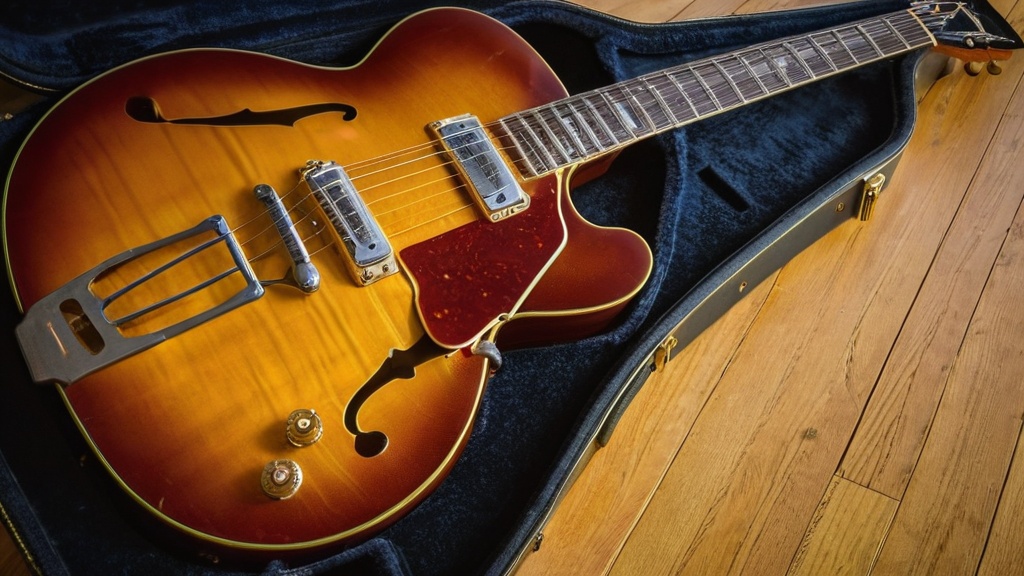

The easiest way to practice the blues scale as a beginner is in A, in first position around the 5th fret. It is the minor pentatonic scale with one extra note, the blue note, which gives it that typical raw sound. Learn the pattern slowly with a metronome first, then play short phrases over a 12-bar blues.
What Is the Blues Scale?
The blues scale is an essential part of the style of music we know as blues. This scale is a variation on the pentatonic scale and adds one extra note, the so-called “blue note.” This gives the music its characteristic, emotional sound.
When you play the blues scale on guitar, you discover a lot of room for expression and creativity. It is not only a technical exercise, but also a way to express your feelings and experiences through music. To understand the blues scale, it is important to know that it usually consists of six notes.
The structure is: root (1), minor third (b3), fourth (4), diminished fifth (b5), perfect fifth (5) and minor seventh (b7). That diminished fifth is the blue note. This creates the unique “bluesy” sound that is so recognizable in many songs. By mastering this scale, you gain the ability to improvise solos and tell your own musical stories.
Summary
- The A blues scale consists of the notes A, C, D, Eb, E and G
- The basics of the blues scale include the use of blue notes and playing in a specific pattern on the guitar neck
- Practice is crucial for beginners to master the blues scale and play it fluently
- Tips for practicing the blues scale include using a metronome, learning different variations and playing with backing tracks
- Common mistakes when practicing the blues scale are ignoring the right fingering, not listening to the rhythm and skipping tone and expression
- The importance of rhythm when practicing the blues scale cannot be overstated, since it forms the basis for a good performance
- Tone and expression are essential when practicing the blues scale, because they convey the emotion and character of the music
- Integrating the blues scale into your playing style takes creativity and the ability to use the scale in a unique and personal way
The Basics of the Blues Scale
To use the blues scale effectively, you first need to understand the basics. The most common blues scale is the A blues scale, which consists of the notes A, C, D, D# (or Eb), E and G. Together these notes form a structure that lets you create different melodies and riffs.
It is crucial to get to know these notes well and understand how they relate to each other. Another important aspect of the blues scale is the use of bent notes. These are notes that you bend slightly up or down to create an expressive sound.
Bending notes is a technique that is common in blues music and can give your playing an extra dimension. By combining these techniques with the right timing and rhythm, you can develop an authentic blues sound that will move your audience.
The A Blues Scale on the Guitar Neck
The easiest place to start is first position (box 1) around the 5th fret. Your index finger sits on fret 5, your middle finger on fret 6, your ring finger on fret 7 and your pinky on fret 8. From low to high you play:
- Low E string: fret 5 (A) and 8 (C)
- A string: fret 5 (D), 6 (Eb) and 7 (E)
- D string: fret 5 (G) and 7 (A)
- G string: fret 5 (C), 7 (D) and 8 (Eb)
- B string: fret 5 (E) and 8 (G)
- High e string: fret 5 (A) and 8 (C)
The blue note (Eb) is on the A string and the G string. If you leave that note out, you are left with the A minor pentatonic scale. You can also shift the pattern: if you start on fret 3 of the low E string, you play the G blues scale.
A Simple Practice Routine
- Play the scale up and down with a metronome at 60 bpm, one note per beat.
- If that goes without mistakes, play two notes per beat (eighth notes) at the same tempo.
- Only raise the tempo by 5 bpm once you play it three times in a row without mistakes.
- Then play short phrases of three or four notes over a 12-bar blues in A, for example with backing tracks.
The basic form of a 12-bar blues in A is: four bars of A7, two bars of D7, two bars of A7, and then E7, D7, A7 and E7 (one bar each). If you want to go further with solos, read how to learn blues improvisation on guitar. A step-by-step plan for making your first solo over a progression like this is in learning to improvise on guitar.
The Importance of Practice for Beginners
Practice is a fundamental part of learning to play guitar, especially when you are just starting out. For beginners it can sometimes be discouraging to master the blues scale, but consistency is the key to success. By practicing regularly, you develop not only your technical skills, but also your musical ear and creativity.
It is important to be patient with yourself and take small steps in your learning process. A good way to start practicing is to play the blues scale slowly and carefully. Focus on placing your fingers correctly and producing clear notes.
As you become more familiar with the scale, you can gradually increase the speed. Don’t forget that it is not only about speed; it is about playing every note with feeling. This will eventually lead to a more expressive playing style.
Tips for Practicing the Blues Scale on Guitar
When you start practicing the blues scale, there are several tips that can help you learn more effectively. First, it helps to use a metronome. This helps you improve your timing and rhythm, which is crucial in blues music.
Start at a slow speed and increase it gradually as you gain confidence in your playing. Recording yourself while you practice can also be valuable. By listening to yourself, you get insight into where you can improve.
You can also experiment with different techniques, such as slides and hammer-ons, to add variety to your playing. Also try playing along with backing tracks or other musicians; this will help you listen better and work together in a musical context.
Common Mistakes When Practicing the Blues Scale
When learning the blues scale, many beginners make a few common mistakes. One of them is ignoring the right fingering. It is essential to learn good fingering from the start, because it will help you play faster and more accurately.
Bad habits can be hard to break, so make sure you pay attention to how you place your fingers. Another mistake that often happens is not listening closely to the sound of each note. It is important to make sure every note sounds clear and distinct.
If you notice that some notes sound dull or unwanted, take a moment to work on your technique before moving on. By avoiding these mistakes, you lay a solid foundation for your further development as a guitarist. Once you know the blues scale well, these scale exercises for improvisation will take you further.
The Importance of Rhythm When Practicing the Blues Scale

Rhythm plays a crucial role in blues music and is something many beginners do not pay enough attention to. A good sense of rhythm helps not only when playing chords, but also when improvising solos. When you practice the blues scale, try different rhythmic patterns to challenge yourself and add more variety to your playing.
An effective way to build rhythm into your practice sessions is to use percussive techniques or to play along with a drummer or backing track. This will help you stay in sync with other musicians and will also contribute to a more dynamic performance of your music. Remember that rhythm is just as important as melody; together they form the basis of every good musical performance.
The Importance of Tone and Expression When Practicing the Blues Scale

Tone and expression are two elements that beginners often overlook, but they are essential for playing blues music. The way you approach each note can have an enormous impact on how emotional and powerful your music sounds. Try different techniques, such as vibrato or bending, to add more character to your playing.
Developing a personal style takes time and patience, but by being deliberate about your tone while practicing, you can set yourself apart as a musician. Listen to different blues artists and pay attention to how they shape their tones and convey their emotions through their playing. This can be inspiring and can help you develop new ideas for your own music.
Integrating the Blues Scale into Your Playing Style
Once you have become comfortable with the blues scale and have practiced it, it is time to integrate it into your own playing style. This can mean you start writing your own songs or that you adapt existing songs by adding elements of the blues. Experiment with different styles and techniques to create a unique sound that suits you.
Integrating the blues scale into your music can also mean collaborating with other musicians or taking part in jam sessions. This offers not only chances to learn new things, but also to challenge yourself and grow further as a guitarist. Remember that making music should above all be fun; let yourself go and enjoy the process!
If you are just starting to practice blues scales on guitar, it can be useful to know that there are various techniques that can help you improve your playing, even if you have thick fingers. A related article you may find interesting is Playing Guitar with Thick Fingers: Tips and Tricks. This article offers valuable insights and practical tips to improve your guitar playing, regardless of the size of your fingers. It can be a great addition to your learning process as you master the blues scales.
Frequently asked questions about the blues scale on guitar
What is a blues scale on guitar?
A blues scale on guitar is a series of notes used in blues music. It is a specific series of notes that creates a bluesy, characteristic sound.
How do you practice the blues scale on guitar as a beginner?
As a beginner, you can practice the blues scale on guitar by starting with learning the notes in the scale and then practicing playing the scale in different positions on the guitar neck.
Which guitar techniques are useful when practicing the blues scale?
When practicing the blues scale on guitar, techniques such as bending, vibrato, sliding and hammer-ons and pull-offs can be useful for creating the bluesy sound.
What are common mistakes when practicing the blues scale on guitar?
Common mistakes when practicing the blues scale on guitar are not learning the notes in the scale well, not using the right techniques and not practicing the scale regularly.
Which songs can I play with the blues scale on guitar?
With the blues scale on guitar you can play songs in the blues genre, such as “Sweet Home Chicago” and “The Thrill Is Gone.” These songs make extensive use of the blues scale and are therefore good to practice as a beginner. If you also want to learn the vibrato and playing style of BB King himself, see learning to play in the style of BB King.
What is the difference between the blues scale and the pentatonic scale?
The minor pentatonic scale has five notes: 1, b3, 4, 5 and b7. The blues scale adds the diminished fifth (b5) to that, the blue note. In A, that is the Eb.
Can you also practice the blues scale on an acoustic guitar?
Yes, the pattern and the notes are the same on every guitar. On an electric guitar with light strings, bends are easier, so on an acoustic guitar you bend the notes a little less far. How string gauge and string tension determine how easy a guitar is to play, you read in electric or acoustic guitar: which is easier to play?.





Leave a Reply