


Short answer: A Les Paul is a solid-body electric guitar from Gibson, named after the guitarist and inventor Les Paul. The first model came out in 1952, and it has had humbuckers since 1957. The mahogany body with an arched maple top, the glued-in neck and two humbuckers give the Les Paul its warm, full tone with long sustain.
The Les Paul is one of the best-known guitars in music history. You hear it in rock, blues, jazz and metal, and it is popular with professional musicians and hobbyists alike. Below you read how the guitar came about, which models exist and what to look for if you want to buy one. If you are just starting out on electric guitar, also read the guide to learning to play electric guitar.
What is a Les Paul?
A Les Paul is an electric guitar with a solid body that Gibson has made since 1952. The guitar is named after Les Paul, the American guitarist who helped think through the design. You recognize a Les Paul by its single cutaway and thick, arched body. These are the standard features:
| Feature | On a Les Paul | What you notice |
|---|---|---|
| Body | Solid mahogany body | Warm tone and long sustain, but also a fairly heavy guitar |
| Top | Arched maple top (carved top) | A bit more brightness in the attack, plus the well-known shape and wood grain |
| Neck | Glued-in mahogany neck (set neck) | A fixed connection to the body: you can’t unscrew the neck |
| Pickups | Two humbuckers (since 1957, P-90s before that) | A full, powerful sound with little hum |
| Scale length | Short: 24.75 inches (about 62.9 cm) | Slightly lower string tension, which makes bends easier |
| Bridge | Tune-o-matic with stopbar tailpiece | Stable tuning, no tremolo |
Besides the Gibson models, there are Les Pauls from Epiphone. That brand has been a subsidiary of Gibson since 1957 and makes official Les Pauls in a lower price range.
Who was Les Paul?
Les Paul was born Lester William Polsfuss on June 9, 1915, in Waukesha, Wisconsin. He started playing guitar at a young age. In the 1930s and 1940s he played in various bands and developed a style of his own, with influences from jazz, country and blues.
Les Paul loved experimenting with sound. Around 1941 he built “The Log” at the Epiphone factory in New York: a solid pine beam with a neck and pickups, to which he attached the two halves of a hollow Epiphone body for looks. It was one of the first solid-body electric guitars. The idea: a solid body vibrates less along with the string, so the note rings longer and feedback is less likely.
He was a pioneer in the studio too. Les Paul was one of the first to use overdubs and multitrack recording. With his wife Mary Ford he scored a number 1 hit in 1951 with “How High the Moon,” on which he recorded his guitar parts over each other many times. What he did then with tape recorders, you now do with recording software on your computer. Les Paul died on August 12, 2009.
The development of the Les Paul guitar

Gibson wasn’t interested in The Log at first. That changed when Fender had success around 1950 with a solid-body electric guitar, the later Telecaster. Gibson president Ted McCarty had a solid-body of its own developed and asked Les Paul to attach his name to the guitar. Les Paul helped think through things like the gold finish and the tailpiece.
In 1952 the Gibson Les Paul Model came on the market, later called the “Goldtop” because of its gold top. The guitar had a mahogany body with an arched maple top, a single cutaway and two P-90 pickups. The design stood out for its elegant lines and luxurious finish, and it was an important step in the evolution of the electric guitar.
Timeline: the most important Les Paul models
| Year | What happened |
|---|---|
| Around 1941 | Les Paul builds “The Log,” his own solid-body prototype |
| 1952 | Gibson releases the Les Paul Model (Goldtop) with two P-90 pickups |
| 1954 | The Les Paul Custom (black, gold hardware, ebony fingerboard) and the simple Les Paul Junior appear; the Tune-o-matic bridge is introduced |
| 1957 | Humbucker pickups (the “PAF,” designed by Seth Lover) replace the P-90s |
| 1958-1960 | The Les Paul Standard with a sunburst finish, now the most sought-after vintage Les Paul |
| 1961 | Gibson replaces the Les Paul with a new design, the later SG |
| 1968 | Thanks to demand from blues and rock guitarists, the Les Paul returns |
| 1969 | The Les Paul Deluxe with mini-humbuckers appears |
The Les Paul in the 1950s and 1960s
In the 1950s the Les Paul sold well, but toward the end of the decade sales fell. Gibson therefore stopped making the original design in 1961 and replaced it with a thinner guitar with two sharp cutaways. That guitar still carried the Les Paul name until 1963 and has been called the SG ever since.
In the mid-1960s, blues-rock guitarists rediscovered the old Les Pauls. Eric Clapton played a Les Paul Standard through a Marshall amplifier in 1966 on John Mayall’s Bluesbreakers album, the “Beano” album. Mike Bloomfield, Peter Green and later Jimmy Page also made the guitar popular. Demand became so great that Gibson put the Les Paul back into production in 1968. If you want to play in that style yourself, blues improvisation on guitar is a good starting point. What Clapton did with that combination of Les Paul and Marshall, and how his style developed afterward, you can read in Eric Clapton’s guitar style.
The influence of famous guitarists on the Les Paul
Famous guitarists have shaped the image of the Les Paul. Jimmy Page of Led Zeppelin recorded countless well-known songs with a Les Paul, and Joe Perry of Aerosmith, Gary Moore, Billy Gibbons of ZZ Top and Pete Townshend of The Who played one too. Slash of Guns N’ Roses made the Les Paul popular with a new generation in the late 1980s. If you want to learn his riffs, read how to learn to play guitar like Slash.
These guitarists not only developed their own style with the Les Paul, they also introduced new techniques and sounds that inspired other musicians.
Contemporary guitarists such as Joe Bonamassa also regularly use Les Pauls on stage and in the studio. Thanks to its versatility, the Les Paul is loved not only by rock guitarists but also by jazz and blues musicians.
The Les Paul in the 1970s, 1980s and 1990s

In the 1970s Gibson released more variants, such as the Les Paul Deluxe with mini-humbuckers. Later came signature models that Gibson designed together with artists, for example for Jimmy Page and Slash. Those models added diversity to the lineup and inspired new generations of guitarists to develop their own sound.
In the late 1980s the Les Paul got a new boost in hard rock and heavy metal. Slash became the face of the guitar, and Zakk Wylde played a Les Paul Custom with his well-known “bullseye” design in Ozzy Osbourne’s band. Kirk Hammett of Metallica now plays “Greeny,” a 1959 Les Paul that used to belong to Peter Green and Gary Moore; you can read more about Metallica’s electric guitars in a separate article.
In the same period, appreciation for vintage guitars grew, which made old models popular again. Gibson responded by offering both traditional and modern versions, so old and new fans could choose what suits them.
Features and sound of a Les Paul

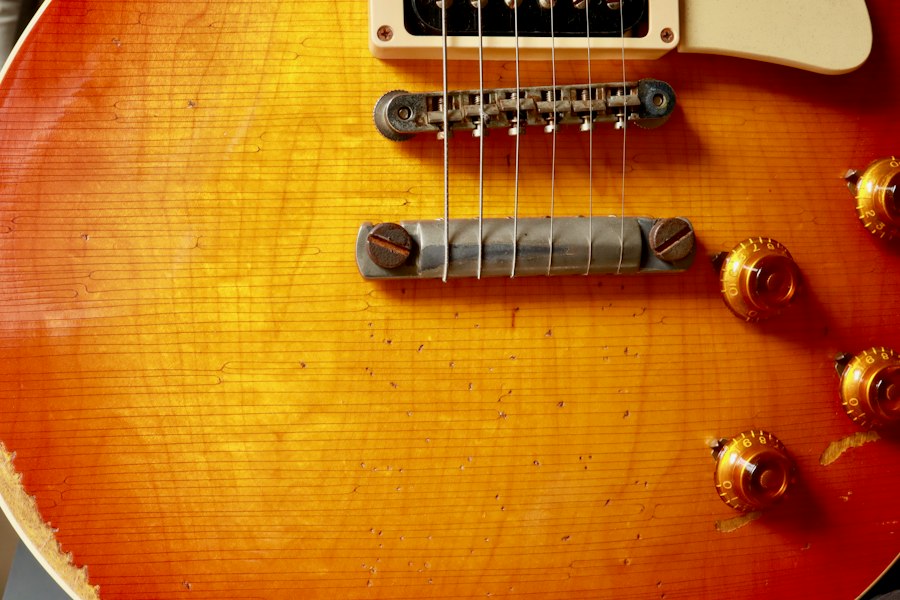
Les Paul guitars are recognizable by their single cutaway and solid body. Most models have a mahogany body with a maple top, a glued-in mahogany neck (set neck) and a fingerboard of rosewood or, on the Custom, ebony. That construction produces a warm, full tone with plenty of sustain.
- Scale length: 24.75 inches (about 62.9 cm), shorter than the 25.5 inches of a Stratocaster. String tension is therefore slightly lower, which makes bends easier.
- Pickups: usually two humbuckers. They cancel hum and give a powerful output.
- Bridge and tailpiece: a Tune-o-matic bridge with a stopbar tailpiece.
- Weight: because of the solid body, a Les Paul is relatively heavy. That is why Gibson drills chambers or holes into the body on many models to save weight.

Thanks to the humbuckers, a Les Paul sounds full and round both clean and with distortion. That makes it suitable for rock, blues and jazz, where rich chords and powerful solos take center stage. How to get that sound out of your amp is explained in how a guitar amplifier works.
Les Paul or Stratocaster: the differences
A Les Paul is often compared with the Fender Stratocaster, the other classic from the 1950s. The Les Paul sounds fuller and warmer, the Stratocaster brighter and tighter.
| Gibson Les Paul | Fender Stratocaster | |
|---|---|---|
| Since | 1952 | 1954 |
| Body | Single cutaway, mahogany with arched maple top | Double cutaway, contoured body |
| Neck | Glued in (set neck) | Bolted on (bolt-on) |
| Scale length | 24.75 inches (about 62.9 cm) | 25.5 inches (about 64.8 cm) |
| Pickups | Usually two humbuckers | Three single-coils |
| Bridge | Tune-o-matic with stopbar tailpiece | Tremolo |
| Sound | Full, warm, lots of sustain | Bright, tight, versatile |
The different models of Les Paul guitars
| Model | Features | Price range |
|---|---|---|
| Les Paul Standard | Maple top, mahogany body, humbuckers, binding and luxurious finish | High |
| Les Paul Custom | Ebony fingerboard, gold hardware, elaborate inlays, humbuckers | Highest |
| Les Paul Studio | No binding, simpler finish, humbuckers | More affordable within Gibson |
| Epiphone Les Paul | Affordable versions from Gibson’s own subsidiary brand | Low to mid |
The best-known models are the Les Paul Standard, Custom and Studio. The Standard is the classic model with a rich tone, often with a glossy finish and visible wood grain. The Custom is designed with extra luxury: gold hardware, elaborate inlays and an ebony fingerboard, which also gives a slightly different sound. The Studio is aimed more at function and offers the typical Les Paul sound with fewer decorations and at a lower price.
There are also models such as the Traditional, Classic and countless signature versions. Epiphone, which has belonged to Gibson since 1957, makes affordable versions of the Les Paul. Gibson also experimented with new technology, such as self-tuning machine heads.
Prices and collector value
The price of a Les Paul depends on the model, the wood and the finish. An Epiphone is the most affordable, the Gibson Les Paul Studio is among the more affordable Gibson models, and the Les Paul Custom is in the highest price range. If you are looking for a first guitar, also read how much a good beginner guitar costs.
Vintage Les Pauls are highly sought after by collectors. The Standards from 1958 to 1960 in particular fetch astronomical prices at auctions and in specialist stores. Rarity, historical significance and the fact that famous musicians played these guitars drive up the price. For many collectors it isn’t just about the sound, but also about a piece of history and craftsmanship.
Tips for buying a Les Paul guitar
- Set your budget. That way you search specifically for models in your price range, new or secondhand.
- Try several guitars. Every Les Paul has its own feel and sound, even within the same model.
- Pay attention to the weight. A Les Paul hangs heavy on your shoulder. Play it standing up for a while before you decide.
- Choose a neck profile that suits you. A ’50s profile is thick and round, a ’60s profile is slimmer.
- Check secondhand guitars for neck breaks. Because of the angled-back headstock, the neck of a Les Paul breaks relatively easily just below the headstock if it is dropped. A well-repaired break is no disaster, but it is a reason for a lower price.
Maintenance and care of Les Paul guitars
After every playing session, wipe dirt and sweat off the strings and the body so the finish doesn’t get damaged. Give the fingerboard extra cleaning now and then; how that works is explained in cleaning the fingerboard and frets. Ready for a bigger job? Then this explanation of cleaning a guitar without damaging the finish will help.
A special guitar cleaner limits scratches and keeps the shine of the lacquer.
Replace your strings regularly for a fresh sound; these tips for replacing guitar strings make it quick. Also check that all the hardware is tight, and have your guitar set up by a professional from time to time. How often that is needed is explained in how often you should have a guitar set up.
The future of the Les Paul guitar
More than seventy years after the first Goldtop, the Les Paul is still one of the most popular electric guitars. Gibson keeps making both historic reissues and modern variants, and new artists keep joining the guitar’s legacy. Whether you choose a traditional model or a modern variant, the appeal of the Les Paul lasts.
If you also want to use a Les Paul for jazz, the article The Magic of Jazz Guitar Music might be for you. It goes deeper into the style and techniques involved in playing jazz on guitar.
Frequently asked questions about Les Paul guitars
What is a Les Paul guitar?
A Les Paul is a solid-body electric guitar from Gibson, named after the guitarist Les Paul. It is known for its single cutaway, two humbucker pickups and thick, warm tone with lots of sustain.
Who designed the Les Paul guitar?
Gibson developed the guitar under the leadership of Ted McCarty and asked the guitarist and inventor Les Paul to attach his name to it and to help think it through. The first model came out in 1952. Les Paul himself had already built a solid-body of his own around 1941: “The Log.”
What are the features of a Les Paul guitar?
A Les Paul has a single cutaway for access to the high frets, a solid mahogany body with a maple top, a glued-in neck, two humbuckers, a Tune-o-matic bridge with stopbar tailpiece and a scale length of 24.75 inches.
Which famous guitarists play a Les Paul guitar?
Among others Jimmy Page, Slash, Eric Clapton, Peter Green, Gary Moore, Pete Townshend, Billy Gibbons, Joe Perry, Zakk Wylde and Joe Bonamassa. It is one of the most influential guitars in the history of rock music.
Which models of Les Paul guitars are there?
Gibson offers the Standard, Custom, Traditional, Studio, Classic and various signature models of famous guitarists, among others. There are also affordable versions under the Epiphone brand.
What is the difference between a Gibson and an Epiphone Les Paul?
Epiphone is a subsidiary of Gibson that makes Les Pauls in a lower price range. The shape and the idea are the same, but the guitars are built elsewhere, with different parts and usually a simpler finish. If you want the Les Paul sound on a limited budget, an Epiphone is a fine choice.
Is a Les Paul suitable for beginners?
Yes, the short scale and slightly lower string tension are comfortable to play, and an Epiphone Les Paul is affordable. Do pay attention to the weight: playing standing up is more tiring with a heavy Les Paul than with a lighter guitar. If you are still unsure, first read which guitar is best for learning to play.
Is Les Paul a person or a guitar?
Both. Les Paul (1915-2009) was an American guitarist and inventor, known for The Log and his recording techniques. The Gibson Les Paul is the guitar that has been named after him since 1952; Les Paul helped think through things like the finish and the tailpiece.
When did the first Les Paul guitar come out?
Gibson released the first Les Paul guitar in 1952: the Les Paul Model with a gold top, later called the Goldtop. It still had two P-90 pickups; humbuckers arrived in 1957.
Why is a Les Paul so heavy?
A Les Paul has a solid mahogany body with a thick, arched maple top on it. That is more wood than on a guitar with a thin, flat body. That is why Gibson drills chambers or holes into the body on many models to save weight. Play it standing up for a while before you buy one.
What music is a Les Paul suited for?
A Les Paul is best known from rock, hard rock, blues and metal, because the humbuckers sound full and powerful with distortion. With a clean sound and the neck pickup you can also play jazz and soul on it. For very bright, twangy funk or country, many guitarists tend to choose a guitar with single-coils.





Leave a Reply