
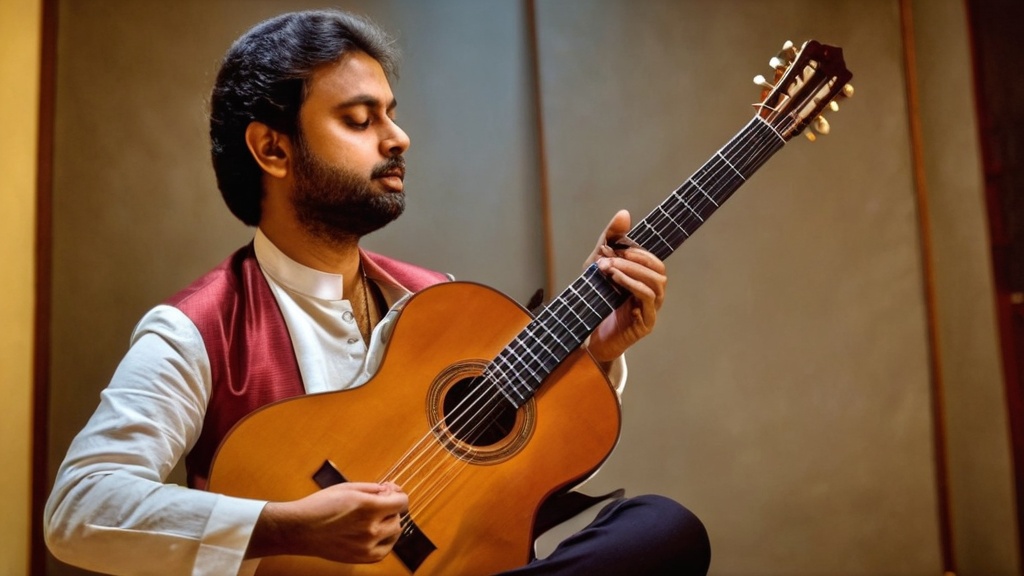

Want to improvise on guitar in the style of an Indian raga? Start with three things: a sustained root note (a drone), a fixed set of notes per raga and plenty of gliding transitions between notes. Pick one raga, for example Bhupali or Yaman, and improvise slowly over the open D string. Below you will find the most important tips for raga guitar improvisation, from the theory to a first exercise.
Indian raga guitar improvisation is a fascinating musical practice with its origins in the rich traditions of Indian music. A raga is not just a melody; it is a complex system of notes and rules that together evoke a particular mood or emotion. When you apply improvisation to a raga, you give yourself the freedom to create within the boundaries of that structure. A very different tradition in which the guitar follows the voice is Portuguese fado; in playing fado on guitar you can read how that accompaniment works.
This makes it a dynamic and lively form of music, in which every performance is unique and reflects the personal expression of the musician. The guitar, although not traditional in Indian music, has adapted and integrated into this rich musical tradition. Thanks to the versatility of the guitar, you can use different sounds and techniques to capture the essence of a raga.
Improvising on guitar within a raga gives you the chance to express your creativity while exploring the depth and complexity of Indian music. This makes it not only a technical exercise but also a spiritual and emotional experience.
Summary
- Indian raga guitar improvisation is a traditional form of musical expression based on centuries-old musical principles and melodies.
- The basis of raga guitar improvisation includes knowledge of specific scales, melodies and rhythms that are characteristic of different ragas.
- It is important to have a thorough understanding of different ragas in order to create authentic and expressive improvisations.
- Techniques for improvising within ragas include the use of ornaments, bends and slides to enrich the melodies.
- Using drone and tala in raga guitar improvisation is essential for creating a solid rhythmic and harmonic foundation for the improvisation.
The basics of raga guitar improvisation
To get started with raga guitar improvisation, it is essential to understand the basic principles of ragas. A raga consists of a specific set of notes, often called ‘swaras’, which together form a melodic structure. These notes are not chosen at random; they are carefully selected to create a particular emotional impact.
It is important to get to know these notes well, so that you can use them as the foundation for your improvisations. There are also various rules and guidelines that determine how you can improvise within a raga. This includes understanding the ‘vadi’ (the most important note) and ‘samvadi’ (the secondary note), as well as the use of ornaments and embellishments that can enrich the melody.
By studying and practicing these elements, you lay a solid foundation for your improvisation skills. It is crucial to master this foundation before moving on to more advanced techniques.
Why knowing ragas matters

Knowledge of ragas is invaluable for every musician who wants to delve into Indian music. Each raga has its own unique character and emotional charge, which means that as a musician you need to understand which raga suits which occasion or mood. This requires not only theoretical knowledge but also a deep listening experience.
By listening to different performances of ragas, you gain insight into how other musicians shape their interpretations. Understanding the context in which a raga is performed also helps you improvise better. Ragas are often linked to specific times of day or seasons, which influences their emotional impact.
By taking this context into account, you can better tune your improvisations to the atmosphere you want to create. This makes your music not only more technical but also more meaningful and authentic.
Techniques for improvising within ragas
There are various techniques you can apply when improvising within ragas on the guitar. One of the most commonly used techniques is playing ‘alankars’, which are ornaments or embellishments added to the basic notes. These embellishments can range from simple vibrations to complex phrasing and add to the expressiveness of your playing.
By experimenting with different alankars, you can develop your own style and enrich your improvisations. Another important technique is the use of ‘meend’, which refers to sliding between notes. This gives your playing a fluid and expressive quality, so you can convey emotions better. On guitar you approach meend with slides and bends.
Combining meend with other techniques such as ‘gamaka’ (embellishments) can lead to unique tonal colors and dynamic performances. It is important to practice these techniques regularly, so that they feel natural during your improvisations. A calm, wide vibrato also helps; you will find tips in improving your vibrato technique.
Three ragas to start with on guitar
You do not need to know all the rules of Indian classical music right away. Put the root note (Sa) on D, so that you can use the open D string as a drone. These three ragas are close to scales you may already know as a guitarist:
- Bhupali: Sa Re Ga Pa Dha, in D that is D-E-F#-A-B. These are the same notes as the major pentatonic scale.
- Yaman: all seven notes with a raised Ma, in D that is D-E-F#-G#-A-B-C#. This resembles the Lydian mode.
- Kafi: lowered Ga and Ni, in D that is D-E-F-G-A-B-C. This resembles the Dorian mode.
A raga is more than a scale: each raga has its own typical phrases and notes that you emphasize. So use the note sequence as a starting point and listen to recordings to hear the characteristic turns. If Western scales are still new to you, start with practicing scales for improvisation.
Basic exercise: drone and gliding notes
Play the notes of Bhupali on a single string, the D string: open (D), 2nd fret (E), 4th fret (F#), 7th fret (A), 9th fret (B) and 12th fret (D). Slide with one finger from note to note instead of picking each note separately, and let the open D keep ringing along. Hold each note and listen to how it sounds against the drone. Only when that feels familiar do you start improvising freely with short phrases.
Using drone and tala in raga guitar improvisation
In Indian music, the drone plays a crucial role in creating a harmonic foundation for improvisation. The drone, often played on an instrument such as the tanpura, provides a constant note that you can build on. This not only helps anchor your melodies but also creates a meditative atmosphere that is essential for raga performances. In Western guitar music that foundation mostly comes from chords; read more about this in this article about harmony on guitar.
When you improvise on guitar, you can try to create a similar drone effect by sustaining certain notes for a long time or by using effects such as delay or reverb. In addition, ‘tala’, the rhythmic aspect of Indian music, is just as important as the melody itself. Tala refers to the repeating rhythmic patterns that give structure to the music. You can also capture a sustained root note (drone) with a looper pedal for guitar, so that you can improvise freely over it.
Understanding and mastering different talas allows you to bring more dynamics and variation to your improvisations. By experimenting with different rhythms and patterns, you can deepen and enrich your musical story further.
The importance of emotion and expression in raga guitar improvisation
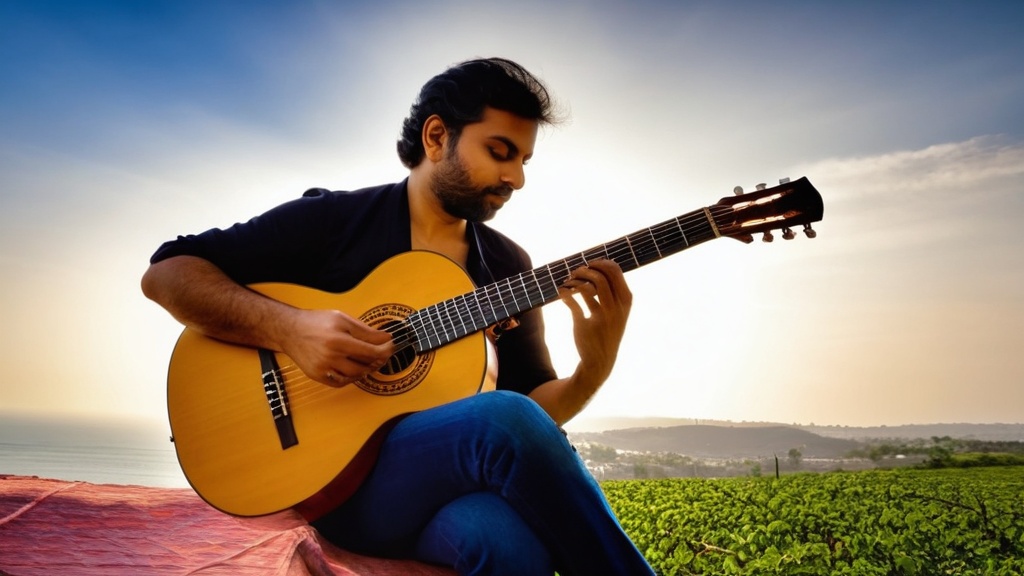
Emotion and expression are perhaps the most essential elements in raga guitar improvisation. A raga is designed to evoke specific feelings, and as a musician it is your job to convey these emotions to your audience. This requires not only technical skills but also a deep understanding of the emotional content of the raga you are playing.
When you improvise, you have to allow yourself to be vulnerable and work your own feelings into the music. Using dynamics, articulation and phrasing can help strengthen the emotional impact of your playing. By varying volume and speed, you can build tension or create release in your music.
It is important to be aware of these elements while playing and to apply them actively in your improvisations. This will not only improve your playing but also create a deeper connection with your audience.
Tips for finding inspiration within ragas
Inspiration can sometimes be hard to find, especially when you get stuck in your improvisations. A good way to get new ideas is to listen to different performances of ragas, both traditional and modern. Try different artists and styles to discover what appeals to you and what inspires you.
Take notes on specific techniques or phrasings that move you and try to apply them in your own playing. It can also help to challenge yourself by playing with other musicians or taking part in workshops. Playing together can offer new perspectives and force you to step outside your comfort zone.
You can also experiment with combining elements from other music styles with ragas to create unique combinations of sounds. This cross-pollination can lead to surprising and inspiring results. If you want to look beyond India, also dive into Arabic scales on guitar or read how to improvise in different styles.
The importance of practice and patience in developing raga guitar improvisation skills
Developing skills in raga guitar improvisation requires dedication and patience. As with any other musical discipline, regular practice is essential to make progress. It is important not only to do technical exercises but also to make time for free improvisation within the context of ragas.
This helps you express yourself and stay creative. You also need to be patient with yourself during this process. It can be frustrating when things do not work right away or when you do not get the result you want.
Remember that every musician has their own pace and that growth takes time. Stay motivated by celebrating small victories and challenging yourself with new techniques or ideas. With consistency and patience, you will notice that your skills in raga guitar improvisation develop and that your musical expression becomes richer and richer.
If you are interested in Indian raga guitar improvisation tips, it is also worth looking at general guitar learning tips that can help you improve your skills. A useful article to support you is How can you learn to play guitar? 5 tips for beginners. This article offers valuable insights for beginners who want to improve their guitar playing, which can form a good basis for exploring specific styles such as Indian raga.
Frequently asked questions about raga guitar improvisation
What is an Indian raga?
An Indian raga is a traditional melody used in Indian classical music. It is based on a series of five or more notes and is used as the basis for improvisation.
How can I play an Indian raga on the guitar?
To play an Indian raga on the guitar, it is important to learn and practice the specific note sequence of the raga. It is also important to master the specific ornaments and techniques used in Indian music, such as meend (glissando) and gamak (embellishments).
Are there specific tips for improvising in an Indian raga on the guitar?
Yes, some tips for improvising in an Indian raga on the guitar are: listening to and studying traditional raga recordings, developing a good understanding of the specific raga you want to improvise on, and practicing the specific ornaments and techniques that belong to the raga.
Which guitar techniques are useful for playing Indian ragas?
When playing Indian ragas on the guitar, techniques such as meend (glissando), gamak (embellishments), and the use of specific scales and chords can be useful. It is also important to develop a good sense of rhythm and timing.
Is the guitar really used in Indian classical music?
Yes, especially as a slide guitar. Vishwa Mohan Bhatt developed the Mohan veena, a modified guitar that is played lying flat with a slide. Debashish Bhattacharya also plays Hindustani music on a lap slide guitar.
Do you need a special guitar for raga improvisation?
No, an ordinary acoustic or electric guitar is enough to start with. With a slide or a tuning in which you tune the low E string down to D, you can get closer to the gliding sounds and the drone.





Leave a Reply