
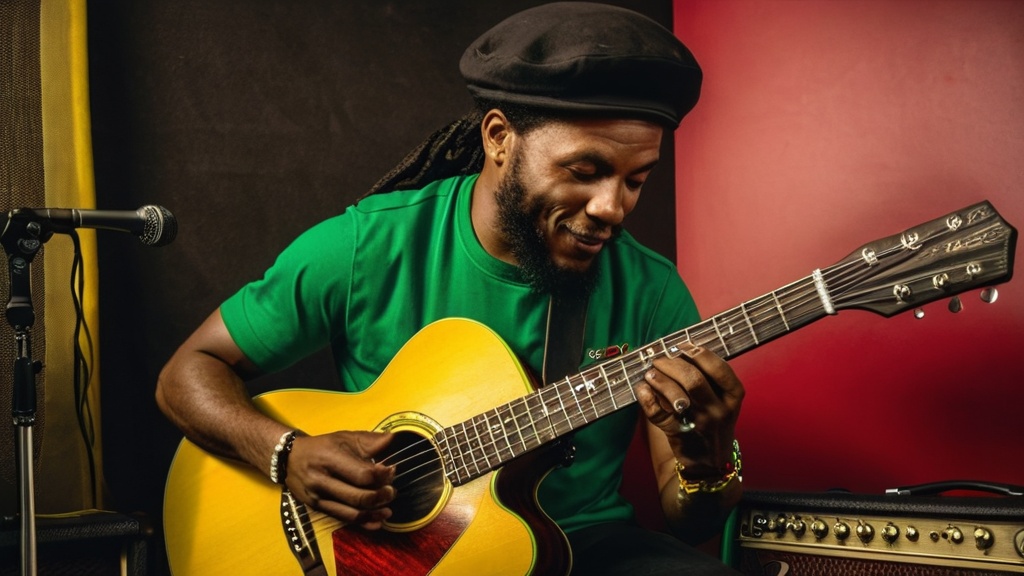

You learn reggae rhythms on guitar by playing chords short and muted on the offbeat: in 4/4 time you usually strike the chord only on beats 2 and 4. That is called the skank. Start slowly with open chords such as A, D and G, then move on to barre chords higher up the neck. With those you can easily mute the chord after every strum by relaxing your fretting hand. Below you can read step by step how to learn reggae rhythms, from the basics to a first practice progression.
Where do reggae rhythms come from?
Reggae emerged in Jamaica in the late 1960s and grew out of ska and rocksteady. In the rhythms you hear African, Caribbean and American influences come together. The rhythms are usually slow and relaxed, which creates the typical laid-back feel of the genre.
Artists such as Bob Marley, Peter Tosh and Jimmy Cliff brought reggae all over the world, with lyrics about love, unity, social justice and resistance to oppression. Their rhythms have become iconic. If you know the background, you better understand why the guitar plays such a modest but indispensable role in reggae.
Summary
- Reggae comes from Jamaica and was influenced by African and Caribbean traditions, ska and rocksteady.
- The guitar plays short, muted chords on the offbeat: the skank on beats 2 and 4.
- The “one drop” is the matching drum pattern, with bass drum and snare together on beat 3.
- Barre chords are ideal for reggae: you can shift them easily and mute them right after the strum.
- Staccato, the chop and palm muting give your rhythm part a tight, dynamic sound.
The basics of playing reggae guitar
Reggae guitar is all about simple chords and a tight strum that emphasizes the offbeat. Start with common chords such as A, D, G and E, supplemented by minor chords like Am and Em. Open chords are easy to start with and sound warm. For the dry, typical skank you move on to barre shapes later.
Strike the chords short on beats 2 and 4 and leave beats 1 and 3 open. That feels unnatural at first, because you are used to starting on beat 1. Count out loud and play slowly; you can read how in the explanation of counting rhythm on guitar. If switching is still clumsy, first practice with these tips for switching chords faster.
The offbeat and the one drop
In many styles of music the emphasis falls on beat 1. Reggae shifts that emphasis to the offbeat, and that gives the genre its relaxed yet driving character. Listen to reggae songs and notice how the guitar keeps falling in between the bass and the bass drum. Guitarists use syncopation and small variations to keep the groove lively.
You often hear the term “one drop” in this context, but it refers to the drum pattern: the drummer leaves beat 1 empty and puts bass drum and snare together on beat 3. The guitar skank on beats 2 and 4 fits right around it. So in reggae, timing matters more than speed. Bring out the offbeats deliberately with short, staccato strums or by giving certain strings more emphasis. If you are working on your timing, this article on developing a sense of timing on guitar helps.
Learning skank rhythms
Skank rhythms are the most recognizable element of reggae guitar. You play chords on the offbeat, which gives a sparkling, light sound. First make sure you have the basic chords and the strum from above under control.
Start with a simple chord progression and strike only on beats 2 and 4. Release the pressure of your fretting hand right after the strum, so the chord sounds short and dry. That feels awkward at first, but with repetition it comes naturally. If you want more variation, add a muted strum now and then; you can read more about that in ghost notes on guitar.
Playing reggae rhythms with barre chords
Barre chords fit reggae well. You lay your index finger flat across several strings, so you can slide the same shape all the way up the neck. Because no open strings ring along, you mute the chord right after the strum by briefly releasing the pressure of your fretting hand. That short, dry sound is exactly what makes a skank recognizable. With barre shapes you can also choose between different voicings and positions, which adds variation to your rhythm part.
Start with simple barre chords such as F (133211) on the first fret and Bm (x24432) on the second fret. Make sure your index finger is placed well and apply just enough pressure to make all the strings ring clearly. Keep your hand relaxed. Once that works, slide the shape to other frets. You will find a full explanation in playing barre chords for beginners.
Many reggae guitarists do not play all six strings on the skank, but only the top three or four strings of the barre shape. That sounds lighter and leaves room for the bass. You can also let an open string ring along now and then for a fuller sound.
Exercise: A-D-E with barre shapes
You hear the A-D-E progression in Three Little Birds by Bob Marley, among other songs. With barre shapes your hand stays around the fifth fret:
- A: E shape at the 5th fret (577655)
- D: A shape at the 5th fret (x57775)
- E: A shape at the 7th fret (x79997)
Play each chord short on beats 2 and 4, mute right after the strum and count out loud. Set a metronome to a slow tempo and only speed it up when every skank sounds equally short and even. Start slowly, practice a few minutes every day and set yourself achievable goals.
Adding reggae chords to your repertoire
Besides the basic chords, there are many other chords that add variety. Think of Bm, Em or seventh chords such as A7 and D7, which you regularly come across in reggae songs. They make the harmony richer.
Also study the chord progressions that often appear in reggae. That shows you how songs are put together and develops your own style at the same time. You can read how progressions work in understanding chord progressions. Try different combinations and add new chords to songs you already play.
Staccato, the chop and palm muting

A commonly used technique in reggae is the chop: you strike the strings short and mute them immediately, creating a staccato effect. By playing notes shorter than normal, the rhythm gets a bounce that suits the offbeat well. Palm muting, where you lightly rest the heel of your picking hand on the strings near the bridge, gives a muted sound. You mainly use it for tight, rhythmic notes between the chords. The right hand position at the bridge is explained step by step in this explanation of palm muting.
Practice these techniques separately first. For example, first play the rhythm on fully muted strings so you focus only on timing, and add the chords afterwards. If you combine palm muting and staccato, you get a tight, dynamic rhythm part. You use the same short, muted strums in funk rhythms on guitar.
Well-known reggae songs to practice with
No Woman, No Cry by Bob Marley revolves around the progression C-G-Am-F; you play the F as a barre chord. Together with Three Little Birds (A-D-E), this is a good start. Look at which chords and positions are used, find a reliable chord chart or tab and practice slowly first. Only play along with the original recording when the chords and strum are going well.
Reggae lead guitar and solos
Reggae is often associated with rhythm guitar, but there is room for lead guitar as well. That ranges from simple melodies to improvisation. In reggae, lead guitar is less about virtuosity and more about melody and feel: catchy lines that fit the groove.
Study the solos of well-known songs and notice how the guitarists build their melodies. Then write short solos of your own. A good starting point is improvising with the pentatonic scale over a simple reggae progression. A simple melody often has more impact than a complicated solo.
Finding your own reggae style
Explore different subgenres, such as roots reggae, dancehall and dub, and listen to how guitarists approach them. Also try combining reggae rhythms and barre chords with elements from rock or pop for a fresh sound. Related Caribbean and Latin American rhythms, such as Cuban guitar rhythms, can give you new ideas too.
Also play with other musicians as often as you can. That brings new ideas and valuable feedback. Dare to experiment and make mistakes; that is how you develop your own musical identity step by step.
Frequently asked questions about reggae rhythms on guitar
What is reggae music?
Reggae is a music genre from Jamaica that emerged in the late 1960s. Its rhythm is characterized by a syncopated beat with accents on the offbeat. The lyrics often carry a social or political message.
How can I learn to play reggae rhythms on guitar?
Learn the typical rhythmic patterns and chords of reggae and above all practice the accents on the offbeat. Play short, muted strums on beats 2 and 4 and listen to a lot of reggae to get a feel for the groove.
How do you learn reggae rhythms with barre chords?
First make sure you have the barre chords themselves under control. Then practice the skank rhythm on muted strings and only then add the barre shapes, for example with the A-D-E progression around the fifth fret.
Which chords are often used in reggae music?
Commonly used chords are A, D, E and G major, minor chords such as Am, Em and Bm, and seventh chords such as A7, D7, E7 and G7.
Which techniques are characteristic of reggae guitar?
The most important one is the skank: chords on the offbeat, which you mute with your fretting hand right after the strum. You also use staccato strums, the chop and palm muting to bring out the rhythmic accents.
What are barre chords?
Barre chords are chords where you press down several strings at once across the width of the neck with one finger, usually your index finger. That way you can use the same shape on any fret.
Are reggae rhythms hard to learn?
For beginners, the syncopated beat with accents on the offbeat takes some getting used to. With regular, slow practice, though, you will learn to master the rhythm well.
What is the difference between ska and reggae on guitar?
In ska the tempo is faster and you often strike on every offbeat, that is, on the “and” between all the beats. Reggae is slower and the guitar usually plays on beats 2 and 4, so the rhythm sounds more spacious and relaxed.
Can you also play reggae on an acoustic guitar?
Yes. On an acoustic guitar the skank sounds fuller, so mute the chords extra short with your fretting hand. On an electric guitar you usually use a clean, bright tone without distortion.



Leave a Reply