


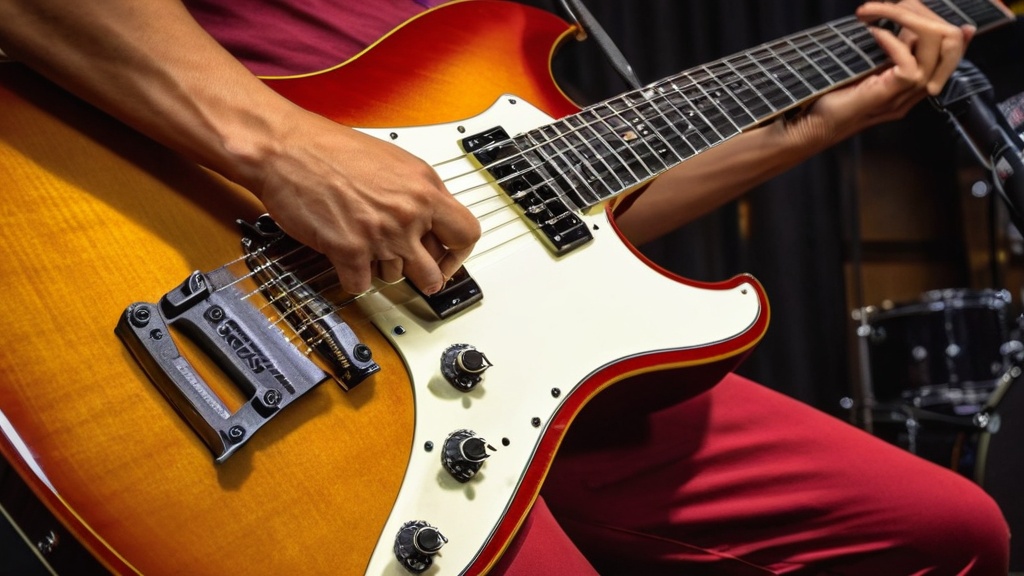
You palm mute by lightly resting the edge of your picking hand on the strings, right at the bridge, and then playing with downstrokes. That makes the strings sound short and tight: the typical metal “chug”. The closer your hand sits to the bridge, the more tone is left; slide toward the neck and the sound gets duller. Below you will read how to find the right hand position, which exercise to start with and how to use palm muting in metal riffs.
Palm muting is a technique widely used in metal music that adds a unique, muted sound to the guitar. When you palm mute, you place the edge of your hand on the strings close to the bridge of the guitar while you pick. This stops the strings from vibrating fully, which results in a shorter, more percussive sound.
This technique is crucial for metal guitarists because it helps create a heavy, powerful sound that fits the aggressive style of the genre perfectly. Using palm muting can also help add rhythmic variation and dynamics to your playing, making your music more interesting and gripping. In metal it is essential to have a distinctive sound, and palm muting offers exactly that.
It allows you to play riffs and chords that are not only powerful, but also have a certain groove. This makes it possible to form a solid foundation together with other instruments, such as drums and bass. Palm muting can also help accentuate melodies and solos, so they come into their own in the mix.
So it is not just a technique, but an essential part of your musical expression as a metal guitarist.
Summary
- Palm muting is a guitar technique in which the palm of the picking hand is placed on the strings to create a muted sound, which is important for the characteristic sound of metal music.
- The right hand position for palm muting requires the palm of your picking hand to rest lightly on the strings, just before the bridge of the guitar, to produce a tight, muted sound.
- Enough string tension helps with tight palm mutes: especially in lower tunings, thicker strings give a tighter sound.
- Different palm muting techniques, such as varying the pressure and position of the palm, can be used to create different sounds, from subtly muted to aggressive and percussive.
- Palm muting can be combined with other guitar techniques in metal music, such as tremolo picking and power chords, to create a dynamic and powerful sound.
The right hand position for palm muting: tips and tricks
Hand position is crucial for applying palm muting effectively. To master the technique, make sure your hand rests in the right spot on the strings. Lay the edge of your hand on the strings, right at the bridge, so you can mute the strings without blocking them completely.
This takes some practice, because you have to learn how to apply the right pressure to get the sound you want. Too much pressure can mute the strings completely, while too little results in an unwanted sound. A handy tip is to move your hand slightly forward or back until you find the perfect balance between muting and resonance.
Try different positions to discover what works best for your playing style and the specific music you want to play. Do not forget that it is also important to stay relaxed while playing; tension in your hand can lead to fatigue and a less accurate technique. Practice regularly to refine your hand position and take your palm muting technique to the next level.
Basic exercise: muted eighth notes and open power chords
Set the metronome to a comfortable tempo, for example 80 bpm, and play eighth notes on the open low E string with downstrokes only and palm muting. Make sure every stroke sounds equally loud and equally short. Then alternate: play three muted eighth notes on the low E and then lift your hand for an open power chord, such as E5 (low E open, A string 2nd fret) or G5 (low E 3rd fret, A string 5th fret). That contrast between muted and open is the basis of many metal riffs. Once it feels tight, increase the tempo in small steps. How to use the metronome smartly here is covered in learning guitar with a metronome; for faster passages you need alternate picking.
The importance of the right string tension for palm muting

Besides hand position, string tension also plays an important role in palm muting. The tension of the strings affects how they respond to muting and how they sound when you pick them. Strings that are too slack start to flap when you pick hard and then sound muddy, especially if you tune your guitar lower. Strings with higher tension respond more tightly to muting, but are a bit heavier to play.
So it is important to choose strings that suit your playing style and preferences. If you find palm muting difficult, it can be useful to try different kinds of strings. Some guitarists prefer thicker strings for a fuller sound, while others choose thinner strings for easier playing.
Experimenting with different string tension can help you find the ideal combination that strengthens your palm muting technique and improves your sound. Do not forget that your guitar’s setup also affects string tension; make sure your guitar is properly set up for optimal performance. Old strings also sound duller and make your palm mutes less tight; read how often you should replace your guitar strings.
Different palm muting techniques for creating different sounds
There are several techniques within palm muting that you can use to bring variation to your sound. A popular technique is combining open strings with muted notes, which creates a dynamic effect in your riffs. By alternating muted and open notes, you can create an interesting rhythmic structure that keeps the listener engaged.
This can be especially effective in metal, where complex rhythms and syncopation are common. Another technique is varying the pressure you apply with your hand while muting. By applying more or less pressure, you can achieve subtle changes in tone and sustain.
This can help add emotion and expression to your playing. You can also experiment with different positions on the neck; by applying palm muting on different strings and frets you can create unique sounds that fit your musical style.
How to use palm muting together with other guitar techniques in metal
Palm muting combines very well with other guitar techniques to create a richer sound. A common combination is using palm muting with slides or bends. For example, by playing a muted note and then sliding up to a higher note, you can make a smooth transition that holds the listener’s attention.
These kinds of techniques not only add variation to your playing, but also help convey emotion. You can also combine palm muting with techniques such as hammer-ons and pull-offs. These techniques can help add speed and complexity to your riffs, while palm muting provides a solid foundation. Pinch harmonics also sound extra fierce between muted notes; you can read how to play them in the explanation of harmonics on guitar.
Combining these techniques takes practice, but the result can be stunning. You can create powerful riffs that are both technically challenging and melodically appealing, which is essential in metal. You will find concrete examples in learning metal riffs on electric guitar.
Common mistakes when applying palm muting and how to avoid them

When learning palm muting, several common mistakes can affect your playing. A frequent mistake is positioning the hand wrongly, which can lead to unwanted sounds or even muting the strings completely. Make sure you are always aware of where your hand is and experiment with different positions until you find the right balance.
Another mistake is using too much force when picking the strings while palm muting. This can result in an unclear or messy sound. Instead, try a light but consistent attack, so the muting is effective without costing clarity of sound.
Practicing regularly and recording yourself can help you spot and fix these mistakes, so your technique keeps improving.
The importance of practice and developing a good palm muting technique
Practice makes perfect, and that certainly goes for palm muting. Developing a good technique takes time and dedication. Start with simple exercises in which you only play muted notes before adding more complex riffs.
This helps you get used to the movements and hand positions needed for effective palm muting. It is also useful to practice with a metronome; this helps you build consistency in tempo and timing. It is also important to be patient with yourself during this process.
Everyone learns at their own pace, and it can take a while before you see the results you want. Keep challenging yourself by trying new techniques and styles, but do not forget to make time to repeat what you have already learned. By practicing regularly, you will notice your technique improving and palm muting becoming a natural part of your playing style.
Applying palm muting in well-known metal songs: examples and exercises
A great way to get palm muting under your fingers is to apply it in well-known metal songs. Many bands use this technique in their music, which makes it an excellent source of inspiration for your own playing. Take songs like “Master of Puppets” by Metallica or “Walk” by Pantera; both songs contain iconic riffs that depend heavily on palm muting. In the best Metallica riffs in notation and tab you will find more riffs in which you can practice this technique.
Try playing these songs and pay close attention to how the guitarists apply palm muting in their playing. Analyze their hand position, string tension and dynamics as they play. This will not only help improve your technique, but also help you understand how palm muting contributes to the overall sound of a song.
Take notes on what works well and try applying these elements in your own riffs and compositions. By applying these techniques and tips, you will notice that palm muting is not only a valuable addition to your guitar playing, but also becomes an essential part of your musical identity as a metal guitarist. Keep practicing, experimenting and learning, so you can develop your own unique sound within this powerful genre. How to build such a riff of your own from rhythm to finished version is covered in making a catchy riff on guitar.
If you are interested in palm muting techniques for metal guitar, it is also worth learning more about the influential guitars in the metal world. An excellent article that can help you with this is The Metallica electric guitar: an icon in the metal world. This article offers insight into how the unique sounds and techniques of Metallica’s guitars have had a lasting impact on the genre, and can inspire you to develop your own playing style further.
Frequently asked questions about palm muting
What are palm muting techniques for metal guitar?
Palm muting is a technique in which the guitarist places the palm of the picking hand on the strings at the bridge of the guitar, creating a muted sound. This technique is widely used in metal music to create an aggressive, percussive sound.
How do you perform palm muting on a metal guitar?
To perform palm muting on a metal guitar, place the palm of your picking hand on the strings at the bridge of the guitar. Make sure your hand is relaxed and does not apply too much pressure, to create a muted sound.
Why is palm muting so widely used in metal music?
Palm muting is widely used in metal music because of the aggressive, percussive sound it creates. It gives the music a raw, powerful feel, which suits the genre well.
Are there different palm muting techniques for metal guitar?
Yes, there are various palm muting techniques that can be used on a metal guitar. These can range from lightly muted chords to heavily muted, fast riffs, depending on the desired sound and style of the music.
How can I improve my palm muting technique?
To improve your palm muting technique, it is important to practice regularly and experiment with different pressure and position of your picking hand on the strings. Also listen to examples from experienced metal guitarists and try to analyze and imitate their technique.
Should you only use downstrokes when palm muting?
For tight, heavy riffs many metal guitarists choose downstrokes, because they sound more even and aggressive. At higher tempos, alternating down and up strokes is often necessary. So practice both, so you can choose per riff.
Why does my palm muting sound muddy?
Often your hand sits too far from the bridge or there is too much gain on your amp. Slide your hand slightly toward the bridge and turn the gain back a little, and the notes become tighter and clearer. Slack or old strings can also make the sound muddy.





Leave a Reply