
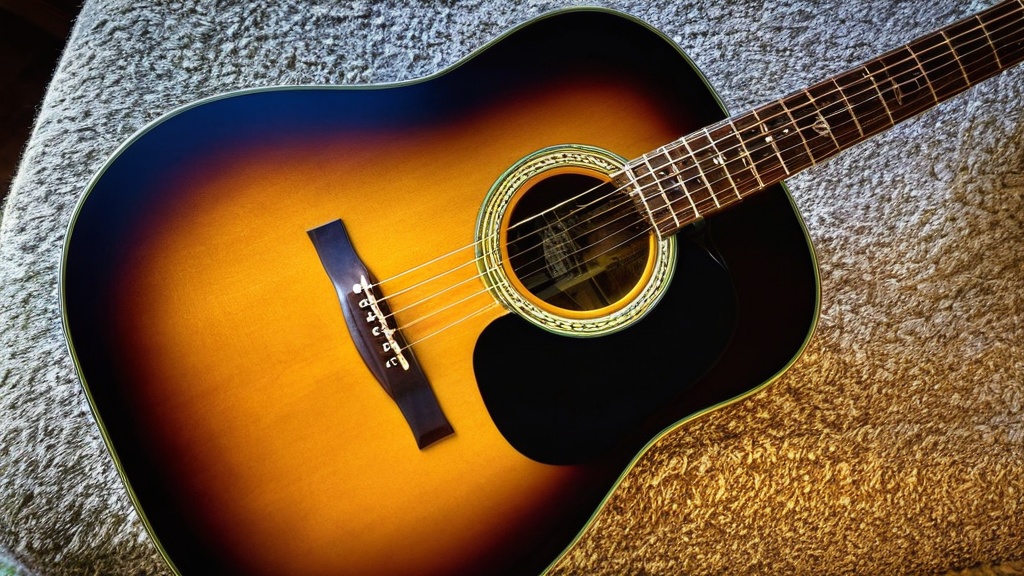

For Irish folk music on guitar you mainly need open chords: G, C, D, A, Em and Bm. Most tunes are in D, G, A or E minor, and you can accompany many songs with just three chords such as G, C and D. Beyond that, it is all about the rhythm of the jig (6/8) and the reel (4/4), and many guitarists use the open tuning DADGAD. Below you will find the chord shapes, progressions and techniques in one place.
Where does Irish folk music come from?
Irish folk music has a rich and complex history that goes back to the early Middle Ages. The origins of this style are intertwined with the cultural and social developments of Ireland. The use of traditional instruments such as the uilleann pipes, the fiddle and the bodhrán has contributed to the unique sound we associate with Irish folk music today.
This form of music arose at a time when stories and traditions were mainly passed on orally, and music served as a way to preserve history and culture. The music is often linked to Celtic culture, although little is known with certainty about its exact origins. Over the centuries, outside influences mixed with local styles.
Over the centuries countless variations have emerged, depending on the region and the social context. This makes Irish folk music not only a reflection of Irish culture, but also a dynamic art form that keeps evolving.
Summary
- Irish folk music has its origins in Celtic traditions and has influences from various European countries.
- Important chords in Irish folk music include the G, D, C and Em chords.
- Typical rhythms in Irish folk music are the jig, reel and polka, which all have a specific dance rhythm.
- Different guitar techniques in Irish folk music include fingerpicking, alternate picking and the use of open tunings.
- Influential Irish folk artists include The Chieftains, Planxty and Christy Moore.
Important chords in Irish folk music
In Irish folk music there are a few chords that come up often and are essential for creating the typical sound. The most common chords are C, G, D and Em. These chords form the basis for many traditional songs and are relatively easy to play, which makes them accessible to beginners and advanced players alike.
Using these chords in different combinations creates a rich harmonic structure that supports the melodies. It is also important to understand that Irish folk music often uses modal scales, such as the Dorian and Mixolydian modes. These scales give the music a unique sound and set it apart from other folk styles.
By experimenting with these chords and scales, you can develop your own style and create an authentic sound that stays true to the Irish tradition. You will find more about picking, vibrato and effects as the basis of your sound in the article about finding your own sound on guitar.
Chords, shapes and progressions to start with
Irish tunes are usually in keys that suit the fiddle and the tin whistle, such as D, G, A and E minor. These chords will already get you a long way:
- G = 320003, C = x32010, D = xx0232
- A = x02220, Em = 022000, Am = x02210
- Bm = x24432, a barre chord on the 2nd fret
Common progressions are D-G-A and D-Bm-G-A in D major, G-C-D in G major and Em-D for a Dorian tune on E. For a Mixolydian tune in D you alternate D and C. If you want to understand why these chords go together, read about understanding chord progressions.
Many Irish accompanists also use the open tuning DADGAD. In it you let many strings ring open and often play chords without the third, so they fit under both major and minor melodies.
Typical rhythms in Irish folk music
Rhythm plays a crucial role in Irish folk music and adds to the liveliness and energy of the songs. One of the most characteristic rhythms is the jig, which is often played in 6/8 time. Jigs are fast and cheerful, which makes them perfect for dancing.
Another common rhythm is the reel, which is usually played in 4/4 time and has a smooth, flowing movement in eighth notes. These rhythms matter not only to the musicians, but also to the dancers who let the pulse of the music guide them. Besides jigs and reels, other rhythmic structures are used in Irish folk music as well, such as hornpipes and polkas.
Each of these rhythms has its own character and can include variations in tempo and dynamics. By experimenting with different rhythms, you can enrich your playing and discover a wider range of musical expression.
How to accompany a jig and a reel
You count a jig in groups of three: 1-2-3 4-5-6. Strum down-up-down, down-up-down and put an accent on beats 1 and 4. You play a reel in straight eighth notes, alternating down and up, with a light accent on beats 1 and 3. Trouble counting? First practice counting rhythm on guitar with a simple chord.
Different guitar techniques in Irish folk music
The guitar plays an important role in Irish folk music, especially as an accompaniment instrument. There are several techniques you can use to improve your playing and make it sound authentic. A popular technique is fingerpicking, in which you pluck the strings with your fingers instead of a pick. If you are just starting out, first practice a short daily fingerpicking routine.
This gives a warmer sound and lets you add more nuance to your playing. Percussive techniques on the guitar are also characteristic of Irish folk music. By tapping on the body of the guitar with your hand or by muting certain strings while you play, you can add rhythmic accents that raise the energy of the song.
Combining these techniques can lead to a dynamic and engaging sound that fits the traditional Irish style perfectly.
Influential Irish folk artists
Countless artists have had a significant impact on the development of Irish folk music. One of the most influential groups is The Chieftains, who since their founding in 1962 have played an important role in popularizing traditional Irish music around the globe. Their use of authentic instruments and respect for traditional styles have made them icons within the genre.
Another important name is Planxty, a band that emerged in the 1970s and was known for its innovative approach to Irish folk music. Their combination of traditional melodies with modern influences has inspired many other musicians to explore new paths within the genre. Artists such as Christy Moore and Sinéad O’Connor have also contributed to the popularity of Irish folk music through their unique voices and interpretations.
How to play Irish folk music on guitar
If you want to learn how to play Irish folk music on guitar, it is important to start by understanding the basic structures and techniques. Begin by practicing the most important chords such as C, G, D and Em, so you get familiar with their fingerings and transitions. Once you have these chords under your fingers, you can start playing simple melodies and rhythms.
It is also useful to listen to recordings of traditional Irish folk songs to get a feel for the style and the tempo. Try playing along with these songs to improve your timing and sense of rhythm. Don’t forget that it is important to have fun while learning; experiment with different techniques and try to create your own interpretations of traditional songs.
Popular Irish folk songs to learn on guitar
There are several popular Irish folk songs that are perfect for beginners to learn on guitar. A classic is “Wild Rover,” which is easy to play with a few basic chords and a recognizable chorus that everyone can sing along to. Another great song is “Danny Boy,” which is not only emotionally charged, but also offers beautiful melodies to play on guitar. You play Wild Rover with just G, C and D, like many other easy songs with 3 chords.
There are also songs such as “The Parting Glass” and “The Irish Rover” that are played a lot within the folk scene. These songs often have simple structures but leave room for creativity in interpretation. By learning these songs, you not only gain more insight into Irish folk music, but also develop your skills as a guitarist. If you sing along yourself, these tips help you accompany yourself on guitar.
Tips for improving your Irish folk guitar playing
There are several strategies you can use to improve your Irish folk guitar playing. First, regular practice is essential; try to make time to play every day, even if it is only a few minutes. This helps not only to improve your technique, but also to build your confidence.
It can also be useful to play together with other musicians or take part in jam sessions. This offers a chance not only to learn new techniques, but also to challenge yourself in a social setting. Don’t forget that it is important to be open to feedback and new ideas; this can help you keep growing as a musician. You will find more ideas for keeping your playing sharp in how to keep challenging yourself on guitar.
By applying these tips and immersing yourself in Irish folk music, you will notice that your playing becomes more and more refined. Keep experimenting with different styles, techniques and songs, so you can find your own voice within this beautiful musical tradition.
If you are interested in Irish folk guitar chords, you might also find the guide to learning the Portuguese guitar interesting. This guide offers a step-by-step approach to mastering the unique sounds of the Portuguese guitar. It can be a nice addition to your musical repertoire and offers a new challenge for guitar lovers.
Frequently asked questions about Irish folk guitar chords
What are Irish folk music guitar chords?
Irish folk music guitar chords are chords that are often used in traditional Irish folk music. These chords are used to play the typical Irish music style on guitar.
Which chords are often used in Irish folk music?
Some common chords in Irish folk music are D, G, C, Am, Em and F. These chords form the basis for many Irish folk songs.
What are typical characteristics of Irish folk music guitar chords?
Typical characteristics of Irish folk music guitar chords are the use of open chords, a fingerpicking playing style and chord progressions that are characteristic of the Irish music tradition.
Are there specific techniques used when playing Irish folk music on guitar?
Yes, when playing Irish folk music on guitar, specific techniques are often used, such as fingering choices, playing fast arpeggios and using alternate tunings to create the typical Irish sound.
Are Irish folk music guitar chords hard to learn?
Learning Irish folk music guitar chords can be challenging because of the specific playing style and techniques that are used. However, with enough practice and dedication, guitarists can master these chords.
What is DADGAD and why do Irish guitarists use it?
DADGAD is an open tuning in which you tune the low E, B and high E strings down a whole step. That gives you the strings D-A-D-G-A-D, with many ringing open strings that suit tunes in D and G.
Which Irish songs are easy for beginners?
Start with songs you can accompany with three chords, such as The Wild Rover with G, C and D. Quieter ballads such as Danny Boy have more chord changes; save those for when you change between the basic chords smoothly.




Leave a Reply