
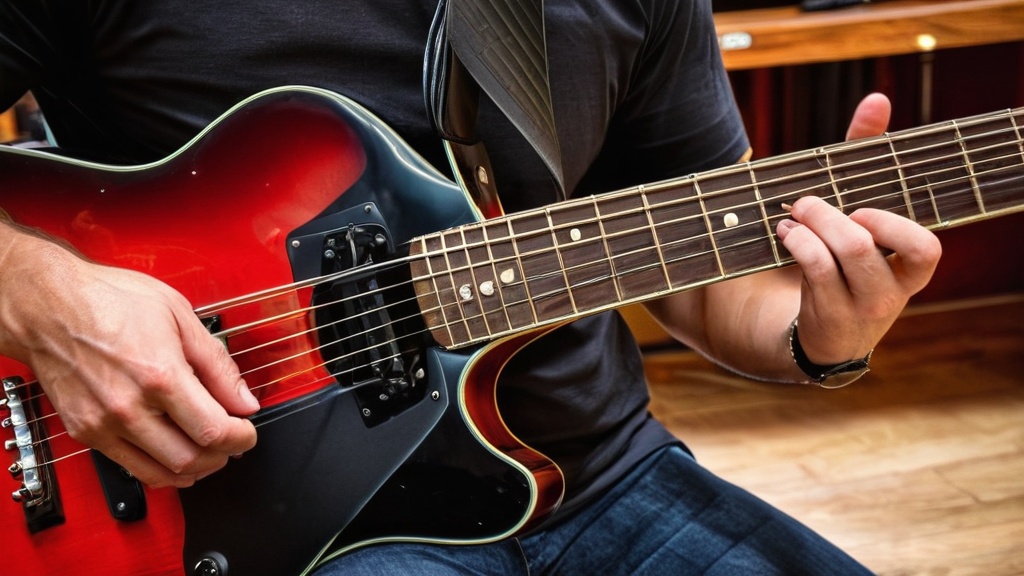

With targeted finger exercises for smooth chord changes, you train your fingers to move from one chord to the next in a single motion. The best exercises are short and concrete: alternate between two chords, leave fingers in place when they’re already in the right spot, and land all your fingers at the same time. Do them for a few minutes a day, and after a few weeks you’ll often notice the gaps between your chords getting smaller.
5 finger exercises for smooth chord changes
- The one-minute change. Choose two chords, such as G (320003) and C (x32010), and count how many times you switch back and forth in one minute. Strum once on each change and write down your score. Try to improve that score a little every day.
- Keep anchor fingers down. From C (x32010) to Am (x02210), your index finger on the B string (1st fret) and your middle finger on the D string (2nd fret) simply stay where they are. Only your ring finger moves, from the A string to the G string. For each pair of chords, look for which fingers can stay put.
- Shift the shape. Em (022000) and Am (x02210) have almost the same shape: your middle and ring fingers both move over one string and your index finger joins them on the B string. Practice that shift slowly, without strumming.
- Place all fingers at once. Lift your hand a few millimeters off the strings, form the chord in the air and put all your fingers down in one go. Repeat that ten times per chord, for example with D (xx0232) and A (x02220).
- Change with a metronome. Set a metronome to a slow tempo and change first after four beats, then after two beats and finally on every beat. If it stops feeling smooth, go back to the previous tempo.
Don’t let the one-minute change tempt you into sloppy chords: a clear-sounding chord matters more than a high score. You can read more general tips for changing guitar chords faster in a separate article.
What are finger exercises?
Finger exercises are specific exercises aimed at improving the dexterity and speed of your fingers on the guitar. They’re crucial for guitarists who want to refine their chord changes. By doing finger exercises regularly, you not only train your fingers to move faster and more accurately, but also develop a better feel for timing and rhythm.
This is especially important when you want to switch from one chord to another without the sound becoming hesitant or uneven. When doing finger exercises, you often focus on the specific movements needed to change chords smoothly. This can mean training your fingers to move quickly from one position to another, or working on strengthening the muscles in your hands and fingers.
The goal is to create a natural flow, so you can switch between different chords without thinking. This makes playing not only more enjoyable, but also much more polished.
Summary
- Finger exercises help you change chords smoothly on the guitar
- Consistent finger exercises are essential for improving your guitar playing
- Different finger exercises can improve your chord changes, such as playing chord progressions and using barre chords
- Effective finger exercises require focus, patience and consistency
- Building finger exercises into your daily practice routine can lead to measurable improvements in your guitar playing
Why finger exercises matter for guitarists
Finger exercises are essential for every guitarist, regardless of level. They help not only with improving technical skills, but also with building confidence. When you can change chords quickly and smoothly, you feel more secure while playing, which leads to a better overall musical experience.
This confidence is crucial, especially if you play in a band or perform for an audience. Finger exercises also contribute to developing good finger technique. A solid technique is the foundation for every style of music, whether you play rock, blues or classical.
By practicing regularly, you build not only strength in your fingers, but also precision and control. This allows you to play more complex pieces and apply more advanced techniques, which takes you to a higher level as a guitarist. If you want to keep working on timing and expression afterward, take a look at the tips for playing guitar like a pro.
Different finger exercises for improving chord changes
There are countless finger exercises you can use to improve your chord changes. One popular exercise is the so-called “chord change exercise,” where you choose two or more chords and switch between them repeatedly. Start slowly and focus on the accuracy of each change.
As you gain confidence, you can increase the speed. This helps not only with the dexterity of your fingers, but also with developing a sense of timing. Another effective exercise is using open chords in combination with barre chords. You can read how to build up that grip in learning to play barre chords.
By alternating between these two types of chords, you force yourself to use different finger positions and techniques. This can be challenging at first, but over time you’ll notice your fingers adapting and the changes getting smoother. Don’t forget to pay attention to the sound too; make sure each chord rings clearly without muting or unwanted noise.
Tips for doing finger exercises effectively
To get the most out of your finger exercises, it’s important to take a structured approach. Start with a warm-up to loosen your fingers before you begin the exercises. This can consist of simple chromatic exercises or playing a few basic chords. A few short warm-up exercises for guitar are enough for that.
A good warm-up helps prevent injuries and prepares your hands for more intensive work. It’s also useful to use a metronome while practicing. This helps you keep a steady speed and improves your timing. You’ll find a step-by-step plan in learning guitar with a metronome.
Start slowly and gradually increase the speed as you get more comfortable with the exercises. Don’t forget to take regular breaks; this prevents fatigue and keeps your mind sharp. It’s better to practice for shorter, concentrated periods than in long sessions where you’re less focused. If you’re prone to overuse injuries, you’ll find more advice in tips for playing guitar with RSI.
The importance of consistency when practicing finger exercises
Consistency is the key to success when learning new skills on the guitar. By making time for finger exercises daily or weekly, you build a solid foundation that is essential for further development. Even if you can only practice a few minutes a day, this regularity will pay off in the long run.
It’s better to have regular short sessions than occasional long sessions where you’re less focused. Consistent practice also helps build muscle memory. This means that over time your fingers will automatically make the right movements without you having to think about them consciously.
This is crucial for playing music in a fluid and natural style. By bringing consistency to your practice routine, you make sure these skills develop and become anchored in your playing. Schedule these finger exercises as a fixed block in your daily guitar practice schedule, so you work on them for a few minutes every day.
How finger exercises help improve your guitar playing
Finger exercises aren’t only useful for chord changes; they also affect other aspects of your guitar playing. By practicing regularly, you improve not only the speed and precision of your fingers, but also your overall musical ear and creativity. You’ll find you’re better able to learn new songs and apply complex techniques.
Finger exercises can also help you develop a style of your own. As you become more familiar with different techniques and chords, you may start trying out new combinations and progressions that are unique to your playing style. This can lead to more confidence in your playing and even to writing your own music. Then put your changes to use in easy songs with 3 chords.
Common mistakes when doing finger exercises and how to avoid them
When doing finger exercises, several common mistakes can hold back your progress. One is ignoring correct finger placement. It’s crucial to make sure each finger is on the right string and that enough pressure is applied to produce a clear sound.
If you don’t, chords can sound dull or not sound at all. Another common mistake is trying to progress too fast. It’s tempting to jump straight to higher speeds or more complex exercises, but this can lead to frustration and even injuries.
Take the time to get each exercise down well before moving on to more difficult techniques. Patience is essential; remember that every guitarist was once a beginner.
Building finger exercises into your daily practice routine
Finger exercises fit easily into your daily practice routine. Start with a specific period of time you want to spend on these exercises, for example 10-15 minutes per session. This can be at the beginning or end of your practice session, depending on what works best for you.
Make sure this time is devoted to focused practice without distractions. You can also vary the exercises you do to prevent boredom and challenge yourself. Try out different chords, techniques or even styles during these sessions. You can read which chords follow each other naturally in which guitar chords go together.
This not only keeps things interesting, but also helps develop versatility in your guitar playing. By building finger exercises into your routine this way, you’ll find they become an integral part of your musical development and growth as a guitarist.
If you want to practice the changes with the chords from your favorite songs, it helps if you can read tabs. You can read how that works in learning guitar with tablature. By practicing regularly with the right techniques, you’ll find your chord changes becoming smoother and more natural.
Frequently asked questions about practicing chord changes
What are finger exercises for smooth chord changes?
Finger exercises for smooth chord changes are exercises that help guitarists improve their finger placement and technique, so they can switch between chords more easily and fluidly while playing.
Why are finger exercises for smooth chord changes important?
Finger exercises for smooth chord changes are important because they strengthen the muscles and coordination of the fingers, allowing guitarists to switch between chords faster and more accurately. This improves the overall playing experience and makes it easier to play complex songs.
What types of finger exercises are there for smooth chord changes?
There are various types of finger exercises for smooth chord changes, including practicing specific chord transitions, using finger gymnastics and playing chord progressions in different rhythms and tempos.
How often should I do finger exercises for smooth chord changes?
It’s recommended to do finger exercises for smooth chord changes regularly, preferably daily or several times a week. Consistent practice will lead to improved finger strength and dexterity.
Are finger exercises for smooth chord changes only for beginners?
No, finger exercises for smooth chord changes are useful for guitarists of all levels. Even experienced players can benefit from practicing finger exercises regularly to maintain and improve their technique.
Which chords are best for practicing changes?
Start with open chords that often appear together, such as G, C and D or Em and Am. Those combinations appear in many songs, so you can apply the changes in music right away.
Should you look at your hand while changing?
At first, that’s perfectly fine. Afterward, also try making the change with your eyes closed. That way you learn to trust the feel in your fingers, and later you can keep reading along or singing along.






Leave a Reply