
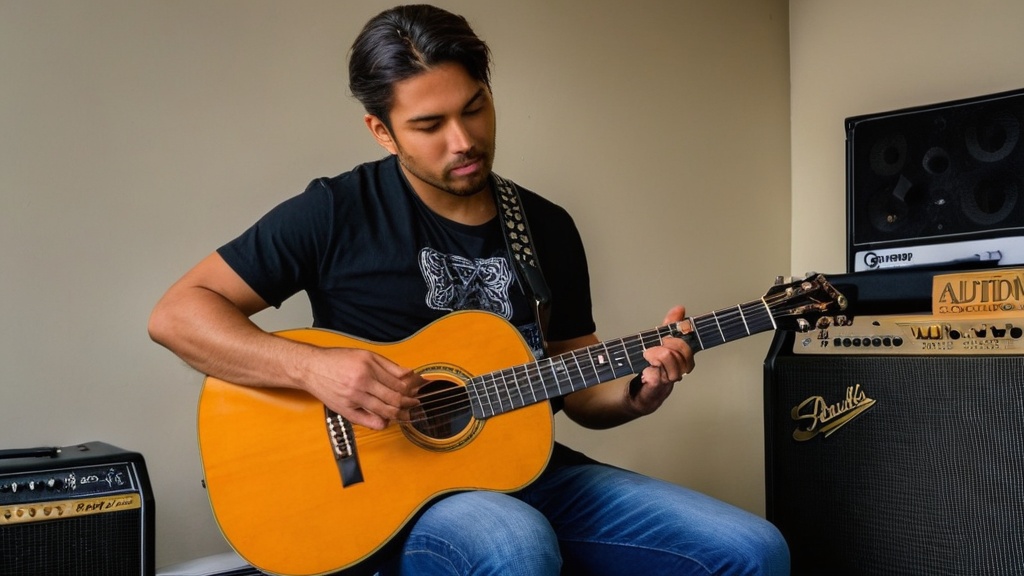

To practice for a guitar audition at a music school, start with the audition requirements: which pieces, styles and tests does the program ask for? Then make a fixed practice plan with your audition pieces, technique, scales, theory and sight-reading, and regularly play your program for an audience or in front of your phone’s camera. That way you can calmly show what you can do on the day itself.
Why focused practice pays off
Practice is the key to success, especially when you’re preparing for a guitar audition. It’s not only a matter of learning the notes; it’s about truly mastering your instrument. By practicing regularly, you develop not only your technical skills but also your confidence.
After all, you want to be able to show what you can do at the crucial moment, without nerves getting in the way. The repetitive nature of practice helps you absorb the music, so you can play it almost automatically when it really counts. It’s also important to practice in a structured way.
That means you don’t just play through your pieces, but set specific goals for each practice session. Maybe you want to work on a difficult piece you haven’t fully mastered yet, or maybe you want to improve your timing and rhythm. By practicing with focus, you make progress faster and feel better prepared for the audition. For timing, a metronome works best; this step-by-step guide to practicing with a metronome shows how to build up the tempo step by step.
It’s essential to develop a routine that works for you, so that every time you practice, you get the most out of your time.
Summary
- Regular practice is essential for a successful guitar audition
- Use a metronome and focus on specific techniques while practicing
- Choose repertoire that fits your skills and personality for a guitar audition
- Breathing exercises and mental preparation help you deal with nerves during an audition
- Musicality and expression are crucial for a convincing guitar audition
- Technique and skills need to be perfected for a successful guitar audition
- Prepare for improvisation by practicing with different chord progressions and scales
- Good posture and presentation contribute to a professional appearance during a guitar audition
Tips for effective practice for a guitar audition
An effective practice routine starts with setting clear goals. Before you start playing, take a moment to think about what you want to achieve in that session. Do you want to perfect a specific piece? You can read how to set up such a routine in how to make an effective guitar practice schedule.
Or maybe you want to work on your technique? By formulating these goals, you give yourself clear direction and focus. This not only makes the time you spend practicing more productive, it also keeps you motivated.
It’s also important to add variety to your practice routine. This not only keeps things interesting, but also helps you develop different skills. For example, try alternating between playing different styles or techniques.
This can range from fingerpicking to strumming or even improvisation. By challenging yourself with different musical elements, you expand not only your skills but also your musical creativity. Don’t forget to take regular breaks; this prevents fatigue and keeps your mind sharp.
Why repertoire choice matters for a guitar audition
The choice of repertoire is crucial for a successful guitar audition. The piece you choose should fit not only your level and style, but also the expectations of the panel. A well-chosen piece can show what you have to offer as a musician and can leave a lasting impression.
It’s important to select pieces that are both technically challenging and musically interesting. This shows that you can not only play, but also understand what music is and how it should be interpreted. You also need to take the time limit of the audition into account.
Choose a piece that can be performed within the given time without feeling rushed or incomplete. It’s also wise to have a few alternative pieces in mind, in case something else is asked for during the audition. This shows not only flexibility, but also a wide range of musical knowledge and skills.
In the end, your choice of repertoire should reflect who you are as a musician and what you want to convey.
How to deal with nerves during a guitar audition
Nerves are a common problem for musicians during auditions, but there are several strategies you can use to deal with them. An effective way to reduce nerves is to be well prepared. The more confidence you have in your skills and repertoire, the less anxious you’ll be.
So practice not only the music, but also the situation itself. Play for friends or family, or record yourself while you play. This helps simulate the pressure of the real audition and makes it less intimidating. You’ll find more tips for preparing to play for an audience in preparing for a guitar performance.
Breathing exercises and mindfulness techniques are also useful for managing nerves. Before you start playing, take a moment to breathe deeply and center yourself. This can help reduce tension in your body and calm your mind.
Visualize yourself playing successfully; this can be a powerful way to build positive energy and reduce anxiety. Remember that nerves are normal and can even be a sign that you’re passionate about what you do.
Why musicality and expression matter in a guitar audition
Musicality and expression are just as important as technical skills in a guitar audition. It’s not just about playing the right notes; it’s about bringing those notes to life. Panel members want to see that you, as a musician, can convey emotions and tell a story with your music.
You can do this through dynamics, phrasing and articulation. Make sure every piece you play carries your personal stamp; this makes it memorable and authentic. To develop musicality and expression, it’s important to listen to different performances of the same piece. You’ll find an exercise that brings technique and expression together in the article on theory and feel on guitar.
Pay attention to how other musicians shape their interpretations and which techniques they use to convey emotion. Try to apply these elements in your own playing, but stay true to yourself and your style. The goal is to find a balance between technical perfection and emotional depth; this will make your audition not only technically impressive but also musically moving. You can practice playing consciously with volume and accents with these ways to play with more dynamics.
The role of technique and skills in a guitar audition

Technique and skills form the foundation of every guitar audition. Without a solid technical foundation, it’s hard to express yourself musically. That’s why it’s essential to work on your technique regularly, whether it’s fingerings, chords or specific playing techniques such as hammer-ons and pull-offs.
Good technique lets you play more freely and with more confidence, which is crucial during an audition. It’s also important to challenge yourself with new techniques and styles. This can range from learning new chords to exploring different genres such as jazz or blues.
By challenging yourself, you expand not only your skills but also develop a broader musical understanding. This will benefit not only your audition, but also your development as a musician in general.
How to prepare for the improvisation part of a guitar audition
Improvisation can be an exciting but challenging part of a guitar audition. To prepare for it, it’s important to practice improvising regularly in different styles and over different chords. Start with simple progressions and gradually build up the complexity as you gain confidence in your skills. A practical start is improvisation exercises with the pentatonic scale, because with five notes you quickly sound convincing.
This helps not only with developing technical skills, but also with expanding your musical creativity. It can also be useful to listen to other musicians and analyze their improvisations. Pay attention to how they structure their ideas and which techniques they use to keep their improvisations interesting.
Try to apply these elements in your own playing, but don’t forget to bring out your unique voice as a musician. Remember that improvisation isn’t only about technical perfection; it’s about being able to express yourself and enjoying what you do.
Theory, ear training and sight-reading
At many music schools, the audition consists of more than just playing. It often includes a theory and ear training test, such as recognizing intervals and chords, clapping back a rhythm or singing back a short melody. Sometimes the panel also asks you to sight-read: a piece you read from the page for the first time on the spot. Check the program’s audition requirements to see exactly what is tested.
Practice these parts every day for fifteen minutes alongside your playing. Brush up your knowledge with music theory for guitarists and make sure you can play major and minor scales in several positions; practicing scales for improvisation helps with that. For sight-reading, read a short, unfamiliar piece every day that is easier than your audition pieces, so you learn to keep playing without stopping.
Why good posture and presentation matter in a guitar audition
Good posture and presentation are essential during a guitar audition, because they contribute to the overall impression you make on the panel. Make sure you walk in with confidence; this starts with how you enter the stage and how you present yourself before you start playing. An open posture radiates confidence and shows that you’re ready for this challenge.
It’s also important to pay attention to how you hold and play your instrument. Good technique goes hand in hand with good posture; this helps not only with the playing itself, but also makes you look professional during your performance. Don’t forget that presentation also includes how you dress; choose something comfortable that also looks professional. If you’re unsure about your posture, read how to hold a guitar properly.
All of this together will make sure you not only impress musically, but also convince visually during your guitar audition.
When you’re preparing for a guitar audition at a music school, it’s important not only to improve your technical skills, but also to develop your musicality and interpretation. A useful article that can help you improve your basic skills is How to play guitar for beginners: tips and tricks. This article offers valuable insights and techniques that can help you play with more confidence and prepare for your audition. By applying these tips, you can take your playing to a higher level and make an impression at your audition.
Frequently asked questions about practicing for a guitar audition
What is a guitar audition for a music school?
A guitar audition for a music school is an assessment process in which students who want to study guitar at a music school are evaluated on their musical skills and potential. During the audition, students are asked to play and possibly also to take music theory and ear training tests.
How can I practice for a guitar audition for a music school?
To practice for a guitar audition for a music school, it’s important to practice regularly and refine your repertoire. It’s also useful to work on technique, musicality and mastering different music styles. It can also help to work with an experienced guitar teacher to prepare for the audition. How to find a suitable teacher and what lessons cost is covered in this overview of guitar lessons.
What kind of pieces should I prepare for a guitar audition?
That depends on the program and the direction you choose. For classical guitar, pieces from different style periods are often required; for pop or jazz, rather songs or standards in different styles. So always read the audition requirements of the program itself. It’s important to have a varied repertoire that shows your technical skills and musicality. You may also be asked to do an improvisation or a sight-reading exercise (playing from the page).
What kind of questions can I expect during a guitar audition for a music school?
During a guitar audition for a music school, you can expect questions about your musical background, your experience playing guitar, your knowledge of music theory and your motivation to join the program. Questions may also be asked about specific pieces you’ve prepared.
How far in advance do you start practicing for an audition?
Start as early as possible, preferably a few months ahead. That gives you time to get your pieces technically solid, play them for an audience often, and brush up on theory and ear training. Use the last weeks mainly to play through your full program in one go.
What do you bring to a guitar audition?
Bring your own guitar, spare strings and a tuner, and for classical guitar your footstool or guitar support. Bring copies of your sheet music if the program asks for it, so the panel can read along. If you play electric, ask beforehand whether an amp will be available.






Leave a Reply